
Browserbase Review, Pricing & Alternatives (2026)
Managed cloud browsers and APIs for developers building web agents.
Last updated: October 26, 2026
What is Browserbase?
Browserbase provides hosted browser sessions, automation APIs, Stagehand, identity features, and session observability for developers building software that operates websites. Its free plan costs $0 per month, while paid plans start at $20 per month. The company targets teams that need managed browser infrastructure instead of running Chrome automation themselves.
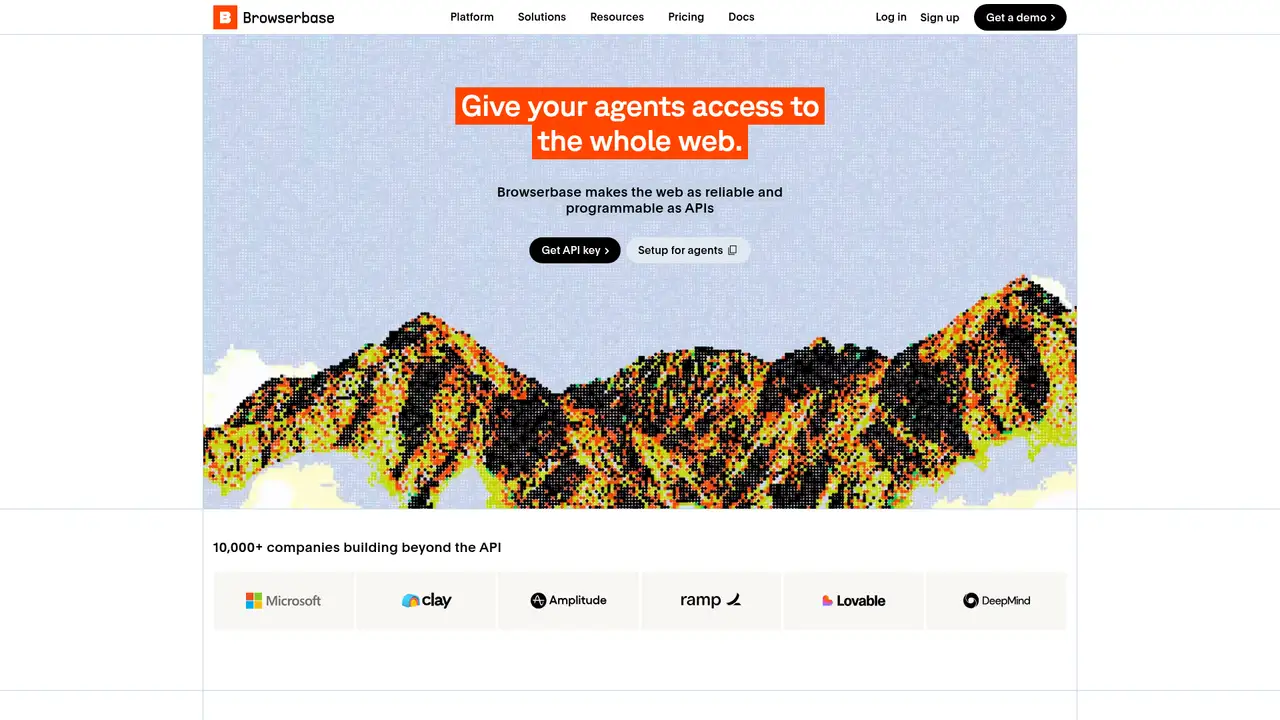
Browserbase is a cloud platform for browser automation and web agents, made by Browserbase. The company says it began 16 months before its June 2025 Series B announcement, placing its launch in 2024. It raised $40 million in that round, led by Notable Capital with participation from CRV and Kleiner Perkins. A June 2025 company announcement said Browserbase served more than 1,000 companies. A contemporaneous PRNewswire report said more than 20,000 developers had signed up and the platform had handled more than 50 million browser sessions in 2025. Its product set includes hosted browsers, Search and Fetch APIs, Stagehand, Director, identity features, and runtime services. The positioning is infrastructure first, with tools that extend from developer APIs to natural language automation.
A typical integration creates a Browserbase session through an API or SDK, then connects Playwright, Puppeteer, Selenium, Stagehand, or another Chrome DevTools Protocol client. The browser runs in the cloud with configurable session duration, concurrency, proxies, retention, recording, and logs. Stagehand adds act, extract, and observe primitives for AI assisted browser workflows. Director starts from a natural language task and generates a repeatable Stagehand script, so a user can begin without writing browser code. The dashboard supplies session recordings, replay, logs, token usage, and live debugging. Teams can organize work across projects, reuse sessions when appropriate, and use session creation and concurrency settings to run parallel tasks. This workflow suits both scripted automation and agent systems that need browser context.
Stagehand is Browserbase's open source browser automation framework, distinct from the hosted Browserbase service. Stagehand v3, released October 29, 2025, removed its Playwright dependency, added a modular driver system, and worked with Puppeteer, Playwright, Bun, and other Chrome DevTools Protocol drivers. Browserbase reported a 44.11 percent average benchmark improvement across iframe and shadow root interactions. The release also aimed to reduce round trips, limit token waste through a context builder, and support automation rather than testing alone. The company introduced Director and Stagehand for Python in June 2025. Later product pages mention Stagehand v4 and Model Gateway in 2026, but Browserbase has published little detail on what they do. That makes v3 the clearest basis for evaluating the current technical direction.
Free costs $0 per month and includes one browser hour, three agent calls, 1,000 Search calls, 1,000 Fetch calls, three concurrent browsers, 15 minute sessions, seven day retention, and $5 in model tokens. Developer costs $20 per month for 100 browser hours, 25 concurrent browsers, one GB of proxies, 15 agent calls, and seven day retention. Startup costs $99 per month for 500 browser hours, 100 concurrent browsers, five GB of proxies, 50 agent calls, and 30 day retention. Browser time, proxy bandwidth, Search, Fetch, Extract, and model use have separate allocations and overage rates. Browser time is billed by the minute, while proxy bandwidth is billed by the MB. Scale is custom, with 250 or more concurrent browsers, so forecasting total cost requires measuring workload mix rather than relying on the subscription price alone.
Browserbase requires cloud execution and usage accounting across browser time, proxies, APIs, and model tokens. Its hosted sessions and dashboard make it a broader infrastructure product than Browser Use, while Browserless is a closer managed browser alternative with a different automation focus. Apify is stronger when a user wants a large catalog of scraping actors, and ScrapingBee centers on scraping APIs rather than interactive agent sessions. Browserbase also has practical privacy limits: Zero Data Retention is Enterprise only, removes managed logs and replay storage, and can be paired with customer owned S3 storage for other artifacts. Users can disable logging and recording per session, but support then has less to work with when investigating problems. Pick Browserbase if you need managed cloud browsers, Stagehand workflows, and session level debugging for a web agent product.
Who is Browserbase best for?
- Developers deploying web agents with managed cloud browser sessions.
- Teams that need recordings, logs, replay, and live session debugging.
- Companies running parallel browser automation or scraping tasks.
- Builders using Stagehand with Node.js, Python, or compatible browser drivers.
Browserbase Pricing (2026)
Pricing model: Usage-based. All prices in USD.
| Plan | Price | What you get |
|---|---|---|
| Free | $0/month | Includes 1 browser hour, 3 agent calls, 1,000 Search calls, 1,000 Fetch calls, 3 concurrent browsers, 15-minute sessions, 7-day retention, and $5 in model tokens. |
| Developer | $20/month | Includes 100 browser hours, 25 concurrent browsers, 1 GB of proxies, 15 agent calls, 1,000 Search calls, and 1,000 Fetch calls. Browser, proxy, Search, Fetch, and Extract overages apply. |
| Startup | $99/month | Includes 500 browser hours, 100 concurrent browsers, 5 GB of proxies, 50 agent calls, 1,000 Search calls, and 10,000 Fetch calls. Browser, proxy, Search, Fetch, and Extract overages apply. |
| Scale | Custom | Provides 250 or more concurrent browsers, custom agent capacity, and usage-based browser, proxy, Search, Fetch, and Extract allocations. |
Pros and Cons
Pros
- Hosted sessions remove the need to operate browser infrastructure.
- Stagehand supports AI actions and Python and Node.js workflows.
- Session recordings, logs, and replay help diagnose automation failures.
- Enterprise ZDR and BYOS support stricter artifact-storage requirements.
Cons
- Separate meters cover browser time, proxies, Search, Fetch, Extract, and tokens.
- Free sessions cannot run longer than 15 minutes.
- ZDR and BYOS are not included in the standard paid plans.
Who should look elsewhere?
- Users seeking a finished consumer-facing browser agent.
- Small scripts that already run reliably on local Playwright.
- Teams that need on-premises browser deployment.
Technical Details
Frequently Asked Questions
How much does Browserbase cost?
Browserbase Free costs $0 per month. Developer costs $20 per month and includes 100 browser hours, while Startup costs $99 per month and includes 500 browser hours. Scale is custom. Browser time, proxies, Search, Fetch, Extract, and model tokens have separate allocations or usage charges, depending on the plan.
Is Browserbase free?
Yes. The Free plan costs $0 per month and includes one browser hour, three agent calls, 1,000 Search calls, 1,000 Fetch calls, three concurrent browsers, 15-minute sessions, seven-day retention, and $5 in model tokens. It is intended for exploration and prototypes, with no included proxy bandwidth.
How does Browserbase compare with Browserless?
Browserbase combines managed browser sessions with Stagehand, Search and Fetch APIs, identity features, runtime services, and session inspection. Browserless is a direct managed-browser alternative. The practical choice depends on whether Stagehand workflows, Browserbase's observability, proxy requirements, and its separate usage meters fit your application.
Does Browserbase train generative AI models on browser data?
Browserbase's privacy policy says it does not use browser data to train generative artificial intelligence models without affirmative consent. The policy also describes collection of account, payment, device, IP, analytics, and geolocation data. Enterprise ZDR can prevent Browserbase from persisting session logs and replay data.
Can Browserbase be used commercially?
Yes. Browserbase offers Developer, Startup, and Scale plans for production software, with browser concurrency, proxies, runtime services, and support tiers. Customers remain responsible for the websites they access, data they collect, and applicable laws. Enterprise plans include options such as DPA, HIPAA BAA availability, SSO, ZDR, and BYOS.
Best Browserbase Alternatives in 2026
These tools do the same job as Browserbase, with different pricing, limits and trade-offs.