
Browser Use Review, Pricing & Alternatives (2026)
Open-source agents for browser workflows, with metered hosted Chromium
Last updated: October 26, 2026
What is Browser Use?
Browser Use is an open-source Python and TypeScript framework for AI agents that operate websites, with hosted Chromium and an agent API. It is aimed at developers automating research, forms, and web workflows who want local execution or managed browsers. The library costs $0, while Cloud starts with a one-time $1 credit and then usage billing.
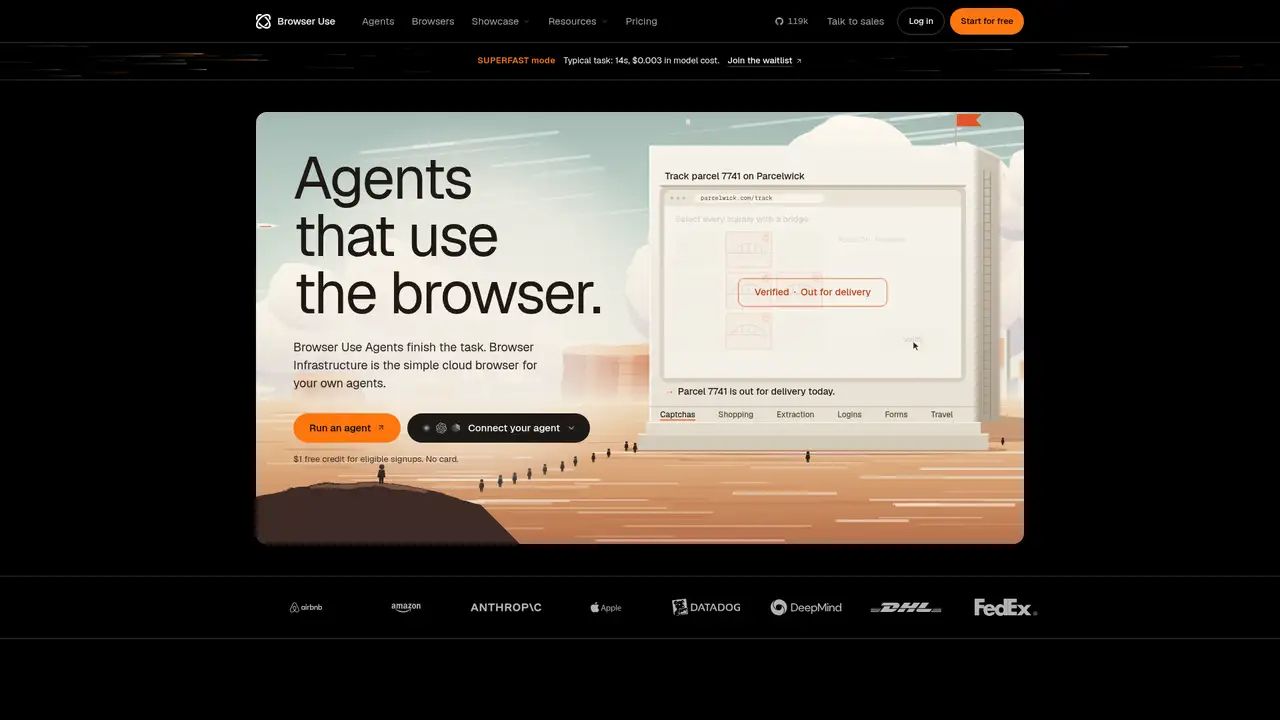
Browser Use is an open-source browser-agent framework created by Magnus Müller and Gregor Žunič, who founded the company in 2024 after meeting at ETH Zurich. The project launched in November 2024, joined Y Combinator’s Winter 2025 batch, and announced a $17 million seed round led by Felicis in March 2025. Its MIT-licensed repository contains Python and TypeScript libraries, while the wider product includes Cloud browsers and a hosted agent API. GitHub listed 119,189 stars and 13,249 forks at the time checked, although those figures change. The product has two main forms: local software developers run with chosen models and infrastructure, and paid services providing managed browsers, models, proxies, profiles, recordings, and enterprise options.
A typical task begins with a natural-language instruction, a language model, and a BrowserSession connected to local or Cloud Chromium. The agent reads structured page state and chooses actions such as clicking, typing, scrolling, uploading, or extracting information until it reaches a result or requests user input. Cloud browsers add CDP access, live previews, saved logins, recordings, CAPTCHA solving, residential proxies, and scheduled tasks. Developers can supply their own browser, credentials, model provider, or Ollama model. Browser Use also provides OpenAI browser tools and toolsets for Claude. The method is suited to changing websites and multi-step forms, but results still depend on page structure, model decisions, permissions, browser state, and network conditions.
Browser Use turns website interfaces into structured text and elements for language models instead of relying only on pixel-based interaction. The library supports direct model providers, Browser Use’s BU 2.0 model, local browsers, Ollama, and hosted Chromium. Release 0.13.13, dated October 15, 2026, added an OpenAI browser-tool driver, 18 default Browser Use tools, six optional actions, and fixes for temporary Cloud tab URLs and scaled-display coordinates. Release 0.13.11 added toolsets for Claude, alongside fixes affecting uploads, saved history, model requests, and browser integrations. The open-source repository and hosted service remain separate operational choices. Telemetry, when enabled, may include instructions, visited URLs, action traces, errors, and final results; users can opt out with ANONYMIZED_TELEMETRY=false.
Cloud billing is pay as you go, with no recurring subscription, and eligible Google, GitHub, or Microsoft signups receive a one-time $1 credit without a card. Cloud browsers cost $0.02 per hour, rounded to a one-minute minimum. Managed residential proxy traffic costs $5 per GB, while direct or custom-proxy traffic costs $0.20 per GB. Hosted agent model rates include Browser Use’s 20 percent fee, with browser time and network charges separate. BYOK still incurs an orchestration fee equal to 20 percent of published token rates, while the provider bills token usage separately. New projects receive 10 concurrent sessions. The limit rises to 50, 250, 500, or 1,000 through qualifying project payments. Browser and proxy charges can continue after a run, so explicit session stopping matters.
Browser Use offers more local control than OpenAI Operator and combines an open agent layer with hosted browsers, unlike Browserbase’s mainly hosted browser service. Browserbase is a close alternative for managed browser infrastructure, while Browserless focuses on browser hosting and deployment through Docker or Kubernetes. Browser Use’s Cloud browser is Chromium-only, cannot accept Selenium connections, and bills browser time, model usage, and network traffic separately. Its hosted sessions support Playwright, Puppeteer, Stagehand version 3, CDP clients, live viewing, profiles, recordings, stealth features, and CAPTCHA solving, but these additions do not remove model or page-specific failure risks. Enabled telemetry may include task-level data, and difficult pages can still produce unreliable actions. Choose Browser Use for development teams wanting an MIT-licensed browser-agent layer with optional managed Chromium.
Who is Browser Use best for?
- Developers building browser agents in Python or TypeScript.
- Teams needing managed Chromium with stealth and proxies.
- Projects requiring local execution under an MIT license.
- Research and operations workflows involving changing websites.
Browser Use Pricing (2026)
Pricing model: Usage-based. All prices in USD.
| Plan | Price | What you get |
|---|---|---|
| Open-source library | $0/month | MIT-licensed local library. Model, browser, proxy, and compute costs remain separate. |
| Browser Use Cloud | $0.02/browser hour | Eligible signups receive a one-time $1 credit. Proxy and network charges are separate, with 10 concurrent sessions initially. |
| Hosted agent API | Model rates + 20% | Browser time and network traffic are billed separately. Supported BYOK still incurs a 20 percent orchestration fee. |
| On-prem | Custom | Enterprise customers can run browsers and agents inside their own network. |
Pros and Cons
Pros
- The MIT library runs locally with a selected browser and model.
- Cloud combines Chromium, CDP, stealth, CAPTCHA solving, and proxies.
- OpenAI and Claude integrations broaden supported agent workflows.
- Concurrency increases with qualifying project payments instead of subscriptions.
Cons
- Hosted billing combines model, browser-time, and network charges.
- Enabled telemetry can include instructions, URLs, traces, and results.
- Web changes and model decisions can produce brittle or unsafe actions.
Who should look elsewhere?
- Teams needing deterministic automation without model decisions.
- Organizations unwilling to review telemetry and hosted data handling.
- Users seeking a fixed monthly bill for unpredictable workloads.
Technical Details
Frequently Asked Questions
How much does Browser Use cost?
The open-source library costs $0/month under the MIT license, although local model and infrastructure costs remain yours. Cloud has no recurring subscription. Eligible new signups receive a one-time $1 credit, then Cloud browsers cost $0.02 per hour. Residential proxy traffic costs $5 per GB, direct or custom traffic costs $0.20 per GB, and hosted agents add 20 percent to published model-token rates.
Does Browser Use have a free plan?
The local Python and TypeScript library is free and MIT-licensed. Cloud is free to start for eligible Google, GitHub, or Microsoft signups through a one-time $1 credit with no card required. After that credit, usage is metered. The credit does not make model tokens, browser time, proxy traffic, or other hosted usage permanently free.
How does Browser Use compare with Browserbase?
Browser Use provides an MIT-licensed local agent library plus a metered Cloud browser costing $0.02 per browser hour. Browserbase is primarily a hosted browser platform with subscription plans and included allowances. Browser Use suits teams that want local customization and optional hosted infrastructure, while Browserbase suits teams that prefer a managed browser service.
Does Browser Use train on my data?
Browser Use telemetry documentation says enabled PostHog collection may include task instructions, visited URLs, action traces, errors, and final results, and may support development of Browser Use and related offerings. Users can disable telemetry with ANONYMIZED_TELEMETRY=false. Cloud customers should review current terms and privacy policy before sending secrets or regulated data.
Can I use Browser Use commercially?
The browser-use library is MIT-licensed, which permits commercial use, modification, and redistribution subject to its license terms. That license applies to the open-source code and does not automatically cover Cloud terms, model providers, website rules, or customer-data obligations. Hosted and enterprise arrangements should be reviewed separately before commercial deployment.
Best Browser Use Alternatives in 2026
These tools do the same job as Browser Use, with different pricing, limits and trade-offs.