
Blackbox AI Review, Pricing & Alternatives (2026)
Metered coding agents with access to hundreds of models
Last updated: October 26, 2026
What is Blackbox AI?
Blackbox AI is a hosted coding-agent and model-orchestration service for developers and enterprise teams. It combines APIs, CLI tools, cloud agents, remote sandboxes, and more than 300 models behind one endpoint. The current public offer has no fixed monthly entry price. Customers commit annually and pay model-specific token rates, with enterprise terms handled through sales.
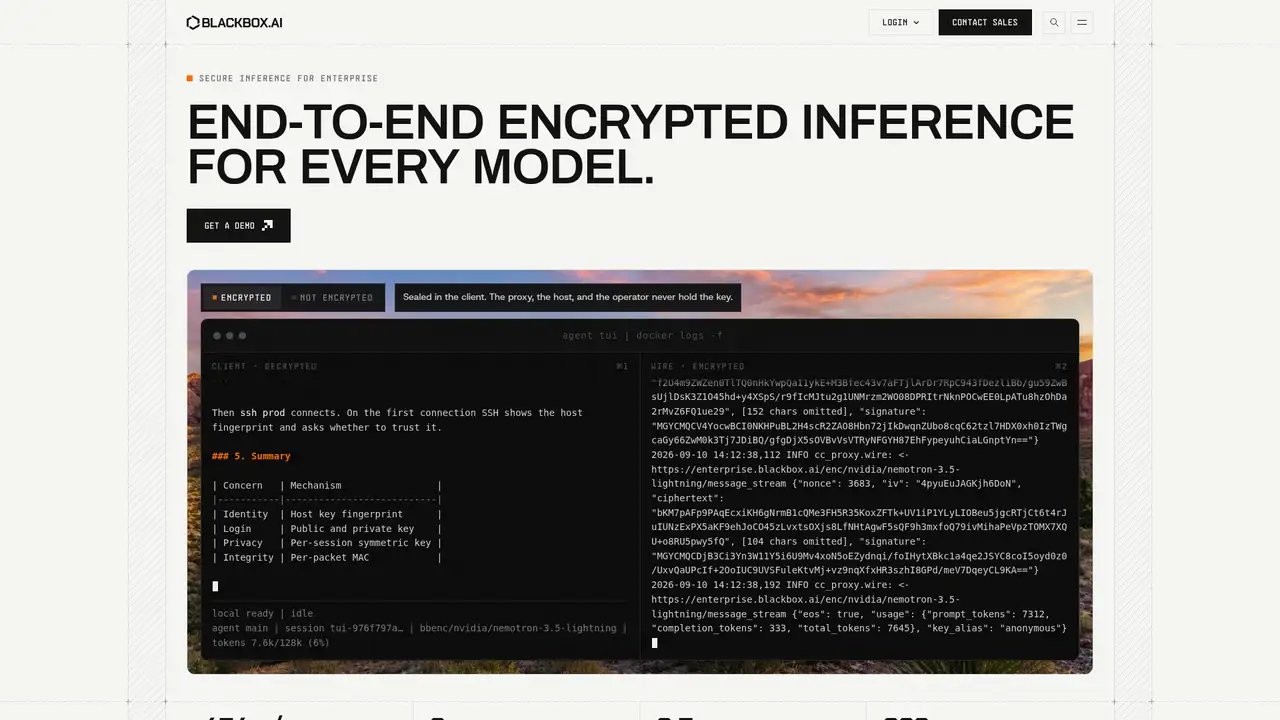
Blackbox AI is a hosted coding-agent and model-orchestration platform launched by brothers Richard and Robert Rizk on September 1, 2022, according to a 2025 conference summary. The company says it has more than 20 million users, although that figure is not independently audited. Its enterprise positioning extends beyond autocomplete by combining coding agents, model access, routing, and operational controls. The current pricing page lists API and CLI access, cloud agents, multi-agent orchestration, Remote Agent sandboxes, dedicated runners, SSO, audit logs, single-tenant deployment, and data residency. It also advertises access to more than 300 models through one endpoint and bill. Funding is not established by the company pages used here. Blackbox is best understood as a hosted coding and inference layer, rather than a standalone editor or self-hosted open source platform.
A typical workflow starts with a task sent to an agent, API, or CLI, followed by model selection or automatic routing. Enterprise customers can use cloud coding agents, Remote Agent cloud sandboxes, dedicated runners, and Chairman multi-agent orchestration. Blackbox lists more than 300 models behind one endpoint and one bill. Its routing layer adds failover, caching, custom rate limits, and spend alerts at 75 and 90 percent. API documentation describes OpenAI compatibility, streaming, tool calling, image generation, and video generation. Enterprise controls include SAML SSO, SCIM, RBAC, audit logs, contractual zero retention, PII removal before closed models, single-tenant deployment, and data residency. This gives teams one operational surface for varied model and agent workloads. Costs and retention still depend on upstream endpoints, provider policies, token volume, and supported per-request controls.
Blackbox AI is an orchestration layer across open and closed models, rather than one proprietary model. A May 2026 post describes Nemotron open weights, encrypted inference, and a claimed 420.2 output tokens per second. A June post reports an orchestrator and executor design pairing Opus 4.8 with GLM-5.2. Blackbox says that setup scored 69.7 versus 58.4 for a solo configuration across 89 Terminal-Bench 2.0 tasks. Later releases include Nemotron 3.5 Lightning, a 30B sparse mixture-of-experts model with 3B active parameters and a 256K context window, plus Nemotron 3.5 Super VL, a 120B-total, 12B-active model with text, image, document, and video understanding. The company reports more than 1,200 tokens per second for Lightning and over 500 for Super VL. These figures are vendor claims, not independent benchmark results.
The current public offer is enterprise-only and token-metered, with annual committed spend, no platform fee, no seat charges, and no published fixed minimum. Unused commitment expires at the billing-period end, while spend alerts trigger at 75 and 90 percent. Listed rates include $0.07 per million input tokens, $0.30 per million output tokens, and $0.002 per million cache-read tokens for DeepSeek V4.1 Flash 1017, $0.66 and $1.98 for DeepSeek V4 Pro 0813, and $3 and $15 for Kimi K3. The pricing page advertises discounts of at least 5 percent for closed models and 10 percent for open models. Enterprise access includes API and CLI tools, cloud coding agents, Remote Agent sandboxes, dedicated runners, SSO, SCIM, RBAC, audit logs, contractual zero retention, single-tenant deployment, and data residency. Exact commitments require a sales conversation.
The main limitation is pricing and operational complexity: model choice, provider policy, token volume, and enterprise terms all affect the bill. The current offer has no seat charges or platform fee, but it requires annual committed spend, and unused commitment expires at the billing-period end. Spend alerts trigger at 75 and 90 percent. Single-tenant deployment, data residency, SAML SSO, SCIM, RBAC, audit logs, contractual zero retention, and dedicated support are available, but general customer-operated hosting is not documented. Compared with GitHub Copilot, Blackbox emphasizes more than 300 models, routing, failover, caching, and infrastructure rather than a focused editor assistant. Compared with Cursor, it provides a broader API and orchestration layer, while Cursor centers on its coding workspace. Compared with Windsurf, Blackbox is more infrastructure-oriented. Pick Blackbox if your team needs centralized, metered access to many coding models and agents.
Who is Blackbox AI best for?
- Enterprise teams routing coding work across many model providers.
- Developers needing coding agents through API, CLI, and cloud sandboxes.
- Organizations requiring SSO, audit logs, residency, and contractual retention terms.
- Teams preferring token billing over per-seat subscriptions.
Blackbox AI Pricing (2026)
Pricing model: Usage-based. All prices in USD.
| Plan | Price | What you get |
|---|---|---|
| Enterprise | Custom | Annual committed spend with token billing and no published minimum. Unused commitment expires at the billing-period end; exact rates vary by model. |
Pros and Cons
Pros
- One endpoint covers more than 300 listed models.
- Enterprise access includes APIs, agents, sandboxes, and dedicated runners.
- Routing, failover, caching, and spend alerts support centralized operations.
- Contractual zero retention and single-tenant deployment are available.
Cons
- The current public offer does not show consumer subscription prices.
- Token costs vary substantially by model and provider.
- The platform is not presented as open source or generally self-hostable.
Who should look elsewhere?
- Individuals seeking a clearly priced consumer coding subscription.
- Teams requiring customer-operated hosting of the complete Blackbox platform.
- Buyers unwilling to manage provider-specific model and retention policies.
Technical Details
Frequently Asked Questions
How much does Blackbox AI cost?
Blackbox AI’s current public pricing page shows an enterprise, token-metered offer rather than fixed monthly plans. Customers commit to annual spend and pay model-specific input, output, and cache-read rates. Examples include $0.07 per million input tokens for DeepSeek V4.1 Flash 1017 and $3 per million input tokens for Kimi K3; output and cache-read rates vary by model. Custom commitments require contacting sales.
Does Blackbox AI have a free plan?
The current official pricing page does not publish a Free plan or usage quotas. Older third-party descriptions mention Free, Pro, Pro Plus, and Unlimited subscriptions, but those figures are absent from the current public offer. Blackbox should therefore be treated as enterprise and usage-priced unless the company gives a different offer directly.
How does Blackbox AI compare with GitHub Copilot?
GitHub Copilot focuses on coding assistance inside supported development tools. Blackbox AI presents a broader orchestration service with APIs, CLI access, cloud agents, remote sandboxes, and more than 300 models. Blackbox suits centralized routing and agent workloads. Copilot is the more direct choice for teams wanting a focused editor assistant with familiar repository workflows.
Does Blackbox AI train on user prompts?
Blackbox says its zero-data-retention controls discard prompts, responses, reasoning, tool definitions, and tool outputs after answering when the provider supports those controls. Operational metadata remains, including request details, model counts, costs, and status. Blackbox conservatively assumes retention and training when provider policy is unclear. Enterprise customers can receive contractual zero-retention terms.
Can companies use Blackbox AI commercially?
Blackbox’s enterprise service supports business use with SSO, RBAC, audit logs, custom service levels, dedicated support, and data residency. Its terms prohibit reselling or commercially exploiting the service, creating derivative works, reverse engineering, or building a competing product. These restrictions do not grant unrestricted commercial rights to Blackbox software or the underlying models.
Sources
- Blackbox AI enterprise pricing
- Blackbox API introduction
- Blackbox model pricing
- Blackbox zero-data-retention documentation
- Blackbox zero-data-retention announcement
- Nemotron on Blackbox
- Blackbox orchestrator and executor system
- Nemotron 3.5 Lightning announcement
- Blackbox privacy policy
- Blackbox terms of service
Best Blackbox AI Alternatives in 2026
These tools do the same job as Blackbox AI, with different pricing, limits and trade-offs.
AI coding assistance across editors, terminals, and GitHub
AI coding workspace with repository context and software agents
An agent-native code editor unified with Cognition's Devin platform

AWS-integrated coding help for IDEs, terminals, and cloud operations
An agentic coding assistant for terminal, IDE, desktop, and web