
AutoGPT Review, Pricing & Alternatives (2026)
Visual AI workflows with hosted agents and self-hosted code
Last updated: October 22, 2026
What is AutoGPT?
AutoGPT provides hosted and self-hosted tools for building, deploying, and running AI agents through chat, visual workflows, schedules, triggers, and connected services. Pro costs $50/month or $510/year, while Max costs $320/month. Self-hosting has no license fee, but users supply infrastructure, maintenance, and model-provider access.
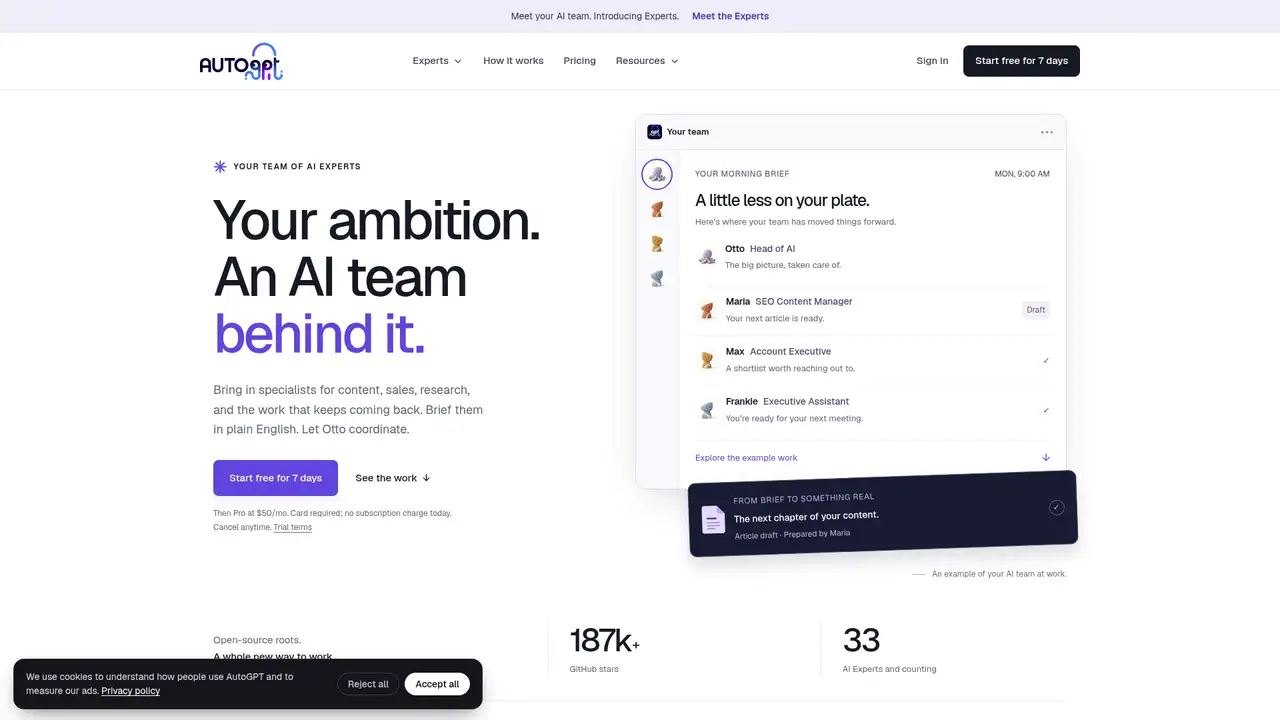
AutoGPT began in 2023, with the repository created on March 16, 2023, by Toran Bruce Richards. Determinist Ltd, trading as AutoGPT, now operates a hosted platform alongside the open-source project. The platform includes AutoPilot, Agents, Marketplace, and Build, allowing users to describe outcomes in plain English, work with Otto and specialist Experts, or assemble workflows visually. Hosted access manages infrastructure, model access, credentials, reliability, and updates. The repository supports self-hosting, but users must operate the deployment and provide model-provider credentials. These options serve different priorities: hosted use favors convenience and managed operations, while self-hosting favors infrastructure control and operational responsibility for the user. The repository separates the platform directory under Polyform Shield licensing from other components, which remain available under the MIT License.
The Build product presents a visual canvas for connecting blocks, branches, loops, parallel paths, webhook triggers, and schedule triggers. Users can inspect inputs and outputs, run workflows, recover drafts, and use safe mode while testing external actions. AutoGPT advertises access to more than 45 platforms and hundreds of AI models, including communication, productivity, developer, search, media, and data services. Hosted credentials are managed for many integrations, while self-hosted installations require infrastructure and model access configured by the operator. Agents can run on demand, on schedules, or from triggers. Task and block costs are visible, and credits are consumed when blocks execute during agent runs. Build supports typed input and output pins, inline validation, searchable block documentation, and rich panels for JSON, code, markdown, images, and files.
AutoGPT uses two repository licenses. Code inside the autogpt_platform directory is licensed under Polyform Shield, while material outside that directory is licensed under MIT. Polyform Shield allows specified uses but prohibits providing a competing product or service, making license review important for organizations that plan to embed, resell, or modify platform code. The classic standalone agent, Forge, benchmark materials, and other code outside the platform directory are identified as MIT-licensed. The platform privacy policy identifies Determinist Ltd as provider and describes personal-data processing under UK GDPR. Subprocessor arrangements include hosting, analytics, model, code-execution, payment, and integration vendors, depending on features used. The hosted Platform is publicly available, while self-hosting requires users to provide infrastructure, model API keys, configuration, and ongoing operational maintenance.
Pro costs $50/month when billed monthly or $510/year when billed annually, equivalent to $42.50/month. Eligible new accounts can receive a seven-day trial, with checkout determining applicable terms. Pro includes Otto chat, Expert chat, visual workflow building, documents, connected applications, scheduled workflows, and spending controls. Max costs $320/month and includes Pro features, 8.5 times Pro usage, five times file storage, early feature access, more integrations, and priority support. Team is described as coming soon with custom pricing, so it is not currently available as a purchasable tier. Subscription fees do not provide unlimited execution because workflow runs consume credits, and block pricing varies by block type and selected model. AutoGPT’s hosted Platform is publicly available, while self-hosting has no license fee but requires user-managed infrastructure and model API keys.
AutoGPT is a strong fit for users who want visual agent workflows, connected services, scheduled work, hosted model access, or self-hosting in one project. It is less suitable for buyers seeking unlimited included execution, a permissive license for a competing hosted product, or an immediately available Team plan. Direct competitors include n8n, LangChain, and CrewAI. n8n emphasizes workflow automation, LangChain focuses on developer frameworks, and CrewAI focuses on multi-agent orchestration. Other direct alternatives include SuperAGI, AgentGPT, and Zapier. Buyers should review license, privacy, credit, and integration requirements before production use. AutoGPT’s hosted Platform provides access to 45 or more connected platforms and hundreds of AI models without requiring model API keys. Choose AutoGPT if you want a visual agent platform with hosted and self-hosted paths.
Who is AutoGPT best for?
- Users building visual agent workflows.
- Teams needing scheduled agents and connected services.
- Developers wanting self-hosted agent software.
- Operators requiring visible workflow spending controls.
AutoGPT Pricing (2026)
Pricing model: Usage-based. All prices in USD.
| Plan | Price | What you get |
|---|---|---|
| Pro | $50/month, or $510/year | Includes Otto and Expert chat, visual workflow building, connected apps, documents, scheduled workflows, and spending controls. Workflow runs consume credits. |
| Max | $320/month | Includes Pro features, 8.5 times Pro usage, five times file storage, early feature access, more integrations, and priority support. Workflow runs consume credits. |
| Team | Custom, coming soon | The company describes workspaces, roles, billing, approvals, and security options, but does not list current availability or a launch date. |
| Self-hosted | Free license fee | Users operate the published code with Docker and their own infrastructure, maintenance, and model-provider accounts. |
| Workflow credits | Pay as you go | Credits are consumed when blocks execute, and block prices vary by block type and selected model. |
Pros and Cons
Pros
- Hosted and self-hosted deployment paths are documented.
- The visual builder exposes workflow inputs and outputs.
- Hosted plans publish subscription prices.
- The repository includes MIT-licensed material outside the platform directory.
Cons
- Workflow execution consumes separate credits.
- Platform code uses restrictive Polyform Shield terms.
- Team availability and pricing are not current.
Who should look elsewhere?
- Buyers expecting unlimited workflow execution.
- Companies building competing hosted products.
- Teams requiring an available Team plan.
Technical Details
Frequently Asked Questions
How much does AutoGPT cost?
Pro costs $50/month or $510/year, equivalent to $42.50/month. Max costs $320/month. Eligible new accounts may receive a seven-day Pro trial, subject to checkout terms. Workflow execution consumes credits separately, so a subscription does not provide unlimited agent runs. Self-hosting has no license fee but requires your own infrastructure and model-provider accounts.
Is AutoGPT free?
The published project can be self-hosted without a license fee, but users pay for infrastructure, maintenance, and model providers. The hosted platform uses paid subscription plans and workflow credits. The repository uses Polyform Shield for the platform directory and MIT for material outside that directory, so free access does not mean every component has identical reuse terms.
Can AutoGPT be self-hosted?
Yes. AutoGPT documents self-hosting through Docker and states that users supply infrastructure, maintenance, and model-provider API keys. The self-hosted path has no license fee. The hosted platform instead manages infrastructure, model access, credentials, updates, and operations. The repository’s platform directory and other directories have different licenses.
How does AutoGPT handle workflow billing?
AutoGPT uses credits for workflow execution. Credits are consumed when blocks run, and block prices can vary according to block type and selected model. Documentation states that credits cover compute, development, and operational costs, without separate infrastructure or API charges for those block executions. Users can replenish credits through platform settings.
Can companies use AutoGPT commercially?
Commercial use depends on the component. Material outside autogpt_platform is under the MIT License, subject to its notice requirements. The platform directory uses Polyform Shield, which prohibits providing a competing product or service. Companies embedding, modifying, or reselling platform code should review the exact version, license terms, and intended use with qualified counsel.
Best AutoGPT Alternatives in 2026
These tools do the same job as AutoGPT, with different pricing, limits and trade-offs.