
Warp Review, Pricing & Alternatives (2026)
An AI-native terminal for coding, command execution, and team workflows
Last updated: October 22, 2026
What is Warp?
Warp is a Rust-based terminal and agentic development environment from Denver Technologies, founded by Zach Lloyd and launched in public beta in 2022. It is aimed at developers and engineering teams that want terminal sessions, AI coding agents, cloud runs, and shared workflows in one application. The free plan starts at $0 per month; Build starts at $18 per month.
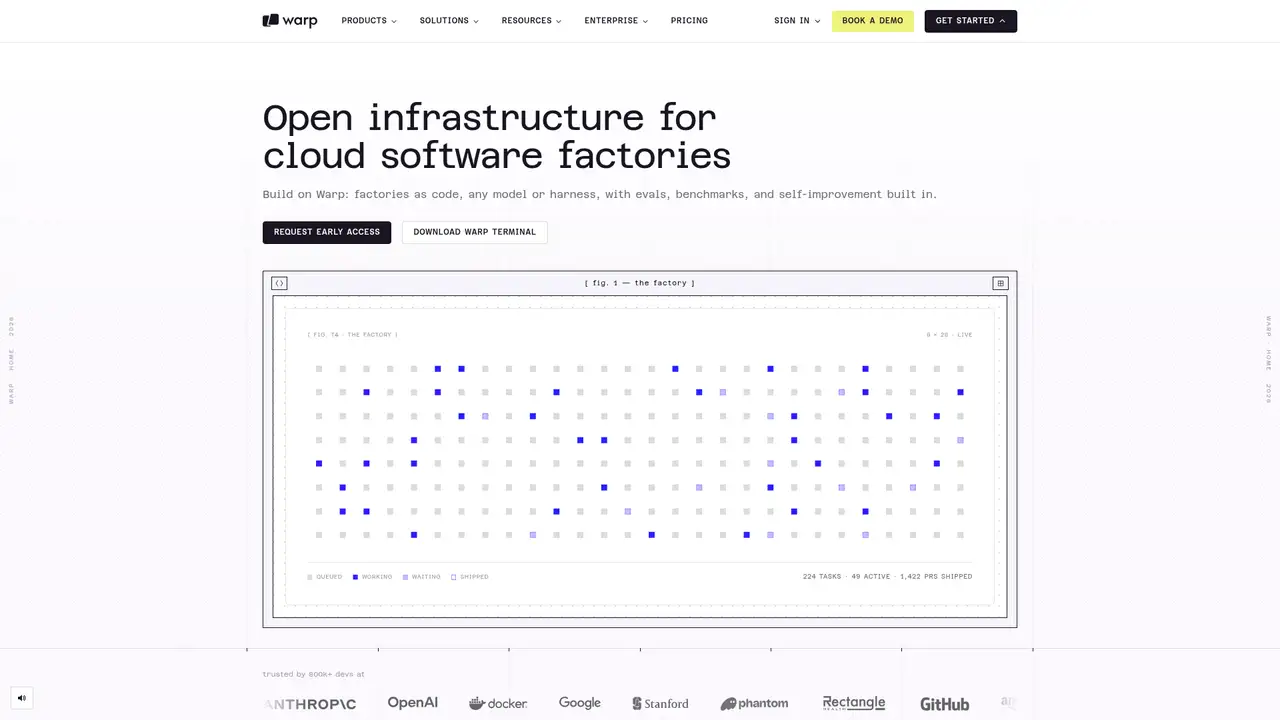
Warp is a Rust-based terminal and agentic development environment made by Denver Technologies, doing business as Warp. Zach Lloyd founded the company, and its public beta launched in April 2022 with $23 million in seed and Series A funding. Warp began as a macOS terminal and later expanded to Linux and Windows. The company reported 800,000 monthly developers in an Anthropic customer profile, while its 2025 review reported 120,000 indexed codebases and 3.2 billion lines edited by agents. The client is open source under AGPL v3, although the complete hosted product includes services that are separate from the client. Warp now groups Code, Agents, Terminal, and Drive in one application, placing it closer to a developer workspace than a conventional terminal emulator. Its value depends on both local shell work and hosted agent features.
A typical Warp session begins in Terminal mode, where commands appear as structured blocks with searchable output and an editor-like input area. Natural-language requests can move into Agent Mode, which maintains a multi-turn conversation, reads project context, runs shell commands, and proposes or applies edits. Users can review diffs, attach terminal output, invoke slash commands, and use voice or image input. MCP servers and Codebase Context extend the working context, with indexed Git repositories supporting semantic retrieval. Cloud agents run tasks in the background, while Warp Drive stores shared Notebooks, Workflows, and other team resources. The product also supports Claude Code, Codex, and other command-line agents. The Warp Agent CLI can run in Ghostty, iTerm2, VS Code, and built-in Windows and Mac terminals, allowing teams to keep familiar shells while adding model routing and cloud handoff.
Warp's built-in agent supports models from OpenAI, Anthropic, Google, xAI, and other providers, with automatic routing and bring-your-own-key options. Recent releases include GPT-5.2 support in December 2025 and the standalone Warp Agent CLI in August 2026. Warp reported a 61.14 percent Terminal-Bench 2.0 score with GPT-5.2, describing it as its strongest score at that time. The CLI adds orchestration, model routing, cloud-agent handoff, and operation inside other terminals. Its multiplexing design maintains persistent agent sessions, supports directory changes, and can run across SSH sessions without installing a remote binary. These features make Warp's agent layer more capable than a prompt box attached to a shell, though results depend on model selection and usage controls.
The Free plan costs $0 per month and includes the terminal, Warp Agent CLI access, pay-as-you-go Warp inference, bring-your-own inference, limited cloud agents, limited collaboration, and limited cloud conversation storage. Free has no bundled Warp-provided agent allowance. Build costs $18 per month and includes $20 of agent usage at API rates, full Warp Agent access, add-on usage, extended cloud agents, higher indexing limits, and unlimited Drive objects and cloud conversation storage. Max costs $180 per month and includes $200 of usage. Business costs $45 per seat and includes $20 of usage per seat, team metrics, admin controls, BYOK, custom endpoints, and SAML SSO. Enterprise is custom and adds shared usage pools, advanced governance, BYOLLM, self-hosted cloud agents, and support. Included usage resets monthly and does not roll over. Purchased usage remains available for up to 12 months, subject to expiration terms. Cloud runs can add charges for inference and compute.
Warp's main tradeoff is cost and cloud dependence. The client is open source, but hosted collaboration, model routing, cloud conversations, indexing, and cloud agents rely on Warp services. Free AI requires telemetry to remain enabled, while paid users can opt out and Business and Enterprise administrators receive stronger controls. Ghostty is a better choice for a minimal open-source terminal, iTerm2 offers mature macOS terminal features, and WezTerm provides configurable cross-platform tooling. Those products do not offer Warp's integrated agent, Drive, and cloud-run workflow. Pick Warp if terminal work, AI coding, background agents, and team sharing belong in one application. Pick a traditional emulator if local execution and predictable costs matter more than hosted agent features.
Who is Warp best for?
- Developers who want AI agents directly inside a terminal workflow.
- Teams sharing command recipes, notebooks, code context, and agent sessions.
- Engineers running background agents for reviews, triage, and maintenance.
- Users who need multiple model providers and optional BYOK configuration.
Warp Pricing (2026)
Pricing model: Usage-based. All prices in USD.
| Plan | Price | What you get |
|---|---|---|
| Free | $0/month | Core terminal, Warp Agent CLI, BYOK, limited cloud agents and collaboration. Warp inference is pay-as-you-go with no bundled allowance. |
| Build | $18/month | Includes $20 of monthly agent usage at API rates, full Warp Agent access, extended cloud agents, higher indexing limits, and unlimited Drive objects. |
| Max | $180/month | Includes $200 of monthly agent usage, ten times Build's allowance, plus Build features and add-on usage. |
| Business | $45/seat/month | Includes $20 of agent usage per seat monthly, team metrics, admin data controls, BYOK, custom endpoints, and SAML SSO. |
| Enterprise | Custom | Custom seats, usage pools, governance, analytics, BYOLLM, self-hosted cloud agents, onboarding, and account support. |
Pros and Cons
Pros
- Agent Mode can run shell commands and review generated diffs.
- The CLI works inside other terminals and supports cloud-agent handoff.
- Codebase Context gives agents semantic access to indexed repositories.
- Business and Enterprise plans provide administrative data controls and SSO.
Cons
- Agent inference, compute, and platform activity can create charges beyond subscriptions.
- Free users receive no bundled Warp-provided agent allowance.
- The strongest governance and self-hosting options require Enterprise.
Who should look elsewhere?
- Users who want a minimal terminal with no account or cloud services.
- Teams requiring a fully self-hosted product on standard plans.
- Heavy agent users who need a fixed, predictable monthly bill.
Technical Details
Frequently Asked Questions
How much does Warp cost?
Warp has a free plan, Build at $18 per month, Max at $180 per month, Business at $45 per seat monthly, and custom Enterprise pricing. Paid plans include monthly agent usage allowances, but inference, hosted compute, and platform charges can be separate. Included usage resets monthly and unused allowance does not roll over. Additional usage is available under the applicable billing terms.
Does Warp have a free plan?
Yes. Free includes the terminal, Warp Agent CLI access, limited cloud agents, limited collaboration, limited cloud conversation storage, and bring-your-own inference. It does not include a bundled allowance for Warp-provided agent inference. Free users can connect an eligible provider key, purchase usage, or upgrade. Telemetry must remain enabled for some Free AI features.
Warp or Ghostty: which terminal is better?
Warp is stronger when you want an integrated agent, code review, cloud runs, model routing, and team workflows. Ghostty is a better fit for a fast, minimal, open-source terminal without a subscription or hosted collaboration layer. Warp also supports structured blocks and semantic code context, while Ghostty stays closer to a traditional terminal. Choose Warp for agent workflows and Ghostty for local simplicity.
Does Warp train models on user data?
Warp says contracted providers for supported managed traffic operate under zero-data-retention agreements, meaning that traffic is not stored or used for training by those providers. Warp's privacy controls cover telemetry, AI interactions, and console inputs, and users can disable collection in settings. Business and Enterprise administrators receive team controls. BYOK traffic follows the selected provider's retention and training policy.
Can I use Warp output commercially?
Warp's terms grant customers a license to use the product and services during the applicable subscription term, while customers retain intellectual property in their own data. The terms also grant Warp rights needed to operate the service and use aggregated or de-identified performance information for improvement. Generated code licensing can depend on the underlying model provider and applicable law, so commercial teams should review those terms.