
Voice.ai Review, Pricing & Alternatives (2026)
AI voice agents, speech generation, cloning, and real-time voice changing
Last updated: October 26, 2026
What is Voice.ai?
Voice.ai is an AI audio platform for creators, developers, streamers, and businesses. It combines voice agents, text-to-speech, voice cloning, audio tools, and real-time voice changing, with cloud and on-premise deployment options. A free plan includes 5,000 monthly credits, while paid plans start at $5/month. Paid features and usage limits vary by plan.
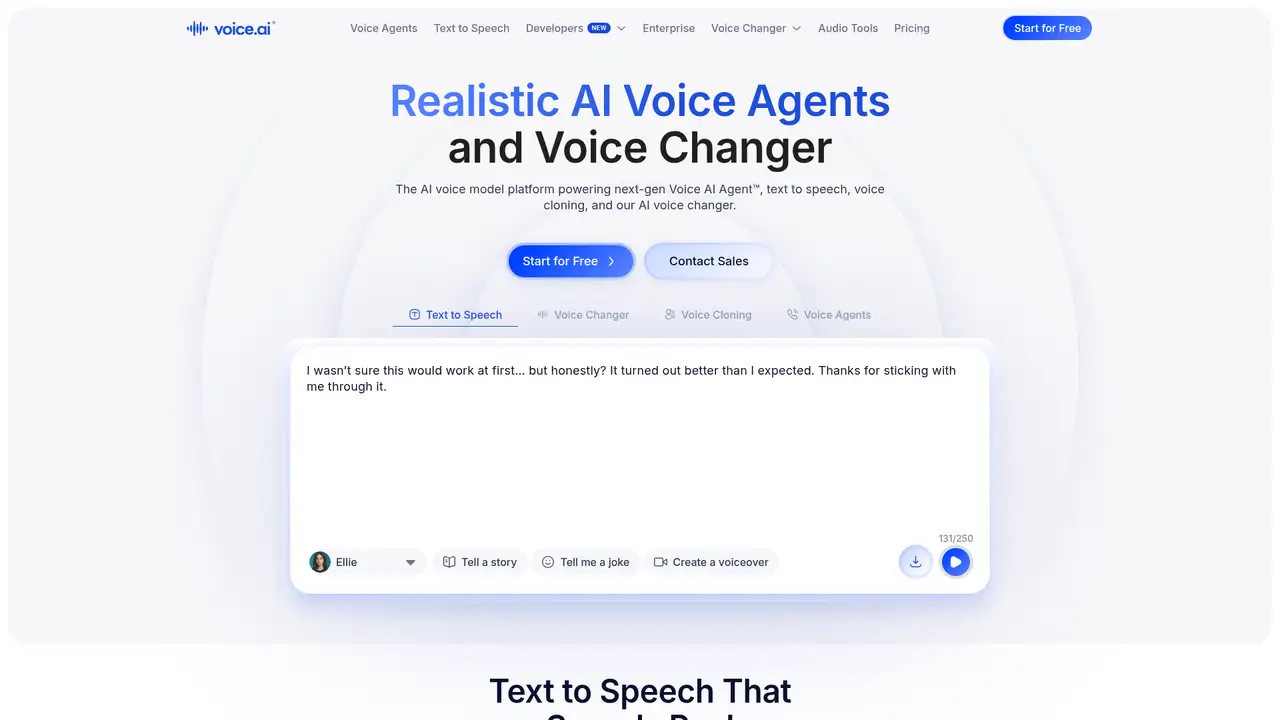
Voice.ai is an AI audio platform that includes its original real-time voice changer for gaming, streaming, and online chat. The company says its current products also cover voice agents, text-to-speech, voice cloning, vocal removal, audio enhancement, stem splitting, and related tools. PitchBook lists the company as founded in 2023, with 48 employees and a $6 million seed round dated May 24, 2023. The service offers web products, desktop software, APIs, SDKs, private cloud, and on-premise deployment. Its positioning reaches beyond consumer voice effects into speech generation and automated phone conversations for organizations. A typical workflow starts with text, a selected voice, and a generated speech file, or with a short recording used for cloning.
The website says cloning can use 10 seconds of audio, while text-to-speech supports more than 15 languages. Creators can also clean audio, remove vocals or reverb, split stems, and find key and BPM values. Businesses can configure inbound or outbound AI phone agents, connect Salesforce, HubSpot, Zendesk, or Slack, and extend workflows through APIs and SDKs. The pricing page applies one credit balance across text-to-speech, voice agents, and audio tools. That shared balance offers flexibility, although consumption depends on the selected feature and workload. Voice.ai offers web products, desktop software, APIs, SDKs, private cloud, and on-premise deployment options for different implementation requirements.
Voice.ai's API documentation names voiceai-tts-v1-latest as the default text-to-speech model and exposes REST examples in Python. The API supports streaming output, web, iOS, and Android integrations, plus compatibility with LiveKit and Pipecat. Voice.ai advertises sub-150ms response time, turn-based conversations, webhooks, tool calling, and RAG and MCP integrations. Full-duplex voice is listed as an alpha feature. The enterprise page says more than 100 million calls have been processed and offers cloud, private cloud, and on-premise deployment. A February 2026 help article distinguishes desktop voice building, where Pro includes the feature, from web voice building, where paid-plan slots apply. The API also supports SDKs, while the platform’s broader product set includes voice cloning, audio tools, phone agents, and real-time voice changing.
The Free plan costs $0/month and includes 5,000 credits, 500 characters per conversion, no instant voice clones, and a five-minute audio-tool limit. Starter costs $5/month and adds 15,000 credits, five clones, downloads, commercial licensing, and 5,000 characters per conversion. Launch costs $24/month, with a first-month price of $12, and includes 200,000 credits. Core costs $99/month for one million credits, Scale costs $330/month for four million, and Business costs $880/month for 22 million. Enterprise pricing is custom. The pricing page gives separate illustrative minute totals for each workload, so users should estimate credits by feature rather than assume a universal per-minute rate. The paid tiers also vary in clone capacity, phone numbers, concurrent generations, and agent calls, with higher tiers adding deployment and support arrangements.
Voice.ai's breadth is useful, but its shared credit system makes costs harder to forecast than a single-purpose voice service. The terms limit consumer services to personal, non-commercial use unless Voice.ai authorizes commercial use separately, while the pricing page lists a commercial license from Starter upward. ElevenLabs is a closer comparison for speech generation and cloning. PlayHT focuses on generated speech, and Resemble AI also targets voice creation and enterprise deployments. Its API supports REST requests, streaming output, web, iOS, and Android integrations, along with LiveKit and Pipecat compatibility for voice applications. Voice.ai is the better fit for teams combining voice changing, speech generation, phone agents, and private deployment, rather than buyers seeking only one voice feature.
Who is Voice.ai best for?
- Creators combining text-to-speech, cloning, and audio tools.
- Developers building low-latency voice agents through APIs.
- Teams requiring private-cloud or on-premise deployment.
- Streamers using real-time voice changing.
Voice.ai Pricing (2026)
Pricing model: Freemium. All prices in USD.
| Plan | Price | What you get |
|---|---|---|
| Free | $0/month | 5,000 credits monthly, 500 characters per conversion, no instant clones, and a five-minute audio-tool limit. |
| Starter | $5/month | 15,000 credits, five instant clones, downloads, commercial license, and 5,000 characters per conversion. |
| Launch | $24/month, first month $12 | 200,000 credits, ten instant clones, usage-based billing, and three phone numbers. |
| Core | $99/month | 1 million credits, 50 instant clones, ten concurrent TTS generations, and eight concurrent agent calls. |
| Scale | $330/month | 4 million credits, 200 instant clones, 20 phone numbers, and 16 concurrent agent calls. |
| Business | $880/month | 22 million credits, 2,200 voice clones, 50 phone numbers, and a technical success manager. |
| Enterprise | Custom | Custom pricing, deployment, support, and service arrangements. |
Pros and Cons
Pros
- It combines voice changing, TTS, cloning, agents, and audio tools.
- The API advertises sub-150ms response time.
- Starter includes a commercial license and five voice clones.
- Enterprise deployment supports cloud, private cloud, and on-premise options.
Cons
- Credits cover different services with different consumption rates.
- Consumer terms restrict commercial use without separate authorization.
- The free plan excludes instant voice clones.
Who should look elsewhere?
- Users seeking a narrowly focused voice changer.
- Commercial users unwilling to leave the free plan.
- Teams requiring one predictable per-minute price.
Technical Details
Frequently Asked Questions
How much does Voice.ai cost?
Voice.ai offers a free plan with 5,000 monthly credits. Starter costs $5/month, Launch costs $24/month after a first-month $12 offer, Core costs $99/month, Scale costs $330/month, and Business costs $880/month. Enterprise pricing is custom. Credits can fund text-to-speech, voice agents, or audio tools, so equivalent minutes vary by workload.
Is Voice.ai still a voice changer?
Yes. The current service includes online and real-time voice changing for gaming, streaming, and chat. It also offers text-to-speech, voice cloning, audio utilities, and AI phone agents. Voice.ai is therefore a broader voice and audio platform, while the voice changer remains one of its consumer-facing products.
Voice.ai or ElevenLabs?
ElevenLabs is the closer comparison for generated speech and voice cloning. Voice.ai covers those uses while also offering real-time voice changing, audio tools, phone agents, and on-premise deployment. Choose Voice.ai when those functions need to share one account; choose ElevenLabs for a more focused speech-generation workflow.
Does Voice.ai train on uploaded data?
Voice.ai's terms say users consent to hardware use for metamodel training, computational purposes, and network operations, while also stating that users can disable the hardware-training feature. The privacy policy covers account, device, log, transaction, and user-generated content data. Review current controls before uploading a voice, and obtain consent from anyone whose voice is used.
Can Voice.ai outputs be used commercially?
The pricing page lists a commercial license beginning with Starter. The terms say consumer services are personal and non-commercial unless Voice.ai separately authorizes commercial use. Users remain responsible for rights, consent, publicity, and likeness. Free-plan users should not assume commercial permission; paid licensing or a written business agreement is safer.
Best Voice.ai Alternatives in 2026
These tools do the same job as Voice.ai, with different pricing, limits and trade-offs.
Expressive speech, dubbing, music and realtime voice agents
Text-to-speech with ultra-realistic voice cloning at scale

Former voice-cloning startup now selling deepfake detection, watermarking and voice ID
Cloud text-to-speech, dubbing, voice conversion, and voice-agent APIs

AI vocal production for singers, producers, and developers