
Vellum Review, Pricing & Alternatives (2026)
A personal AI assistant with memory, skills, and permissioned actions
Last updated: October 26, 2026
What is Vellum?
Vellum is an open-source personal AI assistant for people who want software to remember preferences, work across connected tools, and handle recurring tasks. It suits individuals and small teams comfortable with permissions and model costs. Self-hosting has no Vellum platform fee, while managed Pro packages start at $30/month for Mighty, with usage billed through included bundles and credits.
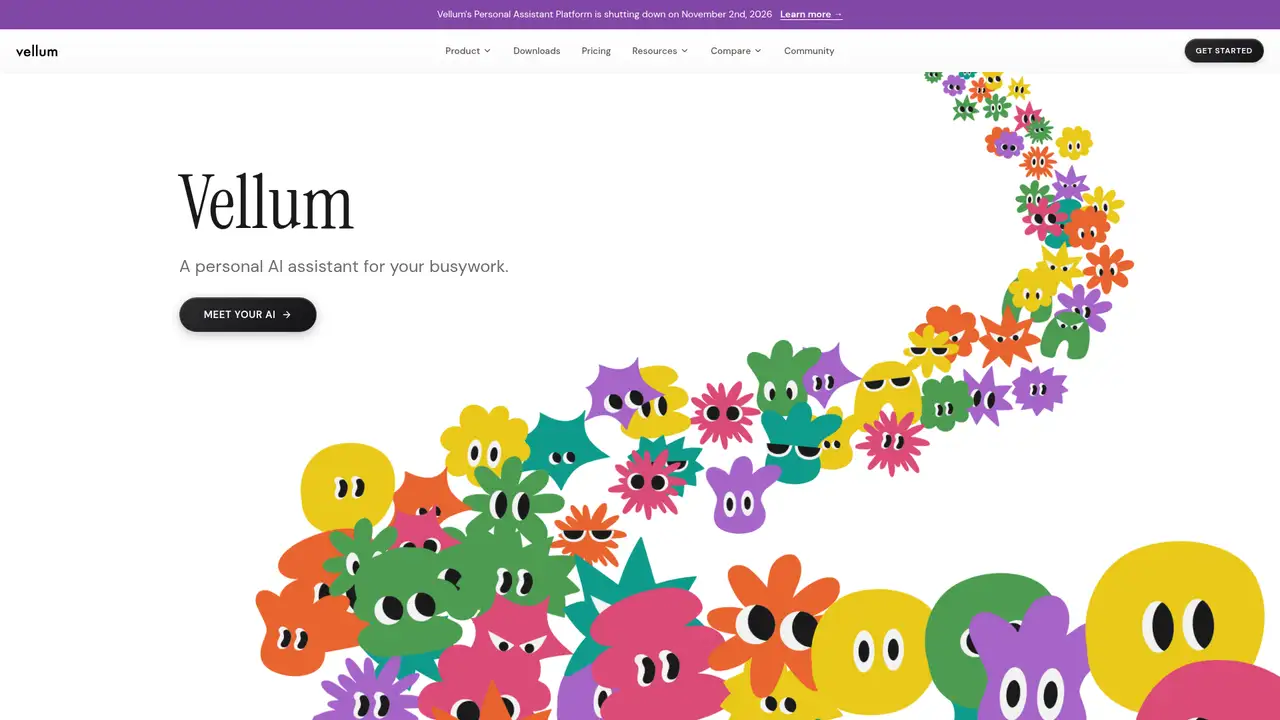
Vellum is an open-source personal AI assistant built by Vellum AI for business and personal work. It remembers preferences, maintains an identity, and acts across connected tools instead of stopping at generated text. The company introduced its Personal Intelligence positioning on May 7, 2026, and announced $25 million raised from Dharmesh Shah, Arash Ferdowsi, Rebel Fund, and Y Combinator. The project repository was created on February 7, 2026, uses the MIT license, and reports 1,450 stars and 219 forks. Supported surfaces include macOS, Windows, iOS, web, voice, email, Telegram, Slack, and Twilio. Local installations keep data on the user’s machine, while Cloud provides an isolated encrypted container. Pricing starts with a free Base plan; Pro packages cost $30, $100, or $200 monthly. Vellum suits users who want an assistant they can self-host, customize, and supervise.
A typical workflow begins with conversation, then draws on memory, skills, scheduled checks, and approval rules. Vellum can read, draft, and prioritize email, manage calendars, browse the web, edit files, create documents, handle GitHub issues, summarize Slack activity, and run recurring tasks. Its repository lists eight memory types, per-user and per-channel isolation, hybrid retrieval, local embeddings by default, and hourly checks for unfinished or soon-due work. OAuth covers Slack, Notion, Google, HubSpot, Linear, Discord, Twitter, Telegram, and Twilio. Plugins add tools and prompt sections through SKILL.md and TOOLS.json files, while 60-plus built-in skills cover services including Google Workspace, Slack, Notion, and the filesystem. Writing files, shell commands, messages, deletion, and computer use can require approval, with trust rules granting narrower or broader permission. It suits users who want an assistant that acts across their tools, while developers may pick OpenClaw.
Vellum’s memory story contains a meaningful architectural split. Its May 2026 product account describes four always-loaded files: essentials.md for costly-to-forget facts, threads.md for open commitments, recent.md for the last day or two, and buffer.md for unfiled memories. A consolidation pass runs every four hours, while corrections are fast-tracked into essentials.md. Behind them sits a graph whose pages use BM25 and dense embeddings, PCA, summaries, and spreading activation to retrieve related context. The repository presents a different implementation: eight memory types, hybrid dense and sparse retrieval, source attribution, deduplication, per-user and per-channel isolation, and local ONNX embeddings with cloud fallback. Model choice is broad, spanning Anthropic, OpenAI, Gemini, Fireworks, OpenRouter, MiniMax, Atlas Cloud, compatible endpoints, and Ollama. The recent releases suit users who value frequent features, while cautious teams should pick tool.
Vellum’s free Base tier provides a Small machine with 1 vCPU and 2 GiB RAM, 6 GiB of persistent storage, managed LLM credentials, and pay-as-you-go credits without a monthly minimum. Pro packages add recurring usage allowances. Mighty costs $30 monthly for Small compute, 10 GiB storage, and Mighty Usage, but excludes the $10 platform fee. Super costs $100 for Medium compute at 2.5 vCPU and 5 GiB RAM, 30 GiB storage, Super Usage, a custom subdomain, static IP, and priority support. Ultra costs $200 for Large compute at 4 vCPU and 8 GiB RAM, 60 GiB storage, Ultra Usage, a custom subdomain, static IP, and priority support. Custom configurations start at $50 monthly. One credit costs $1 and covers inference, web search, image creation, and paid managed APIs, making Base suitable for light users and Pro preferable for heavier workloads.
Vellum’s main limitation is operational and financial complexity. Hosted use combines machine capacity, storage, monthly usage bundles, prepaid credits, and model-provider charges. Base is free with a 1 vCPU, 2 GiB machine and 6 GiB storage, while Pro packages cost $30, $100, or $200 monthly; included usage expires each billing cycle, and purchased credits expire after twelve months. Background heartbeats and memory consolidation can consume credits even when no chat is active. Self-hosting removes platform and computer-tier fees, but users assume responsibility for uptime, updates, backups, and model inference. ChatGPT and Claude remain more familiar conversation tools, whereas Vellum maintains memory, runs scheduled work, and acts across channels. OpenClaw is a closer comparison for developers, offering greater autonomy; Vellum instead provides guided onboarding and progressive approvals. People wanting persistent personal context and controlled recurring work should pick Vellum.
Who is Vellum best for?
- People who want persistent memory across personal and work tasks.
- Users automating email, calendars, files, Slack, and recurring work.
- Teams that need permissioned computer and tool actions.
- Developers who want an MIT-licensed assistant they can self-host.
Vellum Pricing (2026)
Pricing model: Freemium. All prices in USD.
| Plan | Price | What you get |
|---|---|---|
| Base | $0/month | Small machine with 1 vCPU and 2 GiB RAM, 6 GiB persistent storage, managed LLM credentials, and pay-as-you-go credits with no monthly minimum. |
| Mighty | $30/month | Small machine with 1 vCPU and 2 GiB RAM, 10 GiB storage, and Mighty Usage included. |
| Super | $100/month | Medium machine with 2.5 vCPU and 5 GiB RAM, 30 GiB storage, Super Usage, assistant email, and subdomain. |
| Ultra | $200/month | Large machine with 4 vCPU and 8 GiB RAM, 60 GiB storage, Ultra Usage, assistant email, and subdomain. |
| Custom | From $50/month | Select machine, storage, and optional usage components; the minimum documented configuration is $50/month, with credits billed separately. |
Pros and Cons
Pros
- Persistent memory connects preferences, projects, people, and ongoing tasks.
- Permission modes let users approve risky actions before granting trust.
- Self-hosting supports local storage and local Ollama models.
- Channels span desktop, mobile, web, email, Telegram, and Slack.
Cons
- Hosted pricing combines subscriptions, usage bundles, and prepaid credits.
- Self-hosting leaves uptime, updates, backups, and provider costs to the user.
- Background heartbeats and memory work can consume credits.
Who should look elsewhere?
- Users seeking a conventional chat-only interface.
- Teams requiring published enterprise administration or compliance commitments.
- People unwilling to manage usage credits and background activity.
Technical Details
Frequently Asked Questions
How much does Vellum cost?
Vellum has a free Base tier with Small compute, 6 GiB storage, managed LLM credentials, and pay-as-you-go credits. Managed Pro packages cost $30/month for Mighty, $100/month for Super, and $200/month for Ultra. Custom configurations use component pricing with a documented minimum of $50/month. Included usage is spent before prepaid credits, and unused included usage expires each billing cycle.
Does Vellum have a free plan?
Yes. Base costs $0/month and includes a Small machine with 1 vCPU and 2 GiB RAM, 6 GiB persistent storage, managed LLM credentials, and pay-as-you-go credits with no monthly minimum. Local self-hosting also has no Vellum platform fee or computer-tier charge. Model inference, web search, image creation, and eligible paid services can still consume credits.
How does Vellum compare with OpenClaw?
Both are open-source agent products, but they target different starting points. Vellum emphasizes guided onboarding, persistent memory across channels, and permissions that request approval for higher-risk actions. Vellum describes OpenClaw as oriented toward developers and power users who want fuller autonomy with fewer guardrails. Choose Vellum for a structured setup, or OpenClaw for more direct control.
Does Vellum train on user data?
Vellum says user data is not used for training or fine-tuning by Vellum. Conversations still go to an AI model provider for inference, and the default provider is Anthropic with a zero-retention policy described in Vellum's privacy documentation. Users can connect other providers or local Ollama. Channel messages and external tool requests can also pass through those services.
Can I use Vellum commercially?
The Vellum Assistant repository uses the MIT license, which permits commercial use, modification, and redistribution subject to that license's conditions. Separate terms govern Vellum Cloud, model providers, connected services, and generated content. Businesses should review those terms before deploying assistants in customer-facing or regulated workflows, especially when channel messages or third-party APIs process company information.
Best Vellum Alternatives in 2026
These tools do the same job as Vellum, with different pricing, limits and trade-offs.