
Typeface Review, Pricing & Alternatives (2026)
Brand-governed generative content and marketing workflows for enterprises
Last updated: October 26, 2026
What is Typeface?
Typeface is an enterprise marketing AI platform for teams creating brand-controlled text, images, video, and campaign assets. It suits marketing, sales, product, and HR groups that need shared workflows and governance. The company does not publish a current dollar entry price, while its Academy and terms describe a 30-day free trial.
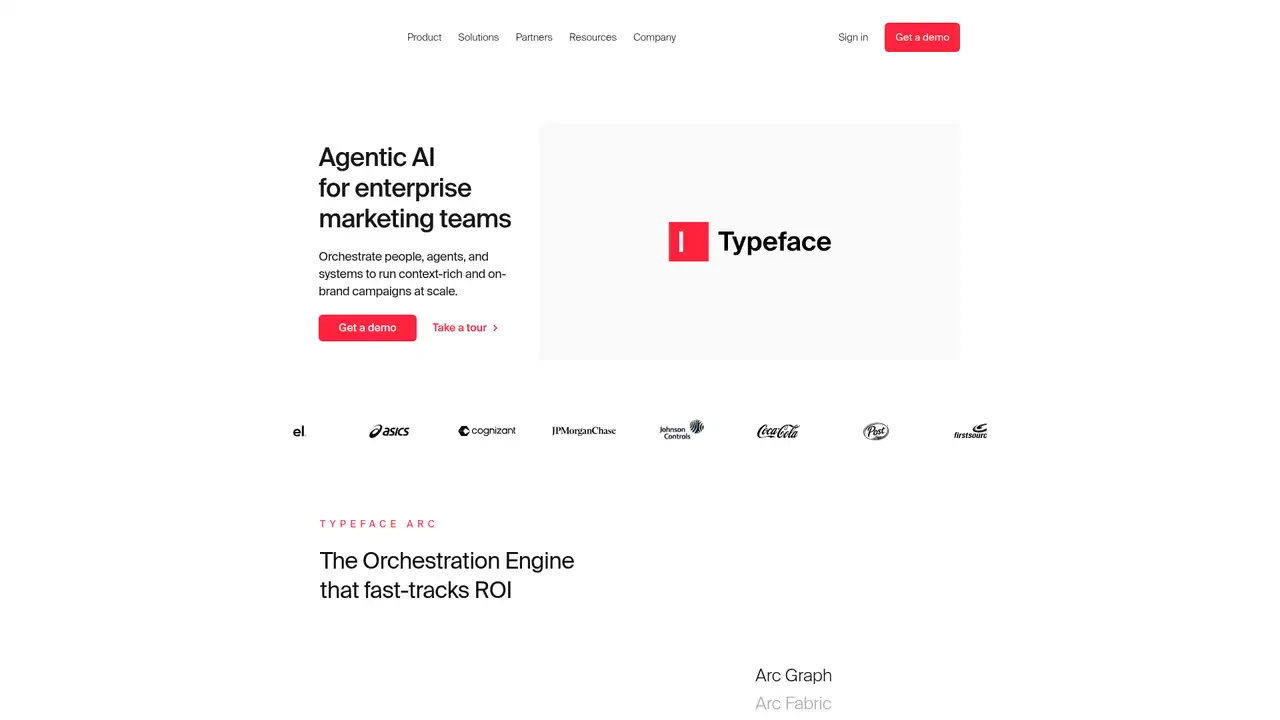
Typeface is an enterprise marketing AI platform from Abhay Parasnis’s company, publicly launched in February 2023 after emerging from stealth with $65 million in Series A funding. A later Series B brought reported total funding to $165 million, with Salesforce Ventures leading the $100 million round. Its core product, Typeface Hub, is a multimodal content workspace, while Typeface Arc adds agents and workflow tools through Arc Graph, Arc Fabric, and Arc Loop. The company says its stack combines brand-specialized AI with services from OpenAI, Google Vertex AI, Microsoft Azure AI, Stability.ai, and Stable Diffusion. Typeface describes SOC 2 Type II, ISO 27001, and ISO/IEC 42001:2023 controls, plus AES-256 encryption, tenant isolation, role-based access, and single sign-on.
Typeface is an enterprise marketing AI platform built around Typeface Hub, a multimodal content hub, and Typeface Arc, an agent and workflow layer. A typical campaign begins with brand rules and intelligence in Arc Graph, uses Arc Fabric to interpret tasks and coordinate agents, and produces text, images, video, or other campaign assets through Hub. Teams can connect these workflows to existing systems through REST APIs and an Embed SDK. Arc Loop feeds campaign-performance information back into the workflow, allowing later work to reflect results. The company says customers retain control of prompts, creative inputs, and outputs, while its security materials describe role-based access control, single sign-on, multifactor authentication, tenant isolation, and audit controls. Typeface supports preferred cloud regions or on-premises deployment according to its IT page, although deployment options may depend on enterprise contracts.
Typeface is an enterprise marketing AI platform built around Typeface Hub, a multimodal content hub, and Typeface Arc, an agent and workflow layer. Its Arc components include Arc Graph for brand intelligence and rules, Arc Fabric for workflow understanding, and Arc Loop for campaign-performance feedback. The company says it combines brand-specialized AI with services from OpenAI, Google Vertex AI, Microsoft Azure AI, and Stability.ai, though that list does not mean every model is selectable. Typeface describes REST APIs, an Embed SDK, tenant isolation, role-based access controls, SSO, MFA, and audit controls. Its security page states SOC 2 Type II, ISO 27001, and ISO/IEC 42001:2023 certifications, plus AES-256 encryption at rest and TLS 1.2 or higher in transit. The company says customer prompts, inputs, and outputs remain private and are not used to train models.
Typeface does not publish a current dollar price table, seat allowance, credit balance, or generation limit. Its website offers “Try now,” demonstrations, contact with sales, and custom packages, leaving the cost of a production deployment opaque. Typeface Academy and the company’s Terms state that new users receive a 30-day free trial, although the Terms allow the duration to change and direct paid fees to separate pricing and payment terms. A Microsoft for Startups page mentions up to three months of free access to a Teams Plan for eligible members, but that offer is not a generally available plan. Current public plan names, seats, credits, and usage caps are not published. For buyers, the practical risk is an uncertain expansion bill as more teams, content volume, workflow automation, and enterprise deployment requirements are added, so request a written quote with limits, overage rules, and renewal terms.
Typeface offers an enterprise marketing platform built around brand governance, multimodal content creation, and agent-based workflows. Its public pricing is a significant limitation: the company publishes a 30-day trial, but no current dollar prices, seat allowances, credit quotas, or generation limits, with paid access handled through custom packages and sales contact. Typeface says it supports REST APIs, an Embed SDK, preferred cloud regions, and potentially on-premises deployment, while its security page lists SOC 2 Type II, ISO 27001, ISO/IEC 42001:2023, encryption, tenant isolation, RBAC, SSO, and MFA. Compared with Adobe Firefly, Typeface emphasizes centralized brand rules and campaign feedback; Jasper and Writer offer comparable enterprise marketing assistance, but Typeface centers its Hub and Arc orchestration stack. The absence of transparent pricing and a public self-hosted package makes evaluation harder for smaller teams, so Typeface suits enterprises needing governed, integrated, multimodal marketing production.
Who is Typeface best for?
- Enterprise marketing teams managing brand-controlled text, image, and video production.
- Organizations that need shared brand rules, approvals, and role-based access.
- Teams connecting generative workflows to existing enterprise systems through APIs.
- Marketing groups running personalized campaigns across multiple audiences.
Typeface Pricing (2026)
Pricing model: Paid. All prices in USD.
| Plan | Price | What you get |
|---|---|---|
| Enterprise | Custom | Contact sales for commercial terms. Typeface does not publish seats, credits, generation limits, or feature availability. |
Pros and Cons
Pros
- Typeface combines brand intelligence with multimodal content generation.
- The platform includes REST APIs and an Embed SDK for integrations.
- The company describes strong enterprise security and governance controls.
- Arc adds workflow and agent capabilities beyond basic asset generation.
Cons
- Current public pricing, seats, and generation limits are unavailable.
- The product’s model list does not confirm selectable models for each workspace.
- Self-hosting and open-source distribution are not publicly offered.
Who should look elsewhere?
- Individuals seeking a transparent monthly subscription with published usage limits.
- Teams requiring a public self-hosted package or open-source model.
- Buyers who need fixed pricing before contacting sales.
Technical Details
Frequently Asked Questions
How much does Typeface cost?
Typeface does not publish a current dollar price table. The company presents demo and contact-sales routes, and its terms say paid fees are governed by separate pricing or payment terms. Typeface Academy and the terms describe a 30-day free trial. Seats, credits, generation allowances, and enterprise package prices require a quote.
Does Typeface have a free plan?
Typeface does not publish a permanent free plan. It describes a 30-day free trial through Academy and its terms, with a caveat that the duration may change. A Microsoft for Startups page references up to three months of Teams Plan access for eligible members, but that offer is not presented as general public pricing.
How does Typeface compare with Jasper?
Typeface and Jasper both support AI-assisted marketing content, but their published emphasis differs. Typeface centers on brand intelligence, multimodal production, enterprise workflows, and orchestration. Jasper focuses on marketing content creation and campaign workflows. Typeface suits organizations seeking broader content operations and deployment controls, while Jasper may fit teams wanting a more focused marketing writing platform.
Does Typeface train models on customer data?
Typeface says prompts, data, and outputs remain private, are not shared with third parties or models, and are not used to train models on proprietary data. Its security materials also describe customer control of prompts, creative inputs, and outputs. Enterprise buyers should review the contract for exact data-processing, retention, and intellectual-property terms.
Can businesses use Typeface output commercially?
Typeface positions the product for enterprise marketing, sales, product, and HR workflows, and its security page says customers own or control prompts, creative inputs, and outputs. Commercial use depends on the applicable agreement, content rights, and third-party model terms. Buyers should obtain enterprise terms and confirm intellectual-property protections before publishing generated assets.
Sources
- Typeface homepage and product positioning
- Typeface platform, Hub, and Arc overview
- Typeface Hub product details
- Typeface security and governance
- Typeface IT deployment and APIs
- Typeface Academy trial information
- Typeface terms of service
- Typeface newsroom and orchestration announcement
- Typeface launch and Series A announcement
- Typeface emerges from stealth with $65M to bring generative AI to the enterprise | TechCrunch
Best Typeface Alternatives in 2026
These tools do the same job as Typeface, with different pricing, limits and trade-offs.
Marketing AI for controlled, on-brand content production

Enterprise AI agents built around Palmyra models and governed workflows
A multi-model studio for generating and editing creative assets
AI-powered GTM workflows for revenue teams.
Performance and compliance AI for regulated-brand marketing