
Type Review, Pricing & Alternatives (2026)
A manuscript-focused editor for drafting, revising, and publishing
Last updated: October 26, 2026
What is Type?
Type.ai is an AI-first writing editor for books, novels, screenplays, stories, and other long-form projects. It combines documents, chat, story details, revision commands, and publishing tools for authors and screenwriters, with support for documents up to 150,000 words. A free plan costs $0, while reported paid plans start at $12 per month.
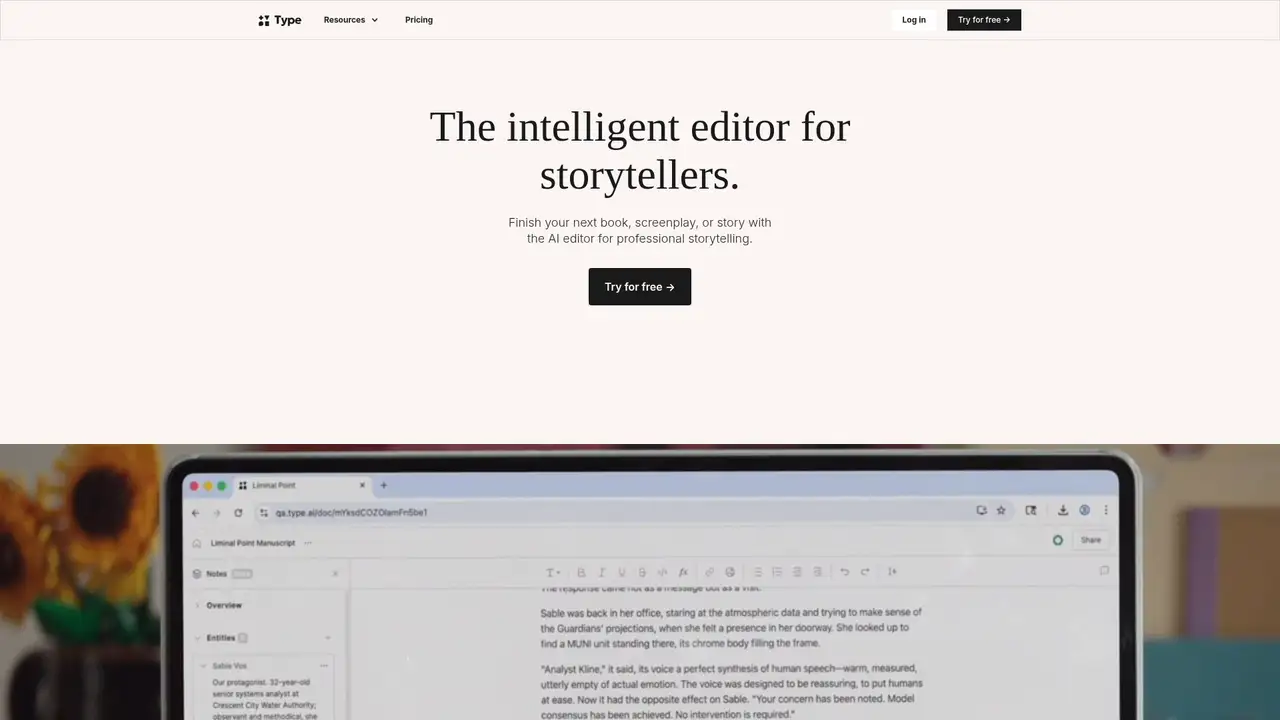
Type.ai is an AI-first editor designed for long-form writing instead of browser-wide completion. It serves authors working on books, novels, screenplays, stories, and related creative projects, combining a document workspace with chat, writing commands, organization, imports, exports, sharing, and publishing tools. Founded in 2023, the company joined Y Combinator’s Winter 2023 batch and announced a $2.8 million pre-seed round in June 2023. This history places Type among newer specialist writing services rather than established general-purpose word processors. Its defining idea is continuity: the manuscript, story information, revision instructions, and assistant occupy one workspace. Buyers seeking sustained narrative work may value that arrangement because it reduces the need to transfer material between a conventional editor and a separate chatbot.
Type.ai lets users supply persistent context through characters, settings, scenes, and custom writing rules. A typical process involves importing or creating a manuscript, recording relevant story details, and asking the assistant to draft, revise, summarize, or review selected passages. The official FAQ says documents and imports can contain up to 150,000 words, with images, headings, and tables preserved. Manual writing, organization, importing, exporting, and sharing do not consume AI credits. That distinction matters for long projects because users can continue editing and managing files after their AI allowance is exhausted. Buyers focused on novels or scripts may therefore find the structure more useful than a lightweight completion tool. Type is less suited to quick browser-field suggestions than HyperWrite, whose focus extends across online applications.
Type’s pricing page says every plan includes supported premium AI models along with writing, editing, and publishing features, but it does not provide a complete current list of model names. AI actions use credits, so potential buyers need to consider both subscription cost and expected usage. The homepage says Type does not train models on user data. Its privacy policy was updated November 5, 2025, while its terms say users own submitted and generated content, grant Type a broad service license, and permit de-identified data use for product and business operations. Public milestones include the January 2025 Type overview and November 2025 privacy update. These materials explain the workspace and policies, but they do not confirm a particular model lineup. Organizations should review current terms before uploading sensitive manuscripts.
Type’s free plan costs $0 and includes fixed credits that do not expire, though the official pricing text does not state the current amount. An independent October 2026 review reports Basic at $12 monthly with 500,000 monthly credits, Pro at $24 with 1,500,000, and Max at $96 with 6,000,000. The same report says annual billing saves 33 percent. Paid monthly credits reset at renewal and do not roll over, whereas purchased credits do not expire. This structure makes the free tier useful for occasional AI assistance and manual editing, but frequent users should estimate how quickly actions consume credits. Because the published paid figures come from an independent review rather than clearly exposed official pricing text, buyers should verify current checkout totals, billing terms, and included allowances before subscribing.
Type’s main limitation is a credit system whose individual action costs are not summarized in the public material described here. The exact current premium model names are also absent from the pricing page, making detailed comparisons difficult. HyperWrite is better for inline browser completion, citations, and cross-site tools, while Type.ai is better for manuscript organization, persistent story details, and long documents. ChatGPT offers broader general-purpose conversation but lacks Type’s dedicated story workspace. Sudowrite is a closer creative-writing alternative, with its own approach to drafting and revision. Buyers should also note that paid monthly credits do not roll over. Pick Type.ai for books, scripts, and other long projects that benefit from persistent document context, imports, exports, and publishing tools.
Who is Type best for?
- Authors drafting books and novels in one workspace.
- Screenwriters managing scenes and story details.
- Writers revising long documents with AI commands.
- Creators needing imports, exports, and publishing tools.
Type Pricing (2026)
Pricing model: Freemium. All prices in USD.
| Plan | Price | What you get |
|---|---|---|
| Free | $0 | Fixed non-expiring credits; the current amount is not exposed in the official pricing text. |
| Basic | $12/month; annual billing reported at 33% savings | 500,000 credits monthly, as reported by an independent October 2026 review. |
| Pro | $24/month; annual billing reported at 33% savings | 1,500,000 credits monthly, as reported by an independent October 2026 review. |
| Max | $96/month; annual billing reported at 33% savings | 6,000,000 credits monthly, as reported by an independent October 2026 review. |
Pros and Cons
Pros
- Documents support up to 150,000 words.
- Story details provide persistent writing context.
- Manual editing remains available without AI credits.
- The free credits do not expire.
Cons
- Paid prices are reported independently rather than exposed clearly.
- Exact current premium model names are not published.
- Paid monthly credits do not roll over.
Who should look elsewhere?
- Users who need browser-wide inline completion.
- Buyers demanding a fully published model roster.
- Teams requiring narrow, short-form copy workflows.
Technical Details
Frequently Asked Questions
How much does Type.ai cost?
Type.ai’s free plan costs $0. An October 13, 2026 independent review reports Basic at $12 monthly, Pro at $24, and Max at $96, with 33 percent annual savings. The official pricing text described here does not expose paid totals, so buyers should verify the current checkout price before subscribing.
Does Type.ai have a free plan?
Yes. Type.ai offers a free plan with fixed credits that do not expire. The current credit amount is not exposed in the official pricing text. Manual writing, organizing, importing, exporting, and sharing do not consume AI credits, so the editor remains usable for non-AI work after those credits are exhausted.
Type.ai or HyperWrite: which is better?
Type.ai is better for books, novels, screenplays, and other long documents that need story details and persistent manuscript context. HyperWrite is better for browser-wide suggestions, email, web forms, citations, and reusable tools. The choice depends on workspace: Type.ai centers the manuscript, while HyperWrite centers writing across browser applications.
Does Type.ai train on user documents?
Type.ai’s homepage says it does not train models on user data. Its terms also grant Type a broad service license and permit de-identified data use for product and business operations. Those statements address different uses, so organizations with sensitive manuscripts should review the current privacy policy and terms before uploading them.
Can Type.ai content be used commercially?
Type.ai’s terms say users own submitted and generated content, which supports ownership of work created in the service. The same terms grant Type a broad, perpetual worldwide service license and allow de-identified data use. Commercial users should read the current terms and any applicable business agreement before publishing paid work.
Best Type Alternatives in 2026
These tools do the same job as Type, with different pricing, limits and trade-offs.
General-purpose AI assistance for writing, research, coding, and work

AI-assisted fiction drafting, rewriting, and story development
Marketing AI for controlled, on-brand content production

Browser-based writing help with inline predictions, tools, and agents

A structured novel workspace with optional AI from your preferred provider