
Tensor.Art Review, Pricing & Alternatives (2026)
Community image generation with model discovery, training, and workflows
Last updated: October 26, 2026
What is Tensor.Art?
Tensor.Art is a community image-generation and model-hosting service for creators who want model discovery, LoRA and checkpoint training, and open-source workflow support. It runs on the web and mobile, with TAMS API access and local ComfyUI integration. The US App Store lists Pro at $9.90 for 30 days, $21.90 quarterly, and $69.90 yearly, while a $1 pass and credit packs are also available.
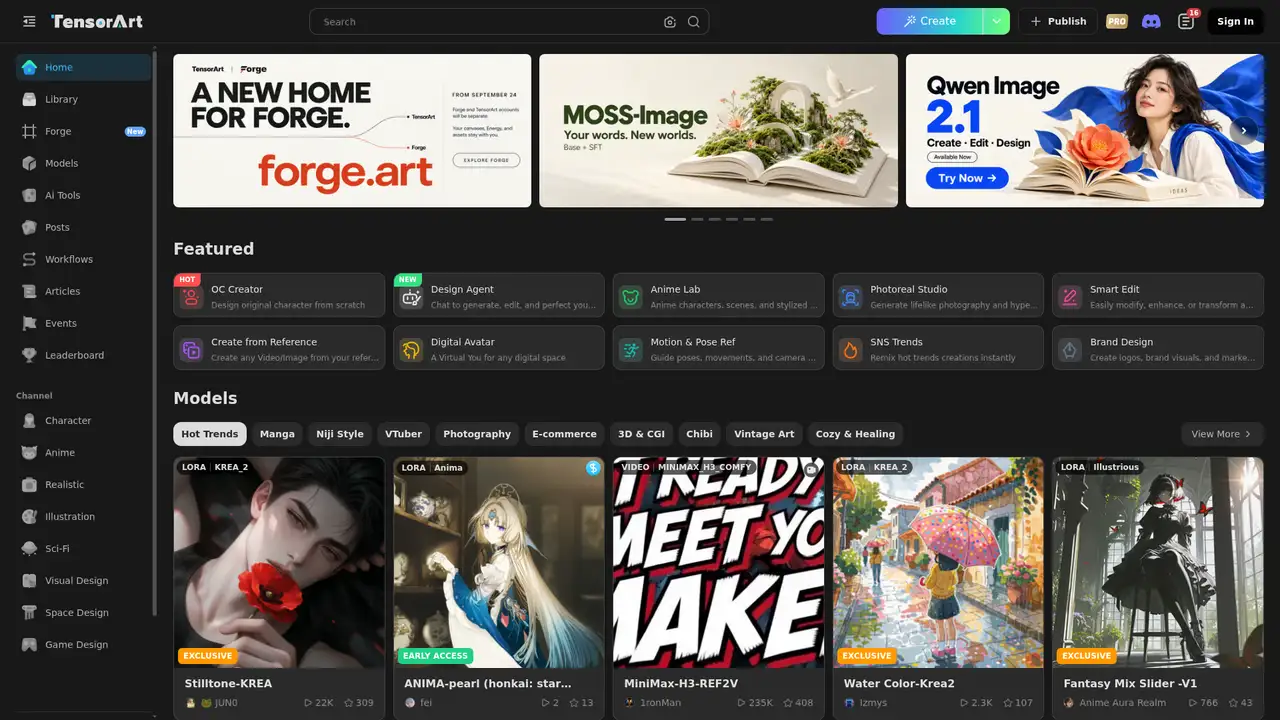
Tensor.Art is a community image-generation and model-hosting service operated by Echo International HK Limited, according to Apple’s listing. It supports web and mobile access, account-based generation, public community posts, model discovery, and creator publishing. Tensor.Art does not publish a reliable launch year, headquarters, funding total, or funding round. Its terms say the company does not claim ownership or copyright over models or AI-generated images. Users remain responsible for applicable law, model licenses, permissions, and uploaded material. The service also operates TensorHub, announced in November 2025 as a separate platform with a more mature-content-friendly policy. TensorHub synchronizes accounts and content with Tensor.Art while using Tokens instead of the main service’s Credits.
Tensor.Art combines generation, model discovery, publishing, training, and workflow tools in one account. A typical session involves choosing a model or community resource, writing a prompt, adjusting settings, generating an image, and spending platform resources. Users can upload datasets for LoRA or checkpoint training, organize files with folders and labels, and upload local datasets. A January 2026 training update added labeling with Gemini-3-Flash, Gemini-2.5-Flash, and Qwen-3-VL. Canvas brings several hosted models into one interface, including Seedance 2.0, Kling, Nano Banana, Midjourney, and Vidu. Developers can use TAMS for hosted commercial models, while official ComfyUI nodes connect a local ComfyUI installation to TAMS APIs. A chosen model can also carry its own commercial-use restrictions, regardless of the membership purchased.
Tensor.Art mixes community models with hosted commercial models and open-source workflows. Its September 2025 updates included HunyuanImage 2.1 with native 2K output, SRPO, and Wan 2.2 VACE video editing. Wan2.7-Image became available on April 1, 2026, supporting text-to-image, instruction editing, 1K to 4K output, transparent PNG files, and up to nine reference images. Canvas launched on April 13, 2026, and some closed models moved from TA Credits to Canvas. The company’s 2024 report describes online training and support for new base models. These releases make Tensor.Art broader than a single-model image generator, though model availability, licensing, resource costs, and controls vary by tool. TAMS integration connects local ComfyUI workflows to remote generation rather than moving the Tensor.Art service onto a personal computer.
Tensor.Art’s current US App Store listing shows Pro at $9.90 for 30 days, $21.90 per quarter, and $69.90 per year. It also lists a $1 pass and separate credit packs priced at $9.90 for 3,000 credits, $29.90 for 10,000, and $59.90 for 30,000. Membership terms describe 300 daily credits that refresh without rollover, although current entitlements can vary by offer. An older official notice advertised a $19.90 quarterly plan and a limited $59.90 annual promotion, so those figures are historical rather than current US App Store prices. Storefront, tax, account, currency, and promotional differences can change the final charge and included credits.
Tensor.Art’s main weakness is billing and policy complexity. Credits, Energy, Tokens, Canvas, model licenses, and community moderation create more decisions than a single-model service. Its terms do not promise that prompts or images are excluded from training, and commercial use depends on the selected model and applicable law. Adobe Firefly offers a more centralized commercial-rights message. Leonardo AI focuses more on models and creative assets. Getimg offers one subscription across multiple image and media models, while Tensor.Art emphasizes community discovery, training, and open-source workflows. Tensor.Art suits creators who want model experimentation, training tools, and community resources rather than the simplest rights and billing model.
Who is Tensor.Art best for?
- Creators exploring community models, LoRAs, and checkpoints.
- Artists who train models or organize datasets online.
- ComfyUI users connecting local workflows to TAMS.
- Users comfortable comparing model-specific licenses and credits.
Tensor.Art Pricing (2026)
Pricing model: Freemium. All prices in USD.
| Plan | Price | What you get |
|---|---|---|
| Free | $0 | Account required for generation and posting. Credit allowances and model costs vary. |
| Day Pass Kit | $1 | One-day purchase listed in the US App Store. |
| 30-day Pro Plan | $9.90/month | US App Store price. Membership terms describe daily credits that expire rather than roll over. |
| Quarterly subscription | $21.90/quarter | US App Store subscription price. Credit entitlements depend on the selected membership offer. |
| Yearly subscription | $69.90/year | US App Store subscription price. This is distinct from the older $59.90 annual promotion. |
| 3k Credit Package | $9.90 | 3,000 credits, purchased separately. |
| 10k Credit Package | $29.90 | 10,000 credits, purchased separately. |
| 30k Credit Package | $59.90 | 30,000 credits, purchased separately. |
Pros and Cons
Pros
- Tensor.Art combines generation, model discovery, training, and community publishing.
- Recent releases include Wan2.7-Image, Canvas, and new video tools.
- Official ComfyUI nodes connect local workflows to TAMS APIs.
- The service offers community and hosted model options.
Cons
- Credits, Energy, Tokens, and Canvas make billing harder to predict.
- Tensor.Art does not promise that prompts or images are excluded from training.
- Commercial rights depend on each model and its applicable terms.
Who should look elsewhere?
- Teams needing one centralized commercial-rights policy.
- Users seeking a simple fixed image-generation subscription.
- Organizations requiring self-hosted platform deployment.
Technical Details
Frequently Asked Questions
How much does Tensor.Art cost?
The US App Store lists Tensor.Art Pro at $9.90 for 30 days, $21.90 quarterly, and $69.90 yearly. It also lists a $1 pass and credit packs at $9.90, $29.90, and $59.90. Taxes, currency, account eligibility, storefront, included credits, and promotions can change the final checkout amount.
Does Tensor.Art have a free plan?
Tensor.Art supports account-based generation and paid memberships, but the company does not publish one universal current free-credit allowance. Older membership terms describe 300 daily credits for membership, refreshed daily without rollover. Free access, credit availability, and generation costs can depend on the current product and resource system.
How does Tensor.Art compare with Leonardo AI?
Tensor.Art focuses on community model discovery, LoRA and checkpoint training, and open-source workflows. Leonardo AI is more focused on models and creative assets. Tensor.Art suits users who want to explore and train community resources, while Leonardo is a more focused choice for users who prefer a centralized creative platform.
Does Tensor.Art train on user prompts or images?
Tensor.Art’s terms describe basic user information and its Privacy Policy, but the company does not promise that prompts or images are excluded from training. Posted community content is public, and users need rights or permission for uploaded images and real-person model training. Review current privacy and model terms before uploading sensitive material.
Can I use Tensor.Art images commercially?
Tensor.Art’s terms allow users to use created content subject to the selected model’s terms and applicable law. The company does not claim ownership or copyright over models or AI-generated images. Commercial use is not a blanket platform guarantee. Check each model’s license, obtain required permissions, and avoid infringing uploads or training.
Sources
- Tensor.Art terms of service
- Tensor.Art pricing adjustment notice
- Tensor.Art membership terms
- Tensor.Art update log
- Tensor.Art model and Canvas updates
- Tensor.Art training and library update
- Tensor.Art TAMS API
- Tensor.Art ComfyUI integration
- Tensor.Art community and model report
- Tensor.Art US App Store prices and developer
Best Tensor.Art Alternatives in 2026
These tools do the same job as Tensor.Art, with different pricing, limits and trade-offs.
A multi-model studio for generating and editing creative assets

Create images, video, and design assets with hosted generative models
High-control image generation for visual development and concept work

One workspace for image, video, editing, music and speech generation

ByteDance workspace for Seed-powered image and video creation