
Synthesis Tutor Review, Pricing & Alternatives (2026)
A voice-led adaptive math tutor for children ages 5 to 11.
Last updated: October 26, 2026
What is Synthesis Tutor?
Synthesis Tutor is a paid, voice-led adaptive math program for ages 5 to 11, with visual lessons, games, read-aloud support, and progress reports. A seven-day free trial is displayed. Entry pricing is $29 monthly or $119 annually for up to seven children, though public offers conflict. It suits guided K-5 practice, not broad subjects, advanced math, or live tutoring.
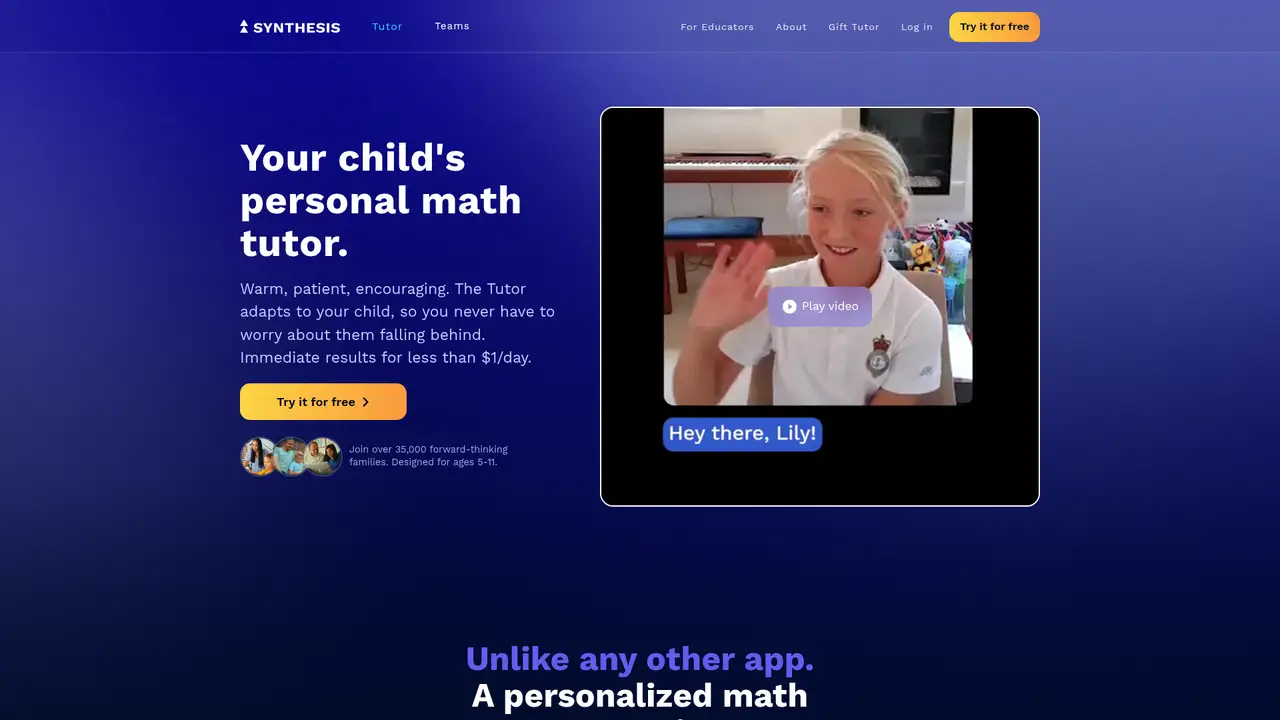
Synthesis Tutor is a paid family math program for children ages 5 to 11, covering the standard K-5 curriculum. Synthesis says more than 35,000 families have joined Tutor, while its About page places the product within a broader Synthesis community and history. The company was founded in 2020 by Josh Dahn and Chrisman Frank after earlier development at an experimental school associated with SpaceX. Tutor’s consumer purpose is focused: foundational mathematics, not general homework help. Families can use it at home and at any time, with plans intended for multiple children. The company also provides educator and school contact routes, although consumer pages center on household subscriptions and parent-managed child accounts. Parents purchase a focused tutoring program rather than an unrestricted assistant that children can prompt about any topic.
A child moves through guided activities that combine spoken instructions, visual representations, questions, and immediate feedback. Synthesis describes adaptive evaluation that identifies gaps and changes lessons after mastery. Topics include counting and cardinality, subtraction, multiplication, division, and algebraic thinking. The program also features manipulatives, progress reports, read-aloud support, and playful activities. Its authored, sequential workflow gives young learners a defined path through each concept instead of an unrestricted chat box. Independent reviews describe voice-led interaction, multiple representations, and game elements, while also noting occasional speech-recognition problems and repetitive exchanges. Parent supervision can remain useful, especially for younger children or learners who need encouragement beyond the programmed lesson. A child's progress through a lesson provides a different signal from the final numerical answer alone.
Synthesis says educators and neuroscientists shape its lessons and that interactions receive quality review. Its descriptions emphasize one-to-one guidance, micro-assessments, multiple representations, and immediate adaptation rather than a named general-purpose model. The company does not publish model names. Official pages describe browser access and tablet support, while the About page lists English and Spanish lesson availability. The privacy policy updated June 10, 2026 identifies Tutor as an adaptive digital math platform for children ages 5 to 11. Independent reviews praise its voice-first design and engagement, but report that advanced learners may complete the available curriculum quickly. Adaptive presentation does not replace human diagnostic judgment or unlimited curriculum depth.
Synthesis displays a seven-day free trial and several paid offers, but public pages do not agree. The Tutor page lists individual pricing at $45 monthly, $348 annually, or $999 lifetime, plus family pricing at $70 monthly, $400 annually, or $1,499 lifetime. The same page also displays $29 monthly and $119 annual offers for up to seven children. The About page repeats those lower family prices and the seven-child limit. Child limits and promotional displays vary, making checkout the practical reference. Tutor has no public free plan. The listed pages identify no public source code, self-hosting package, or developer API. Families should confirm the exact price, renewal terms, and child allowance before subscribing.
Synthesis Tutor suits young children who benefit from spoken, visual, carefully sequenced K-5 math practice. Khan Academy and Khanmigo provide broader subject coverage, IXL Math offers extensive skills practice, and Prodigy Math centers on game-based learning. Beast Academy gives families another elementary math curriculum style. Tutor is less suitable for advanced learners, children needing live human flexibility, or families requiring stable public pricing. Its main strengths are authored multimodal instruction, adaptive checks, and parent progress visibility. Its limitations are narrow K-5 scope, occasional repetitive interactions, and conflicting public offers. Families comparing direct rivals should consider Khanmigo, IXL Math, Prodigy Math, and Beast Academy. Choose Synthesis when guided voice-led math practice matters most.
Who is Synthesis Tutor best for?
- K-5 math reinforcement.
- Emerging readers needing read-aloud support.
- Children who prefer visual and auditory lessons.
- Families seeking guided home practice.
Synthesis Tutor Pricing (2026)
Pricing model: Paid. All prices in USD.
| Plan | Price | What you get |
|---|---|---|
| Individual monthly | $45/month | One child; seven-day free trial displayed. |
| Individual annual | $348/year | One child; seven-day free trial displayed. |
| Individual lifetime | $999 one-time | One child. |
| Family monthly | $70/month | Family offer; displayed child limit varies. |
| Family annual | $400/year | Family offer; displayed child limit varies. |
| Family lifetime | $1,499 one-time | Family offer; displayed child limit varies. |
| Family annual alternative | $119/year | Up to seven children, according to the About page. |
| Family monthly alternative | $29/month | Up to seven children, according to the About page. |
Pros and Cons
Pros
- Voice-led guidance can support emerging readers.
- Multiple representations reinforce mathematical ideas.
- Adaptive checks address gaps during lessons.
- Progress reports give parents learning visibility.
Cons
- The curriculum focuses on K-5 mathematics.
- Some reviewers report repetitive interactions.
- Public prices and child limits conflict.
Who should look elsewhere?
- Advanced secondary math.
- Broad subject tutoring.
- Families requiring live human support.
Technical Details
Frequently Asked Questions
Does Synthesis Tutor have a free plan?
No free plan is displayed. Synthesis promotes a seven-day free trial without a credit card on its Tutor page. Public pages then show paid monthly, annual, and lifetime offers. Because the displayed prices and child limits differ, parents should review the exact offer, renewal terms, and limit at checkout.
What is the closest rival to Synthesis Tutor?
Khanmigo is the closest broad alternative, while IXL Math and Beast Academy are direct elementary math competitors. Synthesis emphasizes guided K-5 lessons, voice support, and adaptive activities. Khanmigo covers more subjects, IXL emphasizes skills practice, and Beast Academy offers a separate elementary math curriculum.
What privacy information does Synthesis publish?
Synthesis published a privacy policy updated June 10, 2026. It identifies Synthesis School, Inc. as the data controller and describes child accounts, parental consent, COPPA, and FERPA practices. Parents should read the full policy and related COPPA terms before creating an account, especially for data collection and deletion details.
Can businesses or schools license Synthesis Tutor?
The Tutor page includes a question about classroom or school access, and the About page lists teachers, schools, homeschool pods, and districts among potential users. The listed pages do not establish current school pricing, API rights, commercial redistribution rights, or procurement terms. Organizations should request written licensing and data terms.
Does Synthesis Tutor use a public model or offer self-hosting?
Synthesis describes Tutor as an adaptive digital math platform but does not publish model names. The listed pages present a hosted service accessed through a website and tablet devices. They do not identify public source code, a self-hosting package, or a developer API.
Best Synthesis Tutor Alternatives in 2026
These tools do the same job as Synthesis Tutor, with different pricing, limits and trade-offs.