
Squibler Review, Pricing & Alternatives (2026)
Structured AI drafting for books, screenplays, and long-form stories
Last updated: October 26, 2026
What is Squibler?
Squibler is an AI writing workspace for authors creating books, screenplays, stories, and manuscripts. It suits writers who want project context, character and plot consistency, manuscript editing, and document export in one place. A free plan includes 1,000 AI credits monthly, while paid plans start at $29.99 per month.
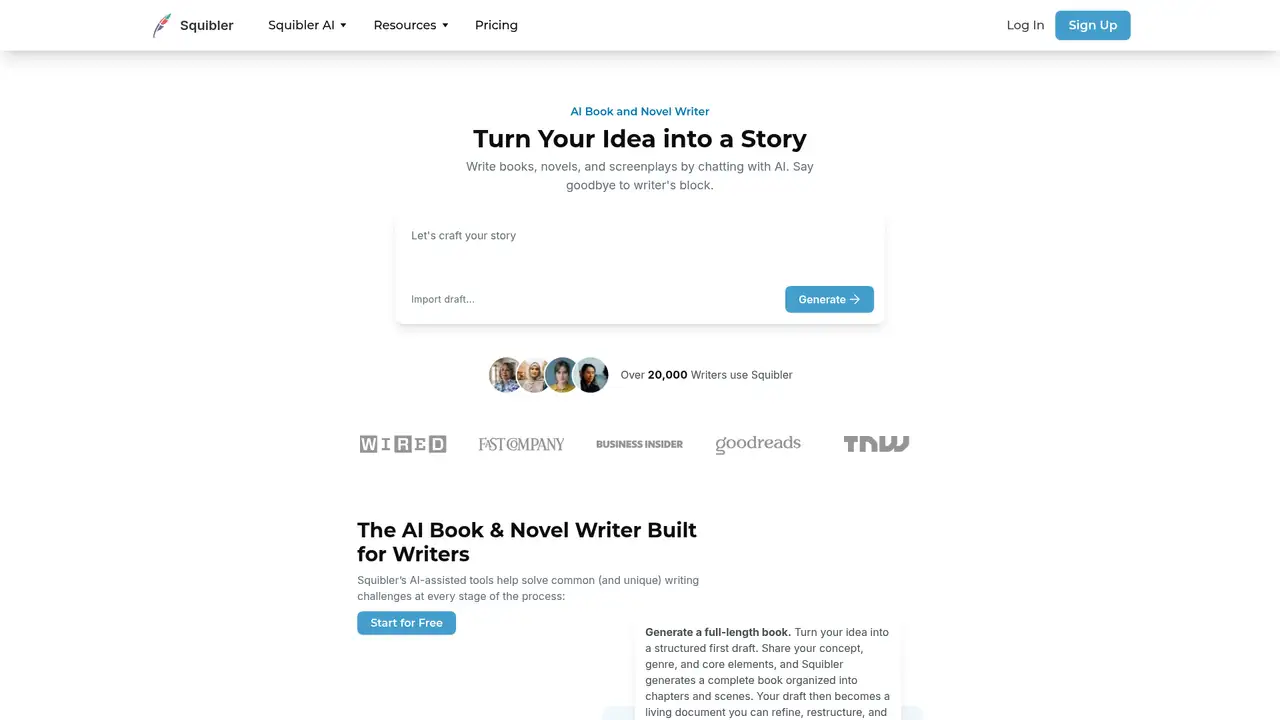
Squibler is a structured writing environment for long-form creative projects, not a general-purpose chat tool. Its focus includes books, screenplays, stories, characters, plots, scenes, and manuscript editing. The workspace keeps project context organized as a writer develops an idea, produces a draft, and revises it. Squibler describes its mission as helping people become storytellers through AI-assisted creation. A founder case study says Josh Fechter and Dhaval Bhatt founded the company in early 2021, although public accounts conflict about the date and founders. A founder-authored 2024 post reported bootstrapping and approximately $3 million in revenue, an unaudited company claim. Buyers should treat the product as writing software requiring human review for quality, accuracy, originality, and publication decisions.
A typical Squibler project starts with a book, screenplay, or story concept, then develops characters, plot elements, scenes, and prose within one workspace. The product emphasizes consistency across characters and plot, full-length manuscript generation, whole-manuscript editing, and PDF or DOCX export. Plus is described as supporting a 200 to 300 page book, while Pro targets multiple books, screenplays, and other content at scale. This structure differs from asking a chatbot for disconnected passages because project details remain available during later writing tasks. That can reduce organizational work for authors handling large drafts. Buyers should still expect to outline, fact check, revise, and review copyright issues themselves, because project organization does not replace editorial judgment or professional manuscript assessment.
Squibler does not publish a verified list of its underlying model names. Its October 20, 2026 changelog says the writing agent and models used for writing and generation were updated. The release also reported better adherence to requested word counts, improved recovery for interrupted long-running tasks, clearer editor highlighting, and a fix for saved story details being overlooked. Earlier February 2025 notes described sequential book generation using Celery and Firebase, alongside reliability and performance work. These changes suggest attention to lengthy manuscript jobs and recovery from failures, which matters when buying software for substantial projects. They do not permit a direct model comparison with ChatGPT, Claude, or another named system, so assess workflow and limits instead.
The Free plan costs $0 and includes 1,000 AI credits each month, with access to test book and screenplay creation. Plus costs $29.99 monthly or $15.83 monthly when billed annually, and includes 10,000 monthly credits, a claimed 200 to 300 page book workflow, manuscript editing, consistency tools, and PDF or DOCX export. Pro costs $89.99 monthly or $49.17 monthly annually, with unlimited AI credits and support for larger-scale content creation. The pricing page advertises a 45 percent annual saving. Squibler’s FAQ rounds the annual figures differently, so buyers should verify the checkout total before subscribing. Its terms say users retain ownership, while prompts and documents may be processed by OpenAI and Anthropic, an important privacy consideration.
Squibler’s strongest case is long-form project management, but its credit system can make heavy use less predictable than a flat unlimited plan. Sudowrite is a closer creative-writing alternative with a different focus, while Novelcrafter also targets long-form fiction workflows. Jasper is more centered on marketing and business content than books and screenplays. Squibler’s privacy policy names OpenAI and Anthropic as AI partners, and its terms do not guarantee copyright protection or commercial rights for every generated passage. Buyers should also consider whether the monthly credits fit their drafting volume. Writers wanting a structured book or screenplay workspace, and willing to monitor credit use and review output carefully, should pick Squibler.
Who is Squibler best for?
- Authors drafting books inside a structured project workspace.
- Screenwriters managing characters, plots, and scenes.
- Writers needing whole-manuscript editing and export.
- High-volume users who can use Pro’s unlimited credits.
Squibler Pricing (2026)
Pricing model: Freemium. All prices in USD.
| Plan | Price | What you get |
|---|---|---|
| Free | $0/month | 1,000 AI credits monthly; test book and screenplay creation. |
| Plus | $29.99/month or $15.83/month annually | 10,000 AI credits monthly; 200 to 300 page book claim, manuscript editing, consistency tools, PDF and DOCX export. |
| Pro | $89.99/month or $49.17/month annually | Unlimited AI credits; books, screenplays, and content at scale. |
Pros and Cons
Pros
- The workspace keeps long-form project elements together.
- Plus includes PDF and DOCX manuscript export.
- Pro removes the monthly AI credit cap.
- The free plan supports 1,000 monthly AI credits.
Cons
- Underlying model names are not publicly identified.
- Annual pricing figures differ between the plan page and FAQ.
- AI partner processing may involve prompts and documents.
Who should look elsewhere?
- Writers seeking a confirmed named underlying model.
- Users requiring guaranteed copyright protection for generated text.
- Occasional users who need more predictable flat-rate usage.
Technical Details
Frequently Asked Questions
Is Squibler free?
Yes. Squibler’s Free tier costs $0 and includes 1,000 AI credits per month with no time-limited trial expiration. The official pricing page says the tier can be used to test full book and screenplay creation. Larger credit allowances, full-length manuscript features, broader export, and unlimited credits require Plus or Pro.
What does Squibler Plus cost?
Plus is listed at $29.99 per month with monthly billing, or $15.83 per month when billed annually. The displayed annual equivalent is approximately $189.96 for a year. Squibler’s FAQ rounds the annual price to $192, so buyers should check the current checkout total before subscribing.
Does Squibler own my writing?
Squibler’s terms say users retain full ownership of content they create, generate, or upload, including AI-assisted text. Squibler receives a limited license to process, store, and display content for operating and improving the service. Users remain responsible for legality, originality, third-party rights, and whether generated passages qualify for copyright protection.
Does Squibler use OpenAI or Anthropic?
Squibler’s privacy policy names OpenAI and Anthropic as AI partners and says prompts and documents may be shared with them to provide writing features. The reviewed materials do not identify exact model versions or state a universal no-training commitment for all partner processing. Users handling confidential manuscripts should read the current policy before uploading them.
What changed in Squibler in 2026?
Squibler’s October 20, 2026 changelog reported a new long-form writing agent, better requested-word-count handling, updated writing models, improved recovery for interrupted long tasks, clearer editor highlighting, and a fix for overlooked saved story details. The changelog does not name the models, so it cannot support a specific GPT or Claude comparison.
Best Squibler Alternatives in 2026
These tools do the same job as Squibler, with different pricing, limits and trade-offs.

AI-assisted fiction drafting, rewriting, and story development
Marketing AI for controlled, on-brand content production
General-purpose AI assistance for writing, research, coding, and work
A structured novel workspace with optional AI from your preferred provider