
Snowflake Cortex AI Review, Pricing & Alternatives (2026)
Governed AI services inside the Snowflake data platform
Last updated: October 22, 2026
What is Snowflake Cortex AI?
Snowflake Cortex AI is a managed group of language model, search, document, agent, and analytical services for Snowflake customers. It suits teams that want inference near governed warehouse data instead of a separate AI stack. There is no single Cortex subscription price: AI Credits cost $2.00 globally or $2.20 regionally, with ordinary Snowflake compute charged separately where applicable.
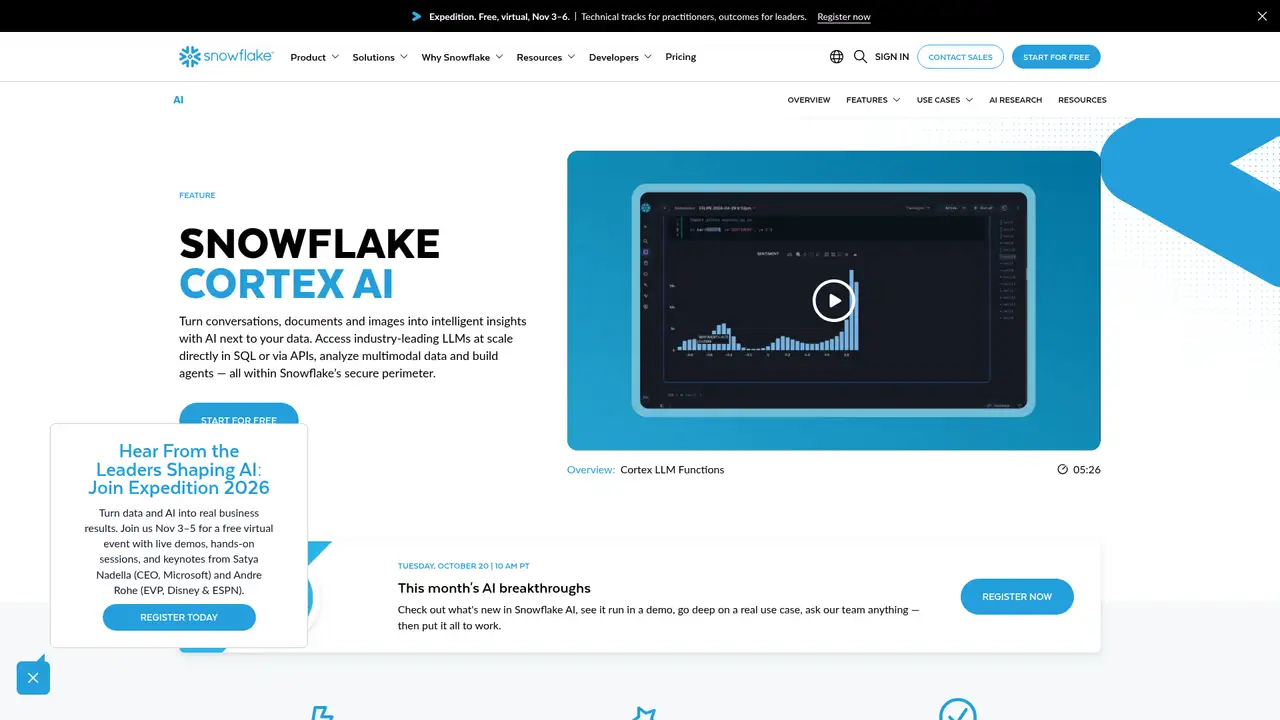
Snowflake Cortex AI is Snowflake's managed AI layer for analysts and developers building applications over enterprise data. Snowflake announced Cortex in 2023, with serverless functions, vector search, Llama 2 access, Document AI, Copilot, and Universal Search among the initial capabilities. The current service includes AI Functions, Cortex Agents, Cortex Search, Cortex Analyst, Cortex REST API, document parsing, embeddings, and fine-tuning. Snowflake says models run inside its service perimeter unless a customer elects otherwise, and customer data is not used to train models made available to customers. Cortex is a Snowflake capability rather than a standalone chatbot, making it most suitable for organizations that already store governed data in Snowflake. Its value depends heavily on existing Snowflake permissions, data models, and account administration.
A typical workflow begins with data and access controls already defined in Snowflake. An analyst can call AI Functions from SQL for completion, classification, extraction, translation, sentiment analysis, filtering, or summarization. A developer can call models through SQL, Python, or the Cortex REST API, add Cortex Search for hybrid and semantic retrieval, and expose an application or agent. Cortex Analyst converts business questions into SQL using semantic models. Cortex Agents can coordinate tools such as Analyst and Search. Generated SQL runs on a virtual warehouse, while agent costs accumulate across the services they call. Role-based access, usage views, regional controls, and Snowflake governance stay in the same environment. This reduces platform switching, although teams still need to design semantic models, permissions, prompts, retrieval content, and cost controls.
The model layer is a changing catalog rather than one Snowflake model. Snowflake's initial 2023 announcement named Llama 2 and Snowflake models, while current documentation describes hosted large language models and task-specific models through AI Functions and inference services. Snowflake's 2025 release records show public preview for Cortex AI Functions on June 2, general availability for AI Functions and AI_TRANSCRIBE in late 2025, Cortex Agents general availability on November 4, 2025, and Cortex CoWork general availability on the same day. Other 2025 additions included multimodal embeddings, AI_EXTRACT, AI_REDACT, document processing improvements, and Cortex Search features. Preview status, model identifiers, supported regions, and service behavior can change. Teams should confirm those details inside current account documentation before committing to a production design or model-specific workflow.
Cortex has no universal free or seat-based plan. AI features use AI Credits, separate from Platform Credits, and Snowflake says the AI price is independent of Standard, Enterprise, Business Critical, and VPS editions. Global routing costs $2.00 per AI Credit, while regional routing costs $2.20. Token-based services charge according to model and input or output tokens. Cortex Analyst's standalone API charges per 1,000 messages. Cortex Search adds serving compute per gigabyte-month and embedding work per token. Warehouses, storage, transfer, generated SQL, and other non-AI work continue to create Platform Credit charges. Annual-contract discounts may apply, but Snowflake does not publish a simple monthly Cortex allowance. Budgeting therefore requires expected tokens, retrieval volume, warehouse time, agent calls, storage, and regional routing.
The main limitation is operational complexity. Users must track two credit systems, warehouse execution, token volume, routing, retrieval indexing, and additive agent calls. Cortex is a closer fit than Databricks Mosaic AI when data already lives in Snowflake, while Databricks suits teams centered on Spark, lakehouse engineering, and model training. Google BigQuery ML and Vertex AI offer a comparable warehouse and model route for Google Cloud estates. Amazon Bedrock is broader as a model marketplace and API layer, but it lacks Snowflake's native SQL and warehouse governance. Cortex is also unsuitable for teams seeking local model weights or a flat monthly chatbot plan. Pick Snowflake Cortex AI for governed AI over Snowflake data and Snowflake administrators who should pick it.
Who is Snowflake Cortex AI best for?
- Snowflake teams adding governed language model functions to SQL pipelines.
- Analysts building natural-language access to warehouse data.
- Developers needing managed retrieval and agent tools near enterprise data.
- Organizations requiring Snowflake roles, regional routing, and auditability.
Snowflake Cortex AI Pricing (2026)
Pricing model: Usage-based. All prices in USD.
| Plan | Price | What you get |
|---|---|---|
| AI Credit, global routing | $2.00 per AI Credit | Consumption pricing for listed Cortex AI features when cross-region routing is global. Token and service rates vary by model or feature; there is no seat fee. |
| AI Credit, regional routing | $2.20 per AI Credit | Consumption pricing when inference is restricted to a region or home-region setting. Token and service rates vary by model or feature; there is no seat fee. |
| Snowflake platform editions | Custom | Standard, Enterprise, Business Critical, and VPS remain Snowflake account editions. Warehouses, storage, transfer, and other non-AI usage use Platform Credits and can add to Cortex costs. |
Pros and Cons
Pros
- AI Functions run beside governed Snowflake data through SQL and Python.
- Agents can combine Cortex Analyst, Search, and other Snowflake tools.
- Snowflake says customer data is not used to train customer-facing models.
- AI Credit pricing is separate from Snowflake edition pricing.
Cons
- Token, AI Credit, warehouse, and indexing charges require careful monitoring.
- Model and feature details vary by region, preview status, and account.
- The service is not self-hosted and has no simple flat monthly plan.
Who should look elsewhere?
- Teams wanting a simple consumer chatbot subscription.
- Companies without Snowflake data or budget for warehouse operations.
- Researchers needing unrestricted local model weights and GPU control.
Technical Details
Frequently Asked Questions
How much does Snowflake Cortex AI cost?
Cortex uses consumption pricing rather than one subscription. Snowflake's current documentation lists AI Credits at $2.00 each for global routing and $2.20 for regional routing. The effective bill also depends on the feature, model, tokens, retrieval indexing, and ordinary Snowflake work. Analyst-generated SQL uses warehouse compute, while non-AI services continue using Platform Credits.
Does Snowflake Cortex have a free plan?
Snowflake does not publish a separate free Cortex plan. A trial or existing Snowflake account may provide credits under its own commercial terms, but Cortex usage is measured as consumption. AI features use AI Credits, while warehouses, storage, and related platform services can create separate charges. The exact entitlement depends on the customer's Snowflake agreement.
How does Cortex compare with Databricks Mosaic AI?
Cortex is the more natural choice when governed data, SQL, semantic models, and applications already run in Snowflake. Databricks Mosaic AI suits lakehouse teams using Spark, model training, and MLflow-centered workflows. Both support model-serving and retrieval patterns, but their pricing and feature boundaries differ. The existing data platform is a practical deciding factor.
Does Snowflake train models on Cortex customer data?
Snowflake says it never uses Customer Data to train models made available to its customer base. It also says its AI models run inside the Snowflake service perimeter unless the customer elects otherwise. Customers still need to review feature-specific terms, routing choices, providers, retention settings, and permissions, especially when using external or elected model services.
Can companies use Cortex commercially and through an API?
Yes. Snowflake provides the Cortex REST API plus SQL and Python interfaces for commercial applications, subject to the customer's Snowflake agreement, service terms, model terms, and usage charges. The API does not make Cortex self-hosted. Inference remains a Snowflake-managed service, and customers pay for AI and related platform consumption.