
Same Review, Pricing & Alternatives (2026)
Build and deploy full stack web apps from prompts
Last updated: October 26, 2026
What is Same?
Same is a no-code builder for creating, revising, and deploying full stack web applications through natural language. It targets builders who want a Next.js workflow with browser editing, a terminal, integrations, and downloadable code. The Free plan costs $0 with 500,000 monthly tokens, while paid plans start at $10 per month.
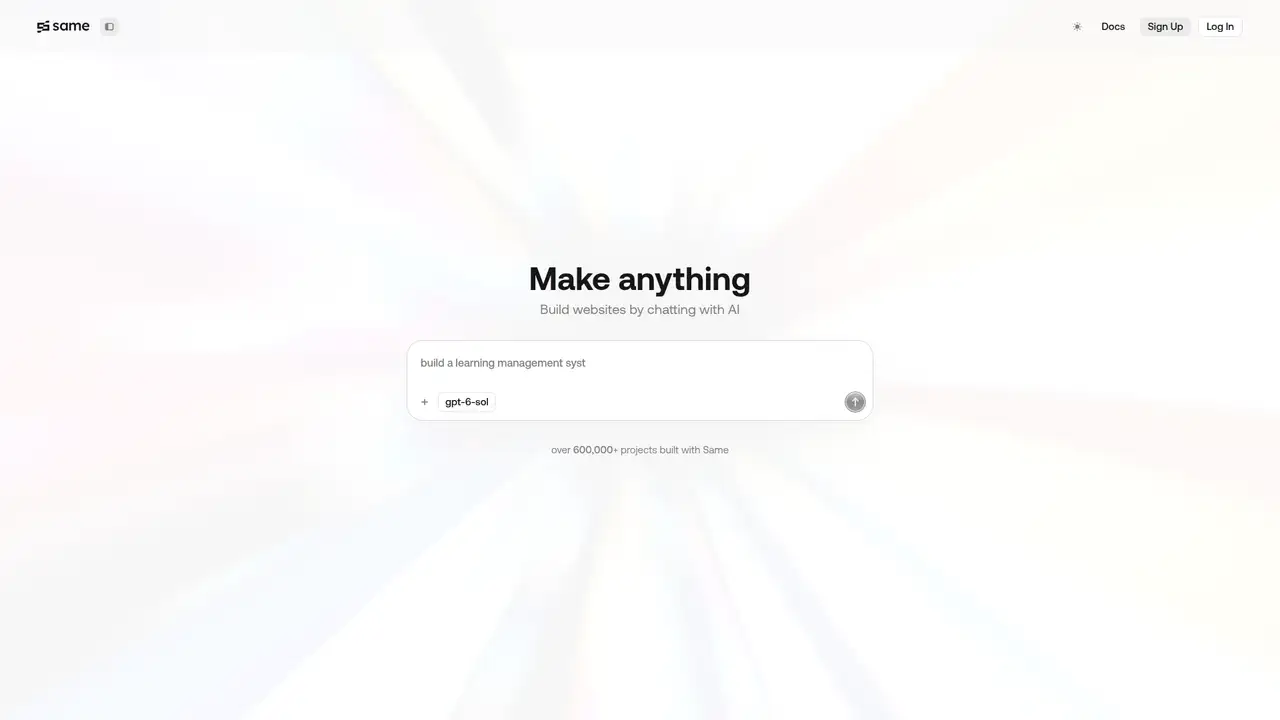
Same is a prompt-driven builder for full stack web applications from Million Software. The company says it launched in March 2025, with founders Aiden Bai, John Yang, and Nisarg Patel. Its careers page self-reports more than 350,000 signups and over $2 million in annual recurring revenue within eight weeks. Its introduction page reports more than 600,000 builders. Same combines visual site building with an AI coding workspace, producing applications instead of static page mockups. Generated projects use Next.js, React, API routes, and TypeScript or JavaScript. The company also identifies Million.js and React Scan as earlier projects from the team. Paid users can download generated project code and deploy it independently, but the hosted Same platform remains proprietary and is not self-hostable or open source.
A typical project starts with a natural language request, often including a URL that communicates an existing design. Same generates a Next.js application with a React front end, API routes, and TypeScript or JavaScript files. Users can continue prompting, inspect the file tree, edit code manually, and run commands in the browser terminal. The documented browser-terminal limitation is that terminal operations reset after a page refresh. Project history supports reverting earlier changes. GitHub integration can push repositories and track changes. Supabase, Neon, Clerk, and custom MCP servers can add data, authentication, and external functionality. Paid users can download a ZIP for local development, while GitHub supports repository-based work. The download makes generated code portable, but the hosted Same builder itself cannot be self-hosted.
Same’s current documentation identifies only a generic premium model, with no published provider, model name, context window, or per-model limits. It also contains no dated 2025 or 2026 release entry naming a model update. The concrete technical description concerns the application workflow. Same generates Next.js projects with React front ends, API routes, and TypeScript or JavaScript files. Users can inspect the file tree, edit files manually, run commands in a containerized browser terminal, and revert project history. GitHub, Supabase, Neon, Clerk, and custom MCP servers are supported integrations. Paid plans add ZIP downloads and remixing, while GitHub synchronization supports repository-based development. Downloadable code can be deployed independently, but the hosted Same builder remains proprietary and cannot be treated as open source.
Same charges by monthly token allowance, with Free including 500,000 tokens. Basic costs $10 per month for 2 million tokens, Pro costs $25 for 5 million, Max costs $50 for 10 million, and Ultra costs $100 for 20 million. Every prompt, URL or image context, and code-generation request consumes tokens. Usage beyond 20 million costs $10 per additional 2 million tokens, while enterprise pricing is custom. Unused tokens expire when the billing cycle ends or the subscription terminates. Upgrading resets the billing cycle and credits unused prior tokens; downgrades take effect in the next billing cycle. Cancellation preserves access through the paid period, then returns the account to Free. Paid plans include premium model access, project downloads, and remixing. New projects remain public by default.
Same is less suitable for teams requiring a documented model choice, a public builder API, persistent infrastructure administration, or private-by-default projects. New projects are public by default, although owners can make them private before sharing. Paid users can download a ZIP for local development, while GitHub synchronization supports repository-based work, but the hosted Same platform itself cannot be self-hosted. The integrated terminal runs in a container, and its operations reset after a page refresh. Compared with Rork, Rork supports iPhone, Android, and web output on paid plans, while Same targets Next.js web applications. Compared with Lovable, Same documents manual file editing and a browser terminal. Compared with Bolt.new, Same offers a similar browser coding workflow with its own token allowances and project controls. Pick Same for prompt-built Next.js applications, browser iteration, GitHub synchronization, and downloadable code.
Who is Same best for?
- People creating Next.js web applications from natural language.
- Developers who want browser editing with an integrated terminal.
- Teams connecting GitHub, Supabase, Neon, Clerk, or MCP servers.
- Paid users who need downloadable generated project files.
Same Pricing (2026)
Pricing model: Freemium. All prices in USD.
| Plan | Price | What you get |
|---|---|---|
| Free | $0 | 500,000 tokens monthly. |
| Basic | $10/month | 2 million tokens monthly, premium model, downloads, and remixing. |
| Pro | $25/month | 5 million tokens monthly, premium model, downloads, and remixing. |
| Max | $50/month | 10 million tokens monthly, premium model, downloads, and remixing. |
| Ultra | $100/month | 20 million tokens monthly, premium model, downloads, and remixing. |
| Over 20m | $10 per additional 2m tokens | Additional usage is billed per 2 million tokens; unused tokens expire at cycle end. |
| Enterprise | Custom | Custom pricing is available through sales. |
Pros and Cons
Pros
- The workflow covers prompting, editing, running, and deployment.
- Paid plans include downloads and project remixing.
- GitHub synchronization supports repository-based development.
- The Free plan includes 500,000 monthly tokens.
Cons
- New projects are public by default.
- Same does not document a general builder API.
- The premium model is not publicly identified.
Who should look elsewhere?
- Teams requiring a public Same-generation API.
- Organizations needing to self-host the Same platform.
- Projects requiring private-by-default visibility.
Technical Details
Frequently Asked Questions
How much does Same cost?
Same has a Free plan with 500,000 tokens monthly. Basic costs $10 monthly for 2 million tokens, Pro costs $25 for 5 million, Max costs $50 for 10 million, and Ultra costs $100 for 20 million. Usage above 20 million costs $10 per additional 2 million tokens. Enterprise pricing is custom.
Does Same have a free plan?
Yes. The Free plan costs $0 and includes 500,000 tokens monthly. Prompts, URL or image context, and code generation consume tokens. Paid plans add premium model access, project downloads, and remixing. New projects are public by default, although owners can make individual projects private.
How does Same compare with Rork?
Same focuses on prompt-driven web applications using a Next.js workflow. Paid Rork plans add Build mode and native iPhone and Android output, while Rork Free is design-only without build or publishing. Same provides browser file editing, a terminal, GitHub synchronization, and downloadable projects. Rork provides mobile previews, device testing, and publishing workflows.
Does Same train on user content?
Same’s terms grant Million Software a license to use submitted content to provide, maintain, improve, and train models. They state that proprietary code will not train models made available to other users or third parties without explicit consent. The terms also cover internal research. Confidential code therefore deserves careful review before submission.
Can Same projects be used commercially?
Same’s terms say users retain ownership of specific AI-generated outputs, subject to Same’s pre-existing intellectual property and underlying model rights. The terms do not clearly provide unrestricted commercial licensing or a broad non-infringement warranty. Paid users can download generated projects and deploy them independently, but commercial use should be reviewed against the applicable terms.
Best Same Alternatives in 2026
These tools do the same job as Same, with different pricing, limits and trade-offs.
Build web apps from natural-language prompts with hosting and backend tools
Prompt-driven web UI and application generation from Vercel

Prompt-built mobile and web apps with exportable native code
Turn text into working web apps in the browser.