
Profound Review, Pricing & Alternatives (2026)
AI visibility measurement and marketing automation for brands
Last updated: October 22, 2026
What is Profound?
Profound measures how brands appear in AI generated answers and connects those findings to research, content, and automated workflows. It serves marketing teams at startups, agencies, and larger companies. A free Trial is available, while the current pricing page presents Enterprise as Custom and help documentation lists self serve credit allowances without publishing a complete paid price table.
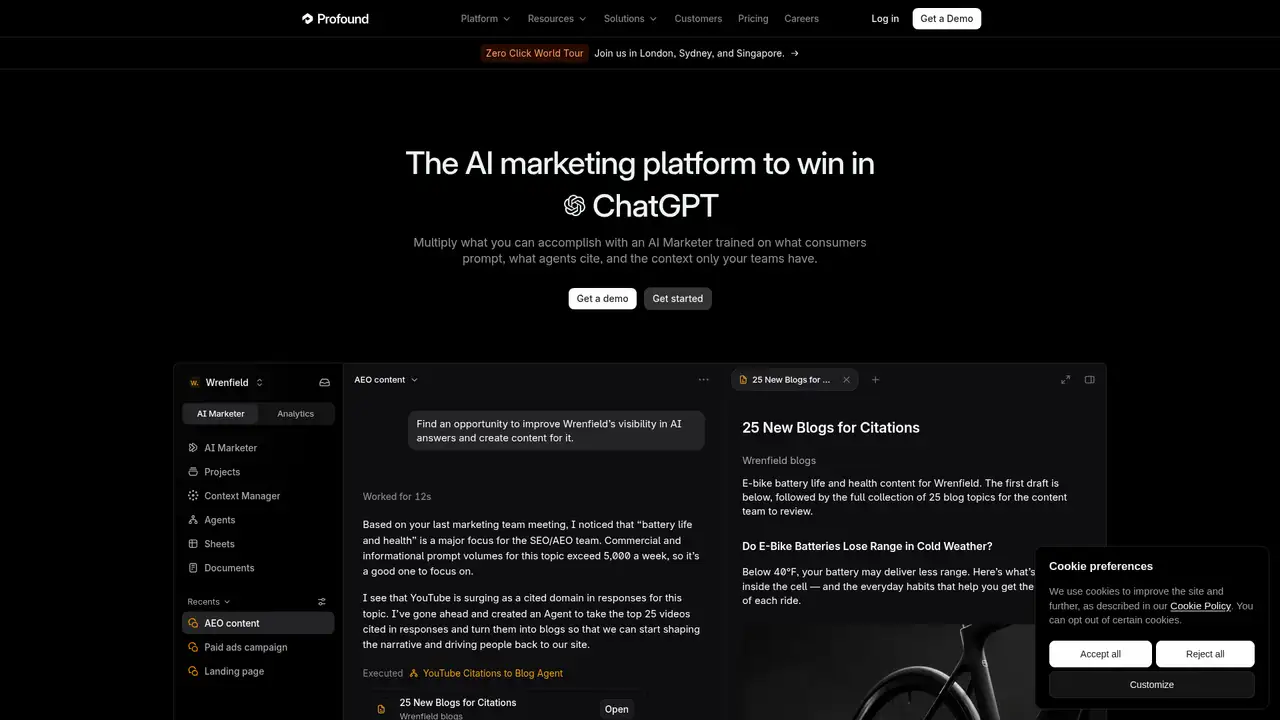
Profound is a marketing platform from Cooper Square Technologies Inc., doing business as Profound. It helps marketing teams study how AI platforms describe brands, products, and competitors, then use those findings in content and recurring workflows. Fortune described Profound as an 18 month old startup in February 2026, with fewer than 120 employees, more than 700 enterprise customers, and customers in 10% of the Fortune 500. The company announced a $96 million Series C at a $1 billion valuation, bringing total funding to $155 million. Profound says its enterprise platform analyzes more than 1 billion citations, 30 billion crawler visits, and 10 million prompts daily. Its current public pricing page presents Trial and Enterprise plans.
Profound combines Answer Engine Insights, Agent Analytics, AI Marketer, Agents, Context Manager, Suggestions, Projects, and Profound Sheets. A typical workflow starts with structured prompts across AI services, followed by analysis of brand mentions, citations, sentiment, rankings, competitors, and AI sourced traffic. Teams can use those findings in AI Marketer for research and writing, or build Agents for recurring tasks. Sheets runs Agents across rows in parallel for bulk research and content operations. Agents can connect with WordPress, Framer, Sanity, Payload, Contentful, Webflow, and Basehub. Other listed integrations include Akamai, AWS, Cloudflare, Fastly, Google Analytics, Google Cloud Platform, Netlify, Vercel, and WordPress. API access supports data retrieval and external workflow connections.
Profound uses third party AI services rather than identifying one exclusive proprietary model. Its Prompt LLM node supports models from Anthropic, OpenAI, and AWS Bedrock, according to the help center, while Search Perplexity supports search oriented workflows. In October 2025, Profound announced Starter and Growth plans, replacing Lite for new customers. In February 2026, the company announced Agents, which brings workflow orchestration into the product and connects automation to AI visibility data. Agents integrate with HubSpot, Google Workspace, Gamma, Parallel AI, and Vercel. The company says content generation uses secure enterprise tier API connections rather than public consumer chat applications. Model availability can change, and bringing personal API keys is not currently supported.
The current pricing page lists a free Trial and Custom Enterprise plan. Trial includes limited AI Marketer credits, 50 unique prompts run daily for seven days, one language, and tracking across ChatGPT, Gemini, and Google AI Overviews. The page does not publish a full dollar table for current paid self serve plans. Help documentation lists 100 Agent credits monthly for Starter, 400 for Growth, and 400 per month per client workspace for Agency Growth. Higher credit thresholds require Enterprise. Enterprise adds tailored prompt tracking, up to nine Answer Engines, dedicated support, SSO or SAML, SOC 2 compliance, unlimited seats, exports, and API access. Agent runs consume credits based on workflow complexity, and accounts can allow overage billing or pause usage.
The main weakness is pricing clarity because the current page identifies Trial and Enterprise while paid self serve allowances are documented elsewhere. Trial lasts seven days, uses a recommended prompt set, and does not allow prompt customization. AI answers and citations can change across services, so measurements require ongoing tracking. Semrush covers broader search marketing, while Ahrefs focuses on SEO research and rank tracking. BrightEdge is a closer enterprise comparison for AI visibility and search performance. Pick Profound if your marketing team needs AI answer measurement connected to content research, publishing workflows, and Agent automation.
Who is Profound best for?
- Marketing teams measuring brand visibility across AI answer platforms.
- Agencies running recurring AI visibility work for multiple client workspaces.
- Content teams connecting citation findings to research and publishing workflows.
- Enterprise teams requiring SSO, SOC 2 compliance, API access, and dedicated support.
Profound Pricing (2026)
Pricing model: Freemium. All prices in USD.
| Plan | Price | What you get |
|---|---|---|
| Trial | $0 | Limited AI Marketer credits, 50 unique prompts daily for 7 days, one language, and ChatGPT, Gemini, and Google AI Overviews tracking. |
| Enterprise | Custom | Includes tailored credits and prompt tracking, up to nine Answer Engines, dedicated support, SSO or SAML, SOC 2 compliance, API access, unlimited seats, and premium support. |
Pros and Cons
Pros
- Trial tracks 50 unique prompts daily across ChatGPT, Gemini, and Google AI Overviews.
- Agents connect visibility findings with research, writing, and publishing workflows.
- Sheets runs Agents across spreadsheet rows in parallel.
- Enterprise includes SSO or SAML, SOC 2 compliance, API access, and dedicated support.
Cons
- The current pricing page does not show a complete paid self serve price table.
- Trial lasts seven days and does not allow prompt customization.
- Agent credit use varies with workflow complexity and may require Enterprise thresholds.
Who should look elsewhere?
- Teams seeking a fully transparent, low cost monthly plan.
- Users needing a permanent free plan with customizable prompts.
- Small teams that only need traditional keyword rank tracking.
Technical Details
Frequently Asked Questions
How much does Profound cost?
Profound's current pricing page lists a free Trial and an Enterprise plan priced Custom. Trial includes 50 unique prompts daily for seven days. Help documentation lists 100 monthly Agent credits for Starter, 400 for Growth, and 400 per client workspace for Agency Growth, but it does not publish current dollar prices for those self serve plans. Higher credit thresholds require Enterprise.
Does Profound have a free plan?
Profound offers a free Trial rather than a permanently described free plan. Trial includes limited AI Marketer credits, 50 prompts daily for seven days, one language, and tracking across ChatGPT, Gemini, and Google AI Overviews. Users receive a recommended prompt set and cannot customize it. Ongoing daily tracking and broader configuration are included with Enterprise.
How does Profound compare with Semrush?
Profound focuses on AI generated answers, citations, sentiment, competitive presence, and AI sourced traffic, with Agents for connected marketing workflows. Semrush covers a broader set of SEO, paid search, content, and competitive marketing tasks. Profound fits teams prioritizing AI visibility operations, while Semrush fits teams that need wider traditional search marketing coverage.
Does Profound train AI models on user data?
Profound's agreement says it does not train artificial intelligence or machine learning models on Customer Data. The help center says data submitted to Prompt LLM and Search Perplexity nodes is contractually prohibited from being used by third party AI providers to train or improve their models. Customers should still review the DPA, subprocessors, and account configuration.
Can customers use Profound generated content commercially?
Profound assigns its rights, if any, in Agents Content to the customer. The supplemental terms state that generated content is provided without warranties, may not be unique, and must be reviewed for accuracy and suitability. Customers also accept indemnity obligations for certain third party claims connected to their use of Agents Content.
Best Profound Alternatives in 2026
These tools do the same job as Profound, with different pricing, limits and trade-offs.