
Paxton Review, Pricing & Alternatives (2026)
Legal research, drafting, and document analysis for attorneys
Last updated: October 26, 2026
What is Paxton?
Paxton is a legal AI assistant for attorneys and firms, combining cited United States legal research, drafting, and file analysis. Individual access costs $499 per user monthly or $2,999 per user annually, with a seven day trial. Enterprise customers receive firm wide access, onboarding, workflow support, and custom volume based pricing.
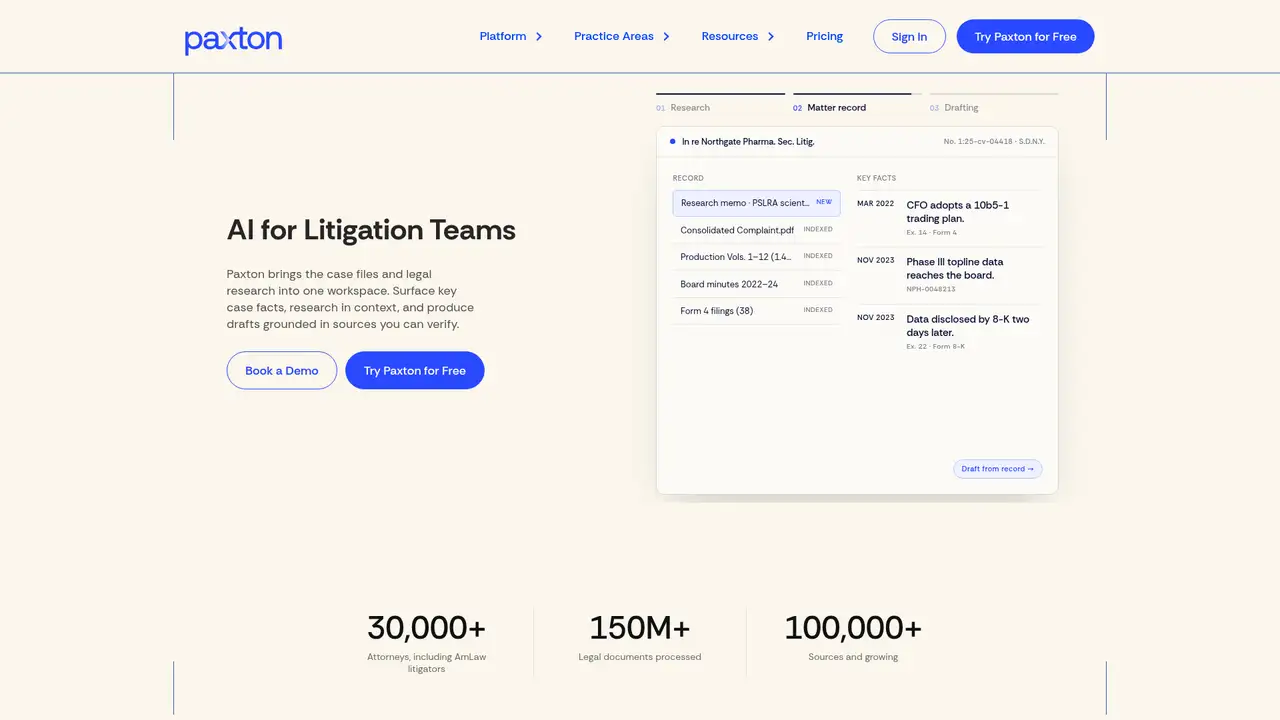
Paxton is a legal AI assistant for attorneys and law firms, with individual and enterprise offerings. The company publishes Individual pricing of $499 per user monthly or $2,999 per user annually, while Enterprise agreements use custom, volume based pricing. Its stated coverage includes United States federal and state laws, regulations, and appellate level and higher case law. Paxton announced a $6 million seed round in September 2023 and a $22 million Series A, bringing announced funding to $28 million. Its reviewed company pages do not publish a launch year or authoritative founding date. That omission makes the product’s age difficult to assess, although its current market position is clear: a general legal assistant built around research, drafting, and document work.
A typical Paxton workflow begins in Assistant, where a user can ask legal research questions and enable sources covering cases, statutes, and regulations. The service presents clickable authority citations, then supports drafting contracts, clauses, letters, pleadings, emails, and other legal work product. Its agentic drafting feature is described as planning, researching, and drafting instead of producing one unchecked response. Users can analyze files for summaries, legal insights, and recommendations, refine generated work in Canvas, and export results. The workflow therefore keeps research, writing, and document review in one product. Coverage remains focused on United States law, which should be the first qualification for firms considering adoption.
Paxton describes its technology as machine learning models combined with retrieval augmented generation and linked authority citations. The company does not name the foundation model vendors or versions behind the service. Releases in 2025 expanded document handling and matter work. Optical character recognition for scanned PDFs and image files arrived in August, followed by templates and one click skills later that month. Matter based organization and medical chronologies appeared in September, while integrated research and drafting connected two previously separate tasks. The OCR feature is described as producing extracted, searchable text and visual citations. These additions suggest a shift toward document heavy legal matters, although model transparency remains limited for buyers comparing technical architectures.
The Individual plan costs $499 per user per month or $2,999 per user per year, with the annual price advertised as a 50 percent saving against monthly billing. It includes the assistant, legal drafting, United States legal coverage, and file analysis. Paxton advertises a seven day free trial and month to month billing, with no long term commitment. Enterprise pricing is custom and volume based, and can include firm wide users, onboarding, workflow setup, collaboration, priority support, and an account manager. The reviewed pricing and FAQ pages do not publish message, token, file, or other usage quotas. Buyers should therefore treat the annual plan as a price saving, not as proof of unlimited usage.
Paxton’s main limits are its United States focus, undisclosed foundation models, and the absence of published customer API or self hosted deployment terms. Its privacy policy permits aggregated and de identified data to improve services, so the company does not make a blanket promise that customer material is never used for improvement. Harvey is a closer comparison for broad legal research and drafting, while Alexi emphasizes isolated firm environments, firm specific workflows, and integrations. LegalOn concentrates more heavily on contract review, playbooks, and in house contracting. Paxton fits attorneys who want a priced, general purpose United States legal assistant with citations, drafting, and file analysis.
Who is Paxton best for?
- Attorneys needing cited research across United States federal and state law.
- Small firms wanting one tool for drafting and file analysis.
- Users who prefer published individual pricing over a sales quote.
- Teams handling scanned PDFs and image heavy legal files.
Paxton Pricing (2026)
Pricing model: Paid. All prices in USD.
| Plan | Price | What you get |
|---|---|---|
| Individual monthly | $499/user/month | Individual access includes Paxton’s legal assistant, drafting, United States legal research coverage, and file analysis. A seven day free trial is advertised. |
| Individual annual | $2,999/user/year | The Individual features with an advertised 50 percent saving compared with monthly billing. A seven day free trial is advertised. |
| Enterprise | Custom | Firm wide users, onboarding, workflow setup, collaboration, priority support, and an account manager. Pricing is volume based. |
Pros and Cons
Pros
- Paxton combines research, drafting, and file analysis in one assistant.
- Retrieval augmented outputs include clickable citations to legal authorities.
- OCR supports scanned PDFs and image files.
- Annual Individual pricing is published clearly.
Cons
- The Individual monthly price is high for solo users.
- Paxton does not name its underlying foundation models.
- Public usage quotas and API terms are unavailable.
Who should look elsewhere?
- Firms needing published customer API or self hosted deployment terms.
- Teams working mainly outside United States law.
- Buyers seeking a low cost general purpose AI subscription.
Technical Details
Frequently Asked Questions
How much does Paxton cost?
Paxton’s Individual plan costs $499 per user per month or $2,999 per user per year. The annual option is advertised as a 50 percent saving compared with monthly billing. Enterprise pricing is custom and volume based. Paxton also advertises a seven day free trial and month to month billing for Individual customers.
Does Paxton have a free plan?
Paxton does not publish a permanent free plan. It advertises a seven day free trial for the Individual offering, which costs $499 per user monthly or $2,999 per user annually. Enterprise access uses custom volume based pricing. The reviewed pricing pages do not publish a free ongoing tier or public usage quota.
How does Paxton compare with Harvey?
Paxton and Harvey both address legal research and drafting. Paxton publishes Individual pricing, United States legal coverage, clickable authority citations, file analysis, and OCR. Paxton does not name its underlying models or publish customer API terms. Paxton identifies Harvey as a competitor, but its pages do not provide a standardized feature, price, or performance comparison.
Does Paxton train on user data?
Paxton’s terms say customers retain ownership of their data and grant Paxton a limited operational license. Its privacy policy includes customer data, outputs, prompts, chats, embeddings, indexes, and content bearing logs. Paxton may use aggregated and de identified data to improve services when customers and individuals are not identified. The company makes no blanket no training promise.
Can Paxton be used for commercial legal work?
Paxton markets its Individual plan to attorneys and offers Enterprise features for firm wide access, onboarding, workflow setup, collaboration, priority support, and account management. Its terms retain customer ownership while permitting operational processing needed to provide and maintain the service. Legal professionals remain responsible for reviewing probabilistic outputs before client use.
Best Paxton Alternatives in 2026
These tools do the same job as Paxton, with different pricing, limits and trade-offs.

Legal AI workspaces for firms and in-house teams.

Authoritative legal research, drafting, and analysis with agentic AI

A research-grounded AI assistant for legal work

Enterprise legal research, drafting, and analysis in a private environment

AI contract review and legal operations for in-house teams