
OpenEvidence Review, Pricing & Alternatives (2026)
Cited clinical answers for verified clinicians.
Last updated: October 26, 2026
What is OpenEvidence?
OpenEvidence is a clinician-only medical search and evidence synthesis service for verified US healthcare professionals. It provides citation-backed answers, model choices for different research depths, and clinical documentation features. Its core clinician access is $0, subject to verification and regional eligibility. Health systems can seek institutional access, while advertising, clinical limitations, and professional review remain important considerations.
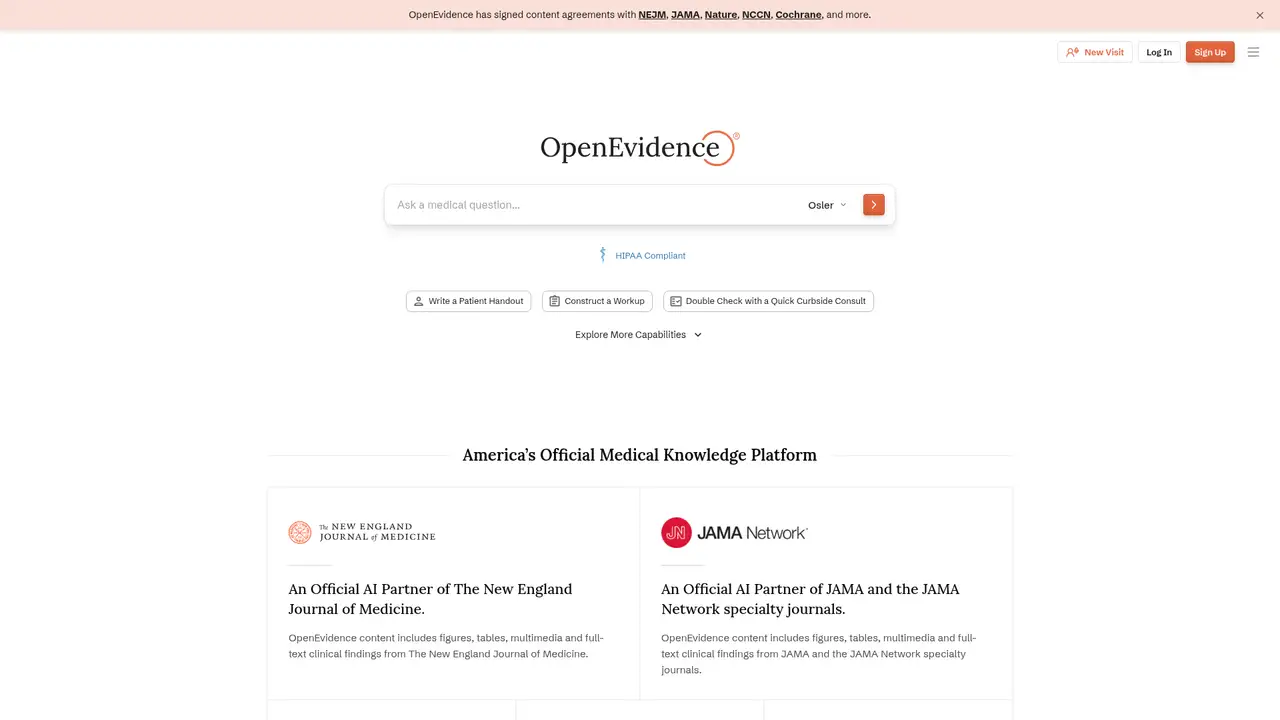
OpenEvidence is a medical search and clinical intelligence company founded in 2022 by Daniel Nadler and Zachary Ziegler, according to independent reporting. The company says its founders are Harvard and MIT trained PhDs. It began as a conversational answer service for verified clinicians and expanded into clinical documentation and deeper medical research. CNBC reported a $250 million January 2026 financing led by Thrive Capital and DST Global at a $12 billion valuation, with total funding near $700 million. Company announcements reported a $210 million 2025 round at a $3.5 billion valuation. OpenEvidence reports use across more than 10,000 hospitals and medical centers, although those scale figures come from the company. This positioning makes the service primarily relevant to professional care settings, rather than general consumer search. Its identity controls and clinician focus also shape who can use it and how organizations may evaluate adoption.
The workflow begins with a natural language clinical question and returns an answer with inline citations, evidence strength indicators, and source links. OpenEvidence offers Osler for direct answers in seconds, Sackett for more extensive responses and clarification, and Snow for comprehensive reports that can take five minutes or more. Verified clinicians can use the models without a fee and choose among them in the interface. Visits adds encounter transcription, evidence-backed assessment and plan drafting, templates, and questions over documentation. The service is designed for clinical evidence work rather than unrestricted public searching or unsupervised medical decisions. In practice, a user can begin with a focused lookup, request greater depth when uncertainty warrants it, then use documentation tools to connect evidence review with an encounter record. Professional review remains necessary before acting on any output.
OpenEvidence's models search and synthesize medical literature while presenting citation-backed responses. Osler prioritizes speed for point-of-care lookups, Sackett surveys evidence more thoroughly, and Snow conducts a longer investigation for difficult differentials, competing comorbidities, treatment planning, or unsettled literature. Snow is the successor to Deep Consult, so Deep Consult should not be treated as a separate current model. Darwin is the most advanced model, according to the company, and is available only through an application-based research preview for institutional partners, research collaborators, and academic researchers. The platform also includes mobile access, voice interaction, CME features, and Visits for documentation, extending the system beyond literature answers. These options divide use by research depth: Osler fits immediate reference needs, Sackett supports broader review, and Snow suits questions requiring a more sustained report. Darwin serves a restricted evaluation audience rather than ordinary clinician access.
The model guide lists Osler, Sackett, and Snow at $0 for verified clinicians, with unlimited use. Visits is advertised as free for verified US healthcare professionals, while Snow has replaced Deep Consult in the current model family. Enterprise institutional access is offered at no cost to eligible US health systems and provider organizations, with SSO, governance, EHR launch where supported, agreements, and support. Darwin has no published subscription price and is available by application only through a research preview. No paid clinician subscription or public enterprise rate is listed. Annual billing does not apply to the published $0 clinician access. The practical value of this structure is low individual cost, although eligibility and organizational requirements determine access. Health systems should clarify agreement terms, supported launch options, governance responsibilities, and the scope of institutional support before deployment.
OpenEvidence suits practicing US clinicians who need fast, source-linked answers and organizations seeking no-fee access with identity controls. UpToDate Expert AI provides a more established subscription reference environment, while Doximity Ask focuses on clinician-oriented questions and ChatGPT Health offers a broader health assistant format. OpenEvidence is strongest for concise evidence checks and deeper literature reports, but it remains unsuitable for patients seeking personal advice and cannot replace clinical judgment. Verification, advertising, regional eligibility, and mixed independent evaluations matter. Pick OpenEvidence when cited medical answers, model depth choices, and $0 verified-clinician access matter most. It may be a practical fit for clinicians who want different research depths without an individual subscription, or for health systems assessing controlled access. Patients and casual users should choose services intended for their needs, while professionals should verify citations and review outputs before clinical use.
Who is OpenEvidence best for?
- US clinicians checking medical evidence during care.
- Health systems seeking $0 clinician access.
- Clinicians needing citation-backed medical answers.
- Researchers benchmarking medical AI models.
OpenEvidence Pricing (2026)
Pricing model: Free. All prices in USD.
| Plan | Price | What you get |
|---|---|---|
| Verified clinician | $0 | Verified clinician access; Osler, Sackett, and Snow have unlimited usage. |
| Enterprise | $0, eligibility based | Eligible US health systems and provider organizations; SSO, governance, EHR launch where supported, agreements, and support. |
| Darwin preview | Custom | Application-only research preview for institutional partners, research collaborators, and accredited academic researchers; price not published. |
Pros and Cons
Pros
- Answers include medical source citations.
- Verified clinician access costs $0.
- Models support different research depths.
- Institutional controls support health-system deployment.
Cons
- Healthcare professional verification is required.
- Advertising creates potential conflict concerns.
- Independent benchmark results are mixed.
Who should look elsewhere?
- Patients seeking personal medical advice.
- Users needing an unrestricted public database.
- Users wanting answers without clinical review.
Technical Details
Frequently Asked Questions
How much does OpenEvidence cost?
OpenEvidence advertises its core service at $0 for verified US clinicians. Osler, Sackett, and Snow have unlimited usage without a fee. Enterprise access is advertised at $0 for eligible health systems and provider organizations. Darwin is an application-only research preview with no published price. Eligibility, verification, regional rules, and organizational arrangements still apply.
Is OpenEvidence free?
Yes, for verified clinicians within the stated eligibility rules. Osler, Sackett, and Snow are available at $0 with unlimited usage. Deep Consult and Visits have been advertised as free for verified US healthcare professionals, while Snow is now the successor to Deep Consult. Users should check citations and apply professional judgment.
What is its closest competitor?
UpToDate Expert AI is the closest named competitor for clinical reference and decision support. Doximity Ask is another clinician-focused alternative, while ChatGPT Health is broader. UpToDate may suit organizations wanting an established subscription reference. OpenEvidence suits verified clinicians prioritizing citation-backed answers, multiple research depths, and $0 individual access.
How does it handle privacy?
OpenEvidence states that its platform is HIPAA compliant and offers enterprise data protection, agreements, identity controls, and governance features. Visits processes encounter documentation and patient context, so organizations should examine agreements, retention terms, access controls, and local policy before use. HIPAA compliance does not remove an organization's responsibility for configuration and clinical data handling.
Can businesses use it commercially?
Eligible US health systems and provider organizations can seek enterprise deployment with institutional access, SSO, governance controls, agreements, support, and EHR launch where supported. Darwin is available by application to institutional partners, research collaborators, and academic researchers. OpenEvidence does not offer general commercial access to unrelated businesses. Advertising is separate from enterprise eligibility.
Best OpenEvidence Alternatives in 2026
These tools do the same job as OpenEvidence, with different pricing, limits and trade-offs.