
OpenAI Agents Platform Review, Pricing & Alternatives (2026)
Code-first and managed runtimes for multi-step AI agents
Last updated: October 22, 2026
What is OpenAI Agents Platform?
OpenAI Agents Platform combines the managed Agents API, open-source Agents SDK, Responses API, built-in tools, and ChatKit for multi-step applications. The SDK has no subscription charge, while model tokens, tool calls, storage, and containers are billed separately. Current standard pricing includes gpt-5-nano at $0.05 per million input tokens and $0.40 per million output tokens.
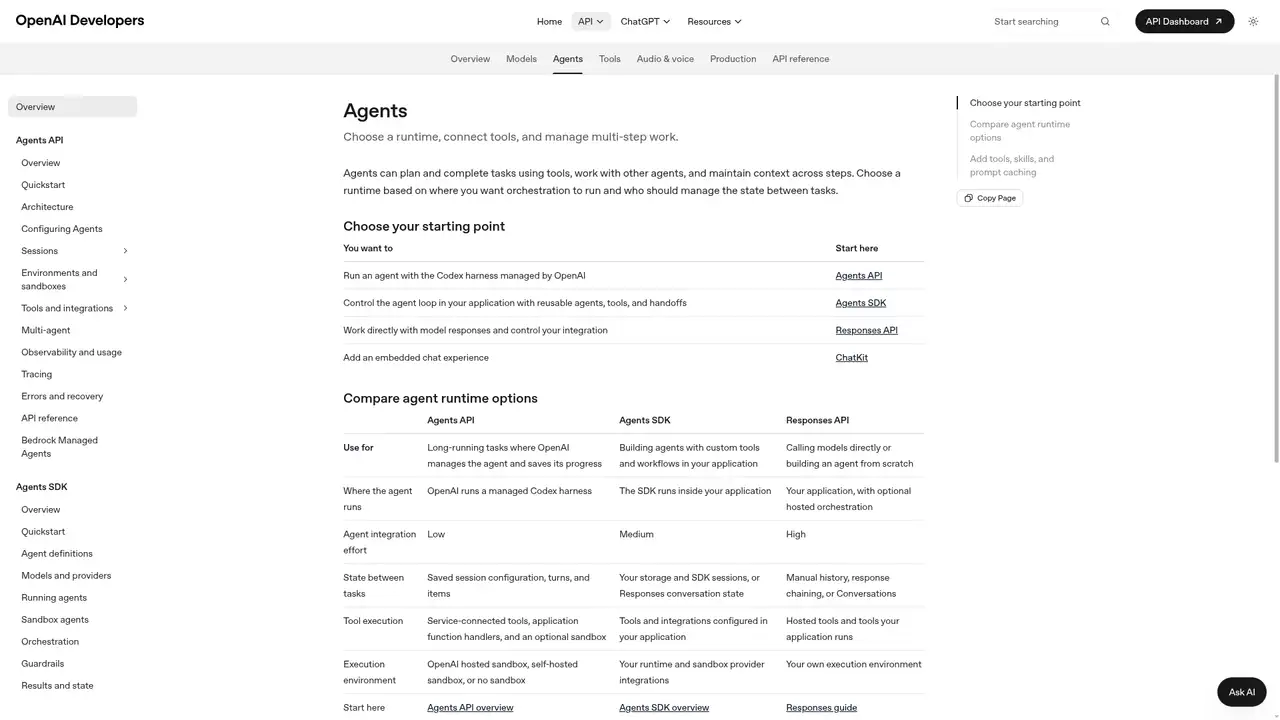
OpenAI Agents Platform is a group of agent-building runtimes and tools from OpenAI. The documentation separates the managed Agents API, the code-first Agents SDK, the lower-level Responses API, and ChatKit for embedded chat. OpenAI released the Responses API and Agents SDK on March 11, 2025, then introduced AgentKit on October 6, 2025. The Agents SDK is open source and supports Python, with current documentation also describing TypeScript and JavaScript usage. The Agents API runs a Codex runtime managed by OpenAI. The platform targets developers and enterprises building customer support, research, code, sales, and other multi-step applications. OpenAI does not publish a separate subscription price or separate privacy terms for the Agents SDK or Responses API. Model and tool consumption remains separately billable.
A typical SDK workflow begins with an agent containing instructions, tools, guardrails, and optional handoffs. The runner manages turns and tool execution, while agents can delegate work through handoffs or agents used as tools. Function tools expose application code, and MCP support connects remote tool servers. Sessions preserve working context, while human-in-the-loop mechanisms can pause execution for review. The Agents API instead stores session configuration, turns, and items while OpenAI runs the Codex runtime. It supports automatic context compaction, multi-agent orchestration, programmatic tool calling, MCP servers, and hosted or self-hosted sandboxes. Responses API users retain more control over history, response chaining, tool dispatch, and execution. These choices let teams select managed execution or application-controlled orchestration.
The platform is built around OpenAI model APIs, with the Agents SDK using the Responses API by default for OpenAI models. The SDK documentation also describes use with providers that expose compatible Chat Completions-style endpoints. Documented capabilities include web search, file search, computer use, hosted shell, Code Interpreter, MCP tools, tracing, sessions, guardrails, and realtime or voice agents. OpenAI released the first Responses API and Agents SDK building blocks in March 2025 and introduced AgentKit in October 2025. OpenAI announced on June 3, 2026 that Agent Builder and Evals will no longer be available on its platform after November 30, 2026. The company recommends the Agents SDK for workflows that should continue as code.
OpenAI charges model usage by tokens rather than adding separate fees for the Responses, Chat Completions, Realtime, Batch, or Assistants APIs. Current standard examples include gpt-5-nano at $0.05 per million input tokens and $0.40 per million output tokens, gpt-5-mini at $0.25 and $2.00, and gpt-4.1 at $2.00 and $8.00. Web search costs $10 per 1,000 calls plus search content tokens at model rates, while non-reasoning preview search costs $25 per 1,000 calls with free search content tokens. File search storage costs $0.10 per gigabyte per day after 1 GB free, and calls cost $2.50 per 1,000. Hosted containers cost $0.03 for 1 GB, $0.12 for 4 GB, $0.48 for 16 GB, or $1.92 for 64 GB per 20-minute session.
The principal limitation is accounting across model tokens, tools, storage, containers, and persisted state. The Agents API is managed, while the SDK runs inside the customer's application and does not provide a self-hosted OpenAI model service. OpenAI states that API inputs and outputs are not used for training by default, although abuse-monitoring logs and application state can have separate retention rules. OpenAI documents default abuse-monitoring retention of up to 30 days and says some stored resources remain until deleted. The SDK can connect to compatible model providers through Chat Completions-style endpoints, but built-in OpenAI services remain OpenAI offerings. Choose this platform for OpenAI-native runtimes and tools, while teams needing another provider's control plane should compare other agent frameworks.
Who is OpenAI Agents Platform best for?
- Teams building OpenAI-native multi-step agents with tools and handoffs.
- Developers needing a Python or TypeScript orchestration framework.
- Applications requiring OpenAI hosted search, containers, or Code Interpreter.
- Products needing traces, guardrails, sessions, or MCP connections.
OpenAI Agents Platform Pricing (2026)
Pricing model: Usage-based. All prices in USD.
| Plan | Price | What you get |
|---|---|---|
| Agents SDK | Free framework | The SDK has no listed subscription charge, but model, tool, tracing, storage, and infrastructure usage can incur separate charges. |
| Agents API | Usage-based | OpenAI runs the managed Codex runtime, while model tokens, tools, containers, and applicable storage are billed separately. |
| Responses API | Usage-based | OpenAI does not charge a separate API fee, but tokens and selected tools use their published rates. |
| Standard model pricing | From $0.05 per 1M input tokens | The listed gpt-5-nano rate is $0.05 per million input tokens and $0.40 per million output tokens. |
| Web search | $10 per 1,000 calls | Search content tokens are billed at model rates, while non-reasoning preview search costs $25 per 1,000 calls with free search content tokens. |
| File search | $0.10 per GB-day | The first 1 GB of storage is free, and file-search calls cost $2.50 per 1,000 calls. |
| Hosted containers | From $0.03 per session | Pricing is $0.03 for 1 GB, $0.12 for 4 GB, $0.48 for 16 GB, or $1.92 for 64 GB per 20-minute session. |
| ChatKit storage | $0.10 per GB-day | ChatKit file and image uploads include 1 GB free per account per month, with daily storage charges afterward. |
Pros and Cons
Pros
- The Agents SDK provides agents, handoffs, guardrails, sessions, tracing, and MCP support.
- The Agents API manages Codex-based orchestration, state, compaction, and sandbox execution.
- OpenAI publishes separate prices for models, search, file search, containers, and storage.
- The SDK supports application-controlled orchestration and compatible Chat Completions providers.
Cons
- Costs can span model tokens, tool calls, storage, containers, and persisted application state.
- The SDK is application code, while OpenAI hosted model services remain external dependencies.
- Agent Builder and Evals have an announced November 30, 2026 discontinuation date.
Who should look elsewhere?
- Organizations requiring a fully self-hosted OpenAI model and control plane.
- Teams seeking one predictable subscription covering model and tool usage.
- Workflows depending on Agent Builder or Evals after November 30, 2026.
Technical Details
Frequently Asked Questions
How much does OpenAI Agents Platform cost?
OpenAI does not list a separate subscription price for the Agents SDK or Responses API. Usage is billed through selected models and optional services. Standard gpt-5-nano pricing starts at $0.05 per million input tokens and $0.40 per million output tokens. Web search, file search, containers, and ChatKit storage have separate published charges.
Is there a free plan for OpenAI Agents Platform?
The Agents SDK is an open-source framework with no listed subscription fee, but OpenAI models and hosted tools can create usage charges. OpenAI lists 1 GB of free file-search storage and 1 GB of free ChatKit upload storage per account per month. OpenAI does not publish a general free model-usage allowance.
How does OpenAI Agents compare with LangSmith?
OpenAI provides managed and code-first runtimes centered on its model APIs, built-in tools, MCP, guardrails, and sandboxes. LangSmith is a separate agent development and operations product. LangSmith does not publish current pricing or complete feature coverage here, so teams should verify those details directly before making a purchasing comparison.
Does OpenAI train on agent inputs and outputs?
OpenAI says API inputs and outputs are not used to train or improve its models by default unless an organization explicitly opts in. API abuse-monitoring logs may be retained for up to 30 days by default. Some agent resources retain application state until deleted, and qualifying organizations can request modified abuse monitoring or zero-data-retention controls.
Can I use OpenAI Agents commercially?
The documented Agents SDK is an open-source framework, and OpenAI provides API access for application development. Commercial deployment still depends on applicable OpenAI API terms, usage policies, model availability, and billing. The SDK itself does not remove model charges, tool charges, storage charges, or other obligations associated with the OpenAI services used.
Best OpenAI Agents Platform Alternatives in 2026
These tools do the same job as OpenAI Agents Platform, with different pricing, limits and trade-offs.