
Nim Review, Pricing & Alternatives (2026)
Generate images and videos from multiple AI models in one workspace
Last updated: October 22, 2026
What is Nim?
Nim is a browser-based AI creation workspace for images, videos, stories, sound, lip sync, upscaling, and related edits. It combines multiple named models with templates and credit-based billing. A September 2026 pricing comparison lists Starter at $17 monthly, Pro at $30, Max at $75, and Team at $200, with lower annual equivalents. Nim also offers an official MCP integration, but NVIDIA does not document a general public REST API for it.
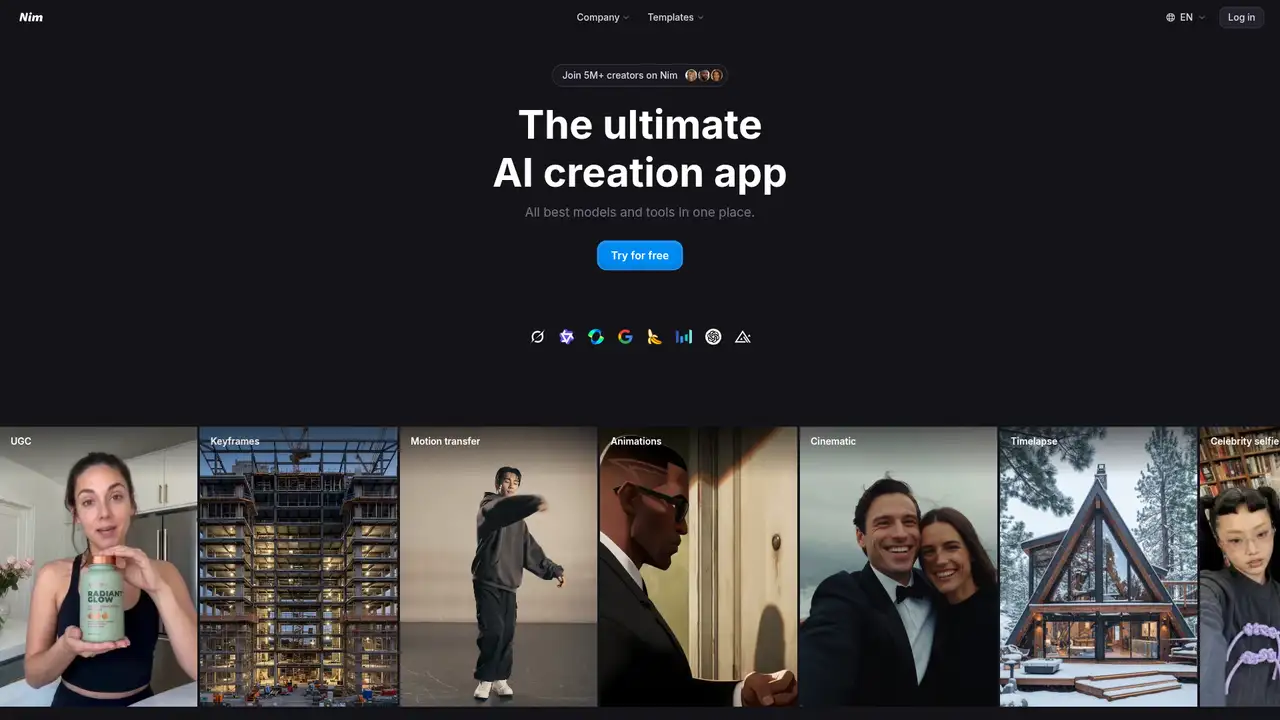
Nim is a browser-based AI creation workspace from Nim AI Inc., founded by Yury Lifshits. The company says Nim entered alpha on February 7, 2024, launched publicly in January 2025, and raised more than $5 million. It combines image and video generation with templates, chat assistance, sound generation, lip sync, upscaling, keyframes, and other media tools. Its listed models include Nano Banana, Seedream, Veo, Kling, Seedance, Sora, Grok, Wan, LTX, Hailuo, Flux, Z-Image, Ideogram, HeyGen, and ElevenLabs. Nim targets creators, marketers, and teams that want multiple media models in one browser workspace. Users spend credits according to the selected model or tool, rather than paying one fixed price for each video.
Nim supports text-to-image, text-to-video, image-to-video, image editing, templates, story creation, sound generation, lip sync, keyframes, upscaling, and prompt creation from uploaded images. Each model and tool has its own credit cost, shown beside the tool name, and credits are deducted when generation begins. Failed generations generally receive refunds. Templates cover ecommerce, architecture and design, AI influencers, business, photoshoots, viral content, and personal projects. Pro and Max include chat assistance. Team adds shared projects, collaboration, seats, common billing, and usage tracking. Nim Stories is described as a one-click agent for TikTok-sized videos. The official MCP integration connects Nim’s creative tools with Claude and related agent workflows.
Nim operates as an orchestration layer around multiple third-party and internally integrated generation services, rather than as one disclosed foundation model. Its current list includes Veo, Kling, Seedance, Hailuo, Wan, LTX, and Grok, alongside image, avatar, and audio services. A January 30, 2025 launch announcement highlighted Kling, Minimax, Flux Pro, Hunyuan Turbo, MMAudio, subject reference, and character reference workflows. Nim later introduced Nim Stories, a one-click agent for TikTok-sized videos, although the cited page does not specify the year. Nim publishes an MCP integration, but no general public REST API has been established. Its roadmap discusses access to open-source and commercial models through one application. Sora was retired in April 2026, with its web and app access ending in September 2024, and no current plans are stated.
Nim uses subscriptions and credit packs, with no unlimited plan. The Free plan includes 200 credits monthly. A September 2026 pricing comparison lists Starter at $17 monthly or $14 with annual billing, Pro at $30 or $20 annually, Max at $75 or $40 annually, and Team at $200 or $160 annually. Starter includes 1,700 credits, while Pro, Max, and Team include 4,500, 12,000, and 30,000 shared credits. Subscription credits expire at the end of each billing cycle, and credit-pack credits expire after six months. A $5 welcome offer provides 2,000 credits and full Pro features for three days before renewal at $30 monthly unless canceled. Costs vary by model and tool.
Nim suits creators, marketers, and teams seeking several generation models, templates, and media tools inside one account. Its credit system can make budgeting difficult, and the service does not publish one fixed price per video. Starter adds a watermark, limits simultaneous tasks, excludes private projects and 4K output, and restricts use to personal and social-media projects. Pro, Max, and Team include commercial use, private projects, and higher production limits. Kling AI offers a dedicated Kling product with web and API offerings, while Veo is a named model within Nim. Runway and Luma are other alternatives. Users wanting one specialist model or a documented public REST API may prefer Kling AI. Nim is best for creators and teams comparing models in one workspace.
Who is Nim best for?
- Creators comparing several image and video models from one browser workspace.
- Marketers producing social, ecommerce, and short-form video assets.
- Teams needing shared projects, seats, billing, and usage tracking.
- Users wanting Nim workflows through the official MCP integration.
Nim Pricing (2026)
Pricing model: Freemium. All prices in USD.
| Plan | Price | What you get |
|---|---|---|
| Free | $0/month | Includes 200 credits monthly. Nim does not publish a complete feature list for this tier. |
| Starter | $17/month or $14/month annually | Includes 1,700 credits, up to 170 videos or 850 images, templates, three simultaneous tasks, watermark output, no 4K, no private projects, and personal or social-media use. |
| Pro | $30/month or $20/month annually | Includes 4,500 credits, up to 450 videos or 2,250 images, 4K output, no watermark, private projects, six simultaneous tasks, commercial use, and chat assistance. |
| Max | $75/month or $40/month annually | Includes 12,000 credits, up to 1,200 videos or 6,000 images, 4K discounts, no watermark, private projects, unlimited simultaneous tasks, commercial use, priority queueing, and five daily Nano Banana Pro generations. |
| Team | $200/month or $160/month annually | Includes 30,000 shared credits, ten seats, private and shared projects, collaboration tools, commercial use, priority support, usage tracking, common billing, and chat assistance. |
| Welcome pack | $5 for three days | Provides 2,000 credits and full Pro features for three days. It automatically renews at $30 monthly unless canceled. |
Pros and Cons
Pros
- Nim puts numerous named image, video, avatar, and audio models behind one interface.
- The product includes templates for ecommerce, design, influencers, and social content.
- Pro, Max, and Team include commercial use and remove Starter’s watermark.
- Failed generations generally refund the credits deducted from the account.
Cons
- Credit costs vary by model and tool, making per-video budgeting difficult.
- Subscription credits expire at the end of each billing cycle.
- Lower tiers restrict privacy, concurrency, resolution, watermarking, or commercial use.
Who should look elsewhere?
- Users needing unlimited generation with predictable output costs.
- Teams requiring a documented general-purpose REST API and API pricing.
- Projects requiring commercial rights on Free or Starter plans.
Technical Details
Frequently Asked Questions
How much does Nim cost?
Nim has a Free plan with 200 monthly credits. A September 2026 pricing comparison lists Starter at $17 monthly, Pro at $30, Max at $75, and Team at $200. Annual billing lists $14, $20, $40, and $160 monthly equivalents. Nim also offers a $5 three-day welcome offer that renews to Pro at $30 monthly unless canceled.
Does Nim have a free plan?
Yes. Nim’s pricing page lists a Free plan with 200 credits monthly. The page does not publish a complete feature list for that tier. Subscription credits expire at the end of each billing cycle, while credit-pack credits expire after six months. Nim also offers a $5 welcome pack with 2,000 credits and full Pro features for three days.
How does Nim compare with Kling AI?
Nim is a multi-model workspace that lists Kling alongside Veo, Seedance, image systems, audio tools, and avatar products. Kling AI is a dedicated service centered on Kling video models and publishes web and API offerings. Nim suits users wanting model variety in one account, while Kling suits users seeking direct Kling workflows, releases, and developer documentation.
Does Nim train on user content?
Nim’s terms grant the company a broad license to use uploaded content to operate and improve its services. The terms state that Nim may use content to train, enhance, or improve models when a plan lacks a training opt-out. The privacy policy also states that personal information may pass through providers outside the United States. Users should review their plan before uploading sensitive material.
Can Nim outputs be used commercially?
Commercial use is explicitly included with Pro, Max, and Team. Starter is limited to personal and social-media use, and Nim does not grant blanket commercial rights to Free users. Users must hold the necessary rights to their inputs, and third-party model terms may affect output rights. Nim’s terms also prohibit illegal content, reverse engineering, and competitive use.
Best Nim Alternatives in 2026
These tools do the same job as Nim, with different pricing, limits and trade-offs.