
MLC LLM Review, Pricing & Alternatives (2026)
Compile open models for fast local inference across desktop, web, and phones
Last updated: October 26, 2026
What is MLC LLM?
MLC LLM is an Apache-2.0 open-source compiler and runtime from the MLC AI project for deploying language models on CPUs, GPUs, browsers, iOS, and Android. It targets developers shipping local inference rather than users seeking a hosted chatbot. The software is free, while model weights and their licenses vary.
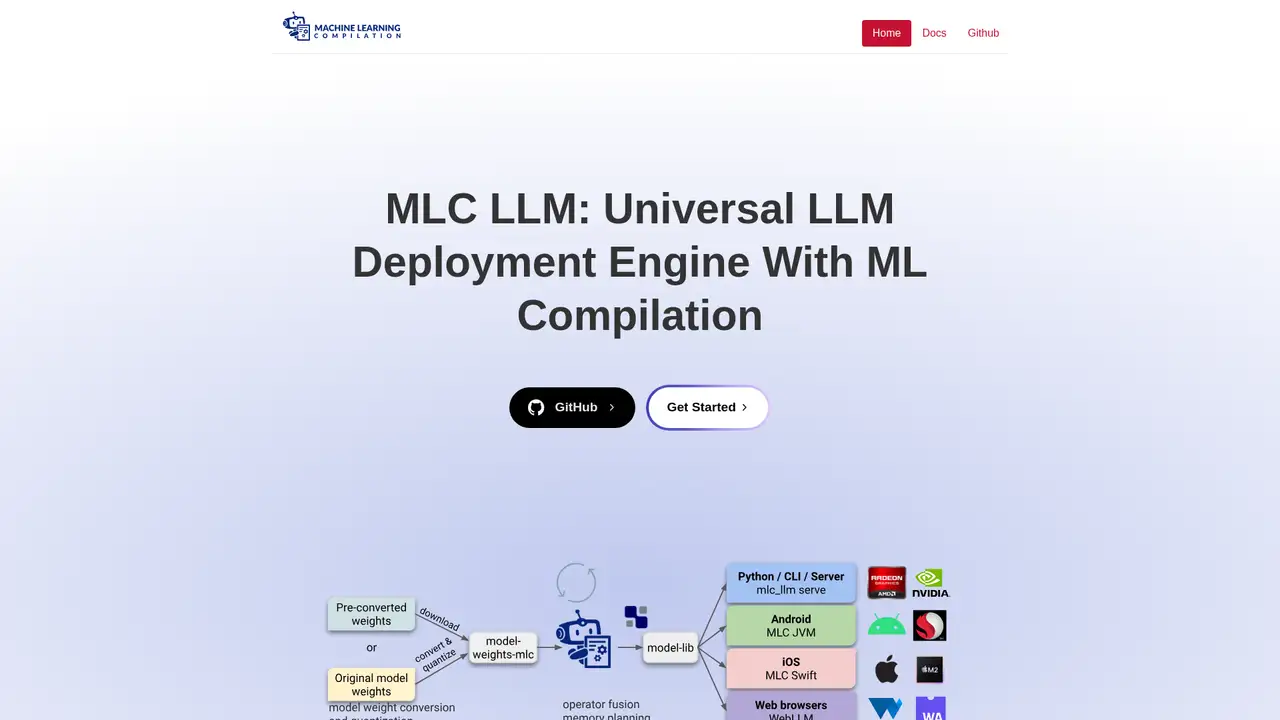
MLC LLM is an Apache-2.0 open-source machine-learning compiler and runtime maintained by the MLC AI project and associated with the Apache TVM community. Its public repository was created in 2023, and it provides a universal deployment solution rather than a hosted chatbot or cloud API. Developers can use its command-line chat client, Python engine, local REST server, or native iOS, Android, and browser integrations. Compilation targets include CUDA, Vulkan, Metal, WebGPU, and WebAssembly, with model libraries specialized for target devices. The software is free, but hardware, storage, downloads, engineering time, platform toolchains, and upstream model licenses remain separate costs. MLC LLM runs inference on controlled hardware, while REST exposes that local engine to network clients.
A typical workflow begins with a compatible model from Hugging Face or a local directory. Developers convert weights when necessary, generate an MLC chat configuration, choose quantization and a conversation template, then use just-in-time compilation or build a device-specific model library. The same runtime supports a command-line chat client, Python engine, local REST server, and native browser or mobile integrations. Targets include CUDA, Vulkan, Metal, WebGPU, iOS, and Android. Browser deployment can use WebGPU or WebAssembly, while mobile applications require compiled libraries, model assets, and platform toolchains such as Xcode. Costs include hardware, storage, downloads, drivers, SDKs, and engineering time. Model licenses remain separate from the Apache-2.0 runtime. MLC LLM suits developers who need compiled local inference across web, mobile, and native backends.
MLC LLM uses Apache TVM and machine-learning compilation to specialize kernels for target hardware, supporting CUDA, Vulkan, Metal, WebGPU, iOS, and Android. Its documentation describes a shared runtime across backends, with model libraries such as.so,.dylib,.dll,.wasm, or mobile archives. Developers can deploy through a command-line client, Python engine, local REST server, browser integration, or native mobile application. Public release tags include v0.19.0 from February 11, 2025 and v0.20.0 from July 7, 2026. The free MLC Chat iOS app and Android demo demonstrate local inference, not an MLC cloud API. Independent mobile studies evaluated MLC LLM alongside llama.cpp, reporting that quantization enables practical on-device execution while creating memory, accuracy, thermal, and battery tradeoffs.
The software is free and open source under Apache-2.0, with no hosted entry plan, usage meter, or published per-token price. Expenses instead include compatible hardware, storage, bandwidth for downloading model files, and engineering time. Its Python engine and REST server run on infrastructure the developer controls, so a local endpoint is not a vendor-hosted API. Model licensing remains separate: commercial terms, attribution, acceptable-use rules, and redistribution permissions come from each model’s upstream license. Quantization and compilation do not grant rights to third-party weights. Teams should also account for platform toolchains, such as Xcode and Metal for iOS, plus suitable GPU drivers or SDKs elsewhere.
MLC LLM covers more deployment targets than llama.cpp, while WebLLM is more focused on JavaScript applications in browsers. Ollama is often easier for desktop developers because it packages model management with a local server, whereas MLC LLM emphasizes cross-compiling one runtime for iOS and Android as well as desktop and web backends. Its tradeoffs include model conversion, compilation, platform-specific toolchains, and hardware-dependent debugging. Android acceleration requires a physical GPU device rather than an emulator. The runtime is free under Apache-2.0, but model weights retain their separate licenses, and developers remain responsible for hardware, storage, downloads, and build work. Choose MLC LLM if you need local inference across web, mobile, and native backends, and have the engineering capacity to manage the model pipeline.
Who is MLC LLM best for?
- Developers shipping private inference in native mobile apps.
- Teams targeting WebGPU, Vulkan, Metal, CUDA, or Android GPUs.
- Engineers needing a local Python or REST serving interface.
- Projects able to compile and validate model libraries per device.
MLC LLM Pricing (2026)
Pricing model: Free. All prices in USD.
| Plan | Price | What you get |
|---|---|---|
| Open-source runtime | $0 | No hosted quota or support tier is published; hardware, model files, and upstream model licenses remain separate. |
Pros and Cons
Pros
- One runtime targets desktop, browser, iOS, and Android backends.
- Compilation can specialize kernels for the target device.
- Local CLI, Python, and REST interfaces are documented.
- The code is available under the Apache-2.0 license.
Cons
- Model conversion and compilation add substantial setup work.
- Performance and compatibility depend on hardware and backend drivers.
- The runtime does not license third-party model weights.
Who should look elsewhere?
- Users wanting a turnkey hosted chatbot.
- Teams unwilling to manage model licenses and build toolchains.
- Applications requiring a vendor-managed, metered API.
Technical Details
Frequently Asked Questions
Is MLC LLM free?
Yes. The runtime and source code are available at no software charge under Apache-2.0. That does not make every model free for commercial use. Developers must check each model's upstream license, and they still pay for compatible hardware, storage, downloads, and engineering work.
Does MLC LLM provide a cloud API?
No hosted vendor API or token price is published. Its Python engine and REST server run the model on infrastructure you control. A REST endpoint can serve other clients over a network, but that is self-hosted inference rather than MLC operating a cloud service.
MLC LLM or llama.cpp?
llama.cpp is often the simpler route for broadly distributed GGUF desktop tooling. MLC LLM is suited to teams needing compiler-generated libraries and a common deployment approach across WebGPU, iOS, Android, Vulkan, Metal, and CUDA. The choice depends on target hardware and tolerance for build work.
Does MLC LLM send prompts for training?
The local runtime does not require prompts to be sent to an MLC cloud service. A developer can run the engine locally or expose a local REST endpoint. Network behavior can still come from the application, model download, telemetry added by an integrator, or a remote model service, so the final app must be audited separately.
Can MLC LLM models be used commercially?
The runtime's Apache-2.0 license permits commercial software subject to its terms. Model weights are separate. Llama, Qwen, Gemma, and other upstream models can impose different attribution, redistribution, acceptable-use, or commercial conditions; compiling a model with MLC LLM does not change those conditions.
Best MLC LLM Alternatives in 2026
These tools do the same job as MLC LLM, with different pricing, limits and trade-offs.