
Manus Review, Pricing & Alternatives (2026)
A cloud agent for research, software, documents, and automations
Last updated: October 22, 2026
What is Manus?
Manus is a general-purpose AI agent from Butterfly Effect that works in a cloud computer and returns reports, slides, websites, code, and other project outputs. It suits individuals, creators, developers, and teams handling multi-step work. The free tier costs $0 per month, while Pro starts at $20 per month with annual billing discounted by 17%.
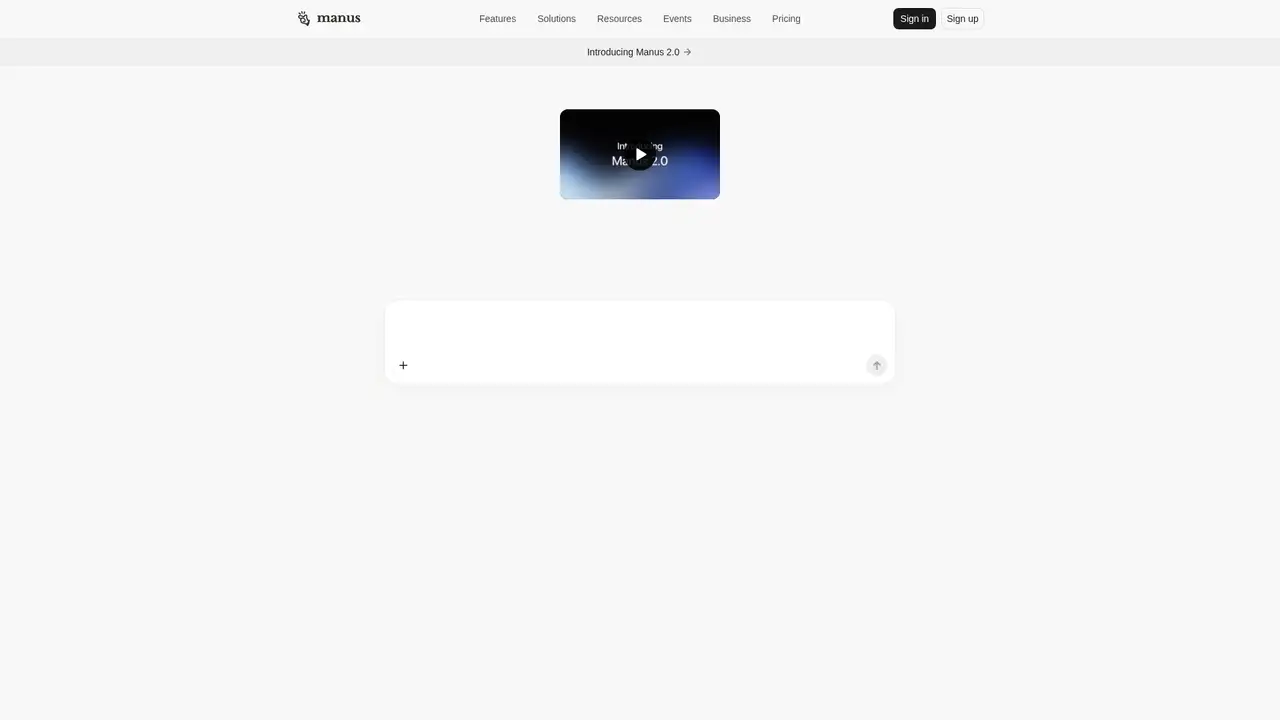
Manus is a general AI agent made by Butterfly Effect Pte. Ltd., the Singapore company behind the service. Butterfly Effect was founded in Beijing in 2022 by Xiao Hong, Yichao Ji, and Tao Zhang, then moved its headquarters and core team to Singapore in mid-2025. Manus reportedly had millions of users and more than $100 million in annual recurring revenue by December 2025. Meta announced an approximately $2 billion acquisition that month, but China ordered the transaction unwound on April 27, 2026. Manus formally resumed independent operations on September 1, 2026, with its founding team continuing to lead the company. A September 2026 report said Manus was discussing a $500 million fundraise at a $4 billion valuation, although that financing was not presented as completed.
Manus turns a natural-language goal into a multi-step task that runs in a cloud computer. A typical project can include web research, browser actions, file uploads, document creation, spreadsheet work, slide generation, website building, code, or deployment. Projects group related work, while connectors bring outside services into tasks. Scheduled Automations can run on a schedule, and the 2.0 release adds triggers for events such as new email, advertising changes, calendar events, Slack messages, or Notion updates. Manus Studio organizes documents, spreadsheets, PDFs, slides, websites, code, games, and video work. Its API creates and manages tasks, sends follow-up messages, uploads files, receives webhooks, and supports built-in or custom skills.
Manus 2.0, released on September 28, 2026, introduces the Cascade agent architecture, Cloud Computer environments, Automations, Manus Studio, Video Editor, and Game Dev. Manus says Cascade selects specialized capabilities as a project requires them. In one company test configuration, the company reported 23.2% lower token use, 28.2% faster completion, and 32% lower cost than its previous system. Manus does not require one named model for every task. Manus Flex lets customers connect a supported inference provider through their own API key. The provider bills model inference directly, while Manus credits continue covering other task services and infrastructure. Manus 2.0 is available on the web, desktop, and mobile.
The Free tier costs $0 per month and includes Chat Mode, Manus 2.0 Lite in Agent Mode, 300 daily refresh credits, one concurrent task, and two Scheduled Automations. Pro starts at $20 per month for 4,000 monthly credits, rises to $40 for 8,000 credits, and reaches $200 for 40,000 credits. Annual billing saves 17%, producing effective monthly prices of about $16.60, $33.20, and $166 when paid annually. Team pricing is listed at $20 per seat monthly in the help center and $49.99 per active user monthly on its pricing page, so buyers should confirm checkout pricing. Team adds SSO, training opt-out, usage analytics, internal access control, and shared slide templates. Enterprise pricing is custom.
Manus has a broad task surface, but its credit pricing makes the cost of a finished task difficult to predict. Credits do not roll over, and different projects consume different amounts. ChatGPT is closer to a conversational assistant and model-access product, while Manus centers on delegated tasks that return files, sites, or reports. Claude emphasizes chat, writing, and coding workflows. Replit focuses more narrowly on software projects and repository-style development, while Manus covers research, documents, slides, media, and applications. The privacy policy permits processing user content to deliver and improve services, and Team includes a training opt-out. Pick Manus if you want one workspace for varied, multi-step deliverables and accept credit-based billing.
Who is Manus best for?
- Researchers who need reports assembled from multi-step web work.
- Creators building websites, presentations, videos, or games from prompts.
- Teams needing shared projects, access controls, and usage analytics.
- Developers automating Manus tasks through an API.
Manus Pricing (2026)
Pricing model: Freemium. All prices in USD.
| Plan | Price | What you get |
|---|---|---|
| Free | $0/month | Includes Chat Mode, Manus 2.0 Lite in Agent Mode, 300 daily refresh credits, 1 concurrent task, and 2 Scheduled Automations. |
| Pro | $20/month | Includes 4,000 monthly credits, Manus 2.0 Max, Manus 2.0, Manus 2.0 Lite, 20 concurrent tasks, and 20 Scheduled Automations. Annual billing saves 17%. |
| Pro | $40/month | Includes 8,000 monthly credits and the Pro feature set, with 20 concurrent tasks and 20 Scheduled Automations. Annual billing saves 17%. |
| Pro | $200/month | Includes 40,000 monthly credits and the Pro feature set. Annual billing saves 17%, and unused monthly credits do not roll over. |
| Team | $20/seat/month | The help center lists $20 per seat monthly and adds SSO, training opt-out, usage analytics, internal access control, and shared slide templates. Annual billing saves 17%. |
| Enterprise | Custom | Enterprise pricing is handled through sales. Published plan information identifies enterprise controls but no standard price or fixed allowance. |
Pros and Cons
Pros
- It combines research, documents, slides, websites, code, media, and automations.
- The API supports tasks, follow-ups, file attachments, webhooks, and custom skills.
- Team includes SSO, training opt-out, analytics, and internal access controls.
- Manus Flex supports customer-managed inference provider keys.
Cons
- Credit consumption varies by task and unused credits do not roll over.
- The help center and pricing page show different Team entry prices.
- The privacy policy permits user-content processing for service improvement and research.
Who should look elsewhere?
- Buyers who need predictable per-task pricing.
- Teams requiring a published enterprise price and allowance.
- Users seeking an open-source or self-hosted agent.
Technical Details
Frequently Asked Questions
How much does Manus cost?
Manus has a free tier, while Pro starts at $20 per month for 4,000 monthly credits. Higher Pro levels cost $40 for 8,000 credits and $200 for 40,000 credits. The help center lists Team at $20 per seat monthly, while the pricing page lists $49.99 per active user monthly. Annual paid plans receive a 17% discount.
Does Manus have a free plan?
Yes. The Free plan costs $0 per month and includes Chat Mode, Manus 2.0 Lite in Agent Mode, 300 daily refresh credits, one concurrent task, and two Scheduled Automations. It supports basic individual use. Access to Manus 2.0 and Manus 2.0 Max in Agent Mode requires a paid Pro plan.
How does Manus compare with ChatGPT?
ChatGPT is primarily a conversational assistant with model and feature access inside OpenAI products. Manus is organized around delegated tasks that run in a cloud computer and return reports, slides, websites, code, spreadsheets, and other outputs. Manus also includes Projects, Automations, connectors, and an agent API. The better fit depends on the work you want delegated.
Does Manus train on user data?
Manus's privacy policy says it processes user content and communication content to provide, improve, and develop its services, including research and innovation. The Team plan includes a data-training opt-out. The policy also says Manus does not sell or share personal information for targeted advertising, while allowing necessary sharing with service providers and during corporate transactions.
Can I use Manus commercially?
Manus offers website deployment, slide generation, research, automation, API access, and Team features that support business use. Commercial rights for each generated asset, model output, connector, and media type depend on applicable terms and third-party services. Buyers should review the current terms before distributing client work or selling generated products.
Best Manus Alternatives in 2026
These tools do the same job as Manus, with different pricing, limits and trade-offs.
General-purpose AI assistance for writing, research, coding, and work
Long-context AI assistant for writing, research, and code
A hosted workspace for building, deploying, and sharing software with AI
Build web apps from natural-language prompts with hosting and backend tools