
Luminance Review, Pricing & Alternatives (2026)
Enterprise contract intelligence for legal and business teams
Last updated: October 22, 2026
What is Luminance?
Luminance is an enterprise contract intelligence platform for drafting, review, negotiation, repository management, and compliance. Founded in 2015 and launched in 2016, it serves legal and business teams handling large agreement portfolios. Current company figures report 1,000+ enterprises, 70+ countries, and 220 million+ legally verified documents. Pricing is quote-based, with no published self-serve plan.
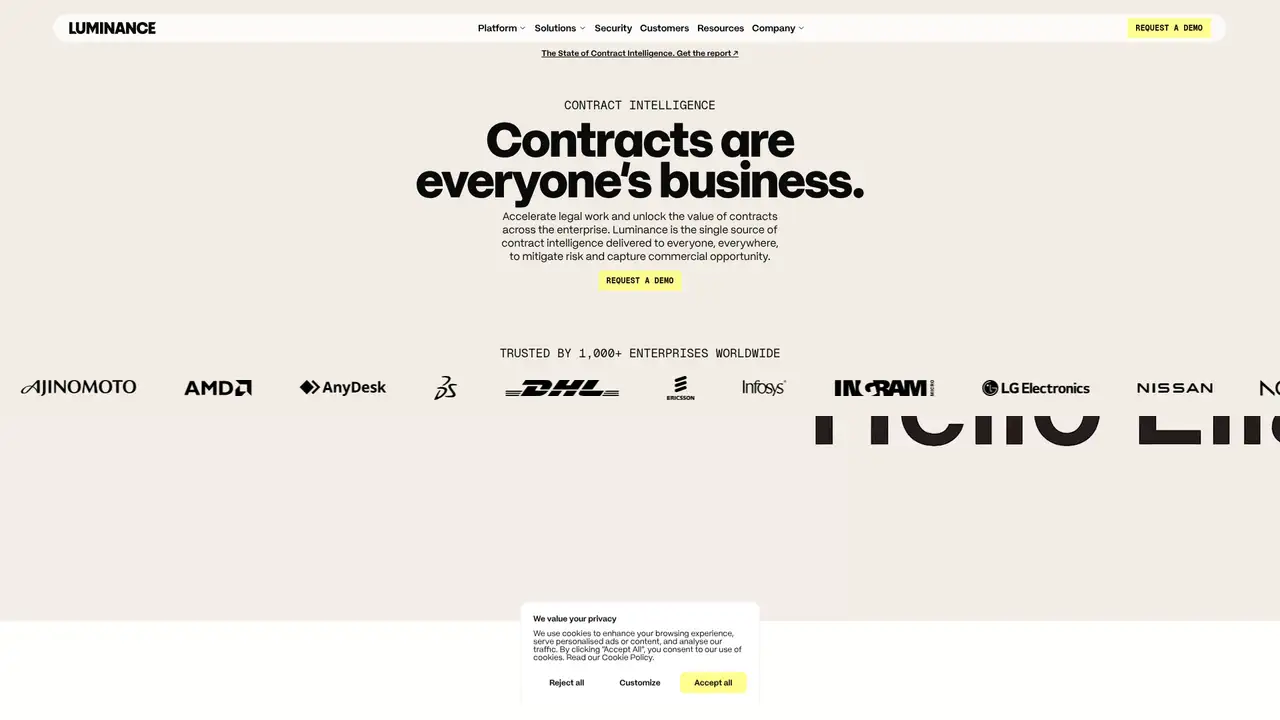
Luminance is a Cambridge-born legal technology company founded in 2015 and launched commercially in 2016. Its platform applies specialist artificial intelligence to contracts and related legal work for enterprise legal departments, law firms, procurement teams, sales groups, finance functions, and compliance staff. The company’s About page reports more than 1,000 enterprise customers across over 70 countries and more than 220 million legally verified documents informing its AI. Its February 2025 funding announcement reported a $75 million Series C led by Point72 Private Investments, bringing total funding to $165 million. Luminance is designed for organisations managing substantial agreement portfolios, rather than consumers seeking an inexpensive general legal chatbot or casual question answering service.
A typical workflow begins when users import agreements from local files or connected repositories. The Repository helps teams organise documents, search across clauses, extract structured terms, identify risks, and examine obligations. Negotiation compares proposed language with an organisation’s preferred positions, supports redlining, and records relevant context. Other workflows address drafting, post-execution monitoring, compliance, investigation, and collaboration. Luminance also markets Lumi, specialist agents, and Lumi Go, which allows a customer to send a draft agreement to a counterparty for AI-assisted negotiation. The platform supports work beyond Legal by presenting contractual information to procurement, sales, finance, and executive teams. Human review remains necessary for legal judgments, business decisions, approvals, and final contract execution.
Luminance combines specialist legal models with models from outside providers through a multi-model architecture. Its model-opinionated approach evaluates models for each task and selects according to accuracy, followed by speed, reliability, and cost, rather than requiring every customer to choose a model. The company says its legal pre-trained transformer was trained on more than 150 million verified legal documents. Its 2026 technology material describes more than 30 models and reasoning settings tested head-to-head, plus five validation stages before production. The platform includes a document search engine, AI orchestration, specialist agents, and differential validation. Luminance announced general availability in AWS Marketplace in October 2025. Customers should still review provider terms, retention settings, access controls, and output review procedures.
Pricing is negotiated enterprise software pricing rather than a public monthly plan. Luminance’s master agreement states that fees are specified in each Product Order Form, so no public dollar entry price is available. The 2025 hosted terms describe subscription allowances based on total documents held, with a fair-use ceiling of 200 percent of those allowances for documents uploaded during a term. The company’s model-selection material says customers are not charged by model usage, distinguishing the service from token-priced application programming interfaces. Prospective buyers should request a quote and confirm document allowances, users, modules, hosting region, support, renewal terms, implementation services, security controls, and evaluation conditions. A quoted total may differ substantially by scope and contract duration.
Luminance’s enterprise focus, negotiated procurement, and dependence on contract context make it a poor fit for casual legal questions or teams requiring transparent self-serve pricing. CoCounsel and Lexis+ with Protégé are broader comparisons for legal research, analysis, drafting, and question answering connected to large legal information services. Legora is a closer workspace competitor for law firms and in-house legal teams seeking integrated drafting, research, collaboration, and agent workflows. Luminance is strongest when the central problem is a large corporate contract portfolio spanning review, negotiation, repository analysis, and obligations. Choose it when governance, portfolio intelligence, and controlled model selection matter more than a public price, an open developer platform, or a general legal research assistant.
Who is Luminance best for?
- In-house legal teams managing large contract portfolios.
- Procurement and sales teams that need controlled agreement workflows.
- Enterprises requiring dedicated tenant isolation and regional hosting.
- Organisations seeking multi-model legal AI without choosing models themselves.
Luminance Pricing (2026)
Pricing model: Paid. All prices in USD.
| Plan | Price | What you get |
|---|---|---|
| Enterprise platform | Custom | Fees, modules, document allowances, term, and support are set in a Product Order Form. Luminance does not publish a free tier or public usage rate. |
Pros and Cons
Pros
- It covers drafting, negotiation, repository analysis, and post-execution monitoring in one platform.
- Its model-opinionated architecture assigns models to tasks instead of exposing model choice to every user.
- Dedicated customer instances and regional AWS hosting support enterprise data controls.
- The company reports more than 1,000 enterprise customers across over 70 countries.
Cons
- Luminance publishes no public price, free plan, or standard usage rate.
- The platform is designed for enterprise procurement rather than casual or individual use.
- The public product material does not document a self-serve API or customer-managed deployment option.
Who should look elsewhere?
- Individuals seeking a free legal chatbot.
- Teams that require transparent self-serve pricing.
- Developers seeking a documented public API product.
Technical Details
Frequently Asked Questions
How much does Luminance cost?
Luminance does not publish a standard price, monthly plan, or per-document rate. Its master agreement says fees are stated in the Product Order Form negotiated with each customer. Buyers should request a quote and confirm document allowances, modules, users, hosting, support, renewal terms, implementation services, and evaluation conditions before comparing total costs with other legal AI platforms.
Does Luminance have a free plan?
No public free tier is listed. Luminance sells an enterprise platform through a quote-based process, and its legal terms describe evaluations and commercial orders governed by a Product Order Form. A prospective customer can ask about an evaluation, but the company does not publish a free self-serve plan or guarantee a trial allowance.
How does Luminance compare with CoCounsel?
Luminance centres on enterprise contract intelligence, including repository analysis, negotiation, drafting, and obligations. CoCounsel is a broader legal work assistant associated with Thomson Reuters and is especially relevant for research, analysis, drafting, and litigation tasks. Luminance is the closer choice when contract portfolio operations are primary; CoCounsel is broader for general legal knowledge work.
Does Luminance train models on customer data?
Luminance’s data processing terms say personal data is processed to provide the product and support, subject to customer instructions and applicable law. Its security material describes isolated customer instances, encryption, access controls, and customer-controlled deletion. The reviewed public documents do not state that customer documents train general-purpose provider models, so buyers should confirm model-provider terms contractually.
Can customers use Luminance commercially, and is it open source?
Luminance is proprietary commercial software, not an open-source package. Customers obtain rights through an order and the master agreement, which governs fees, term, access, and use. The public product is sold as a hosted enterprise service, and no public self-serve API or self-hosting license is documented. Commercial deployment therefore requires a contract with Luminance.
Best Luminance Alternatives in 2026
These tools do the same job as Luminance, with different pricing, limits and trade-offs.