
Lexica Review, Pricing & Alternatives (2026)
Search proven prompts, then generate images with Lexica Aperture.
Last updated: October 26, 2026
What is Lexica?
Lexica combines a searchable gallery of AI images and prompts with its Aperture image generator. It suits artists, designers, marketers, and prompt learners who want visual references before generating. Paid access starts at $8 per month when billed annually, while commercial rights and privacy depend on the selected plan and team size.
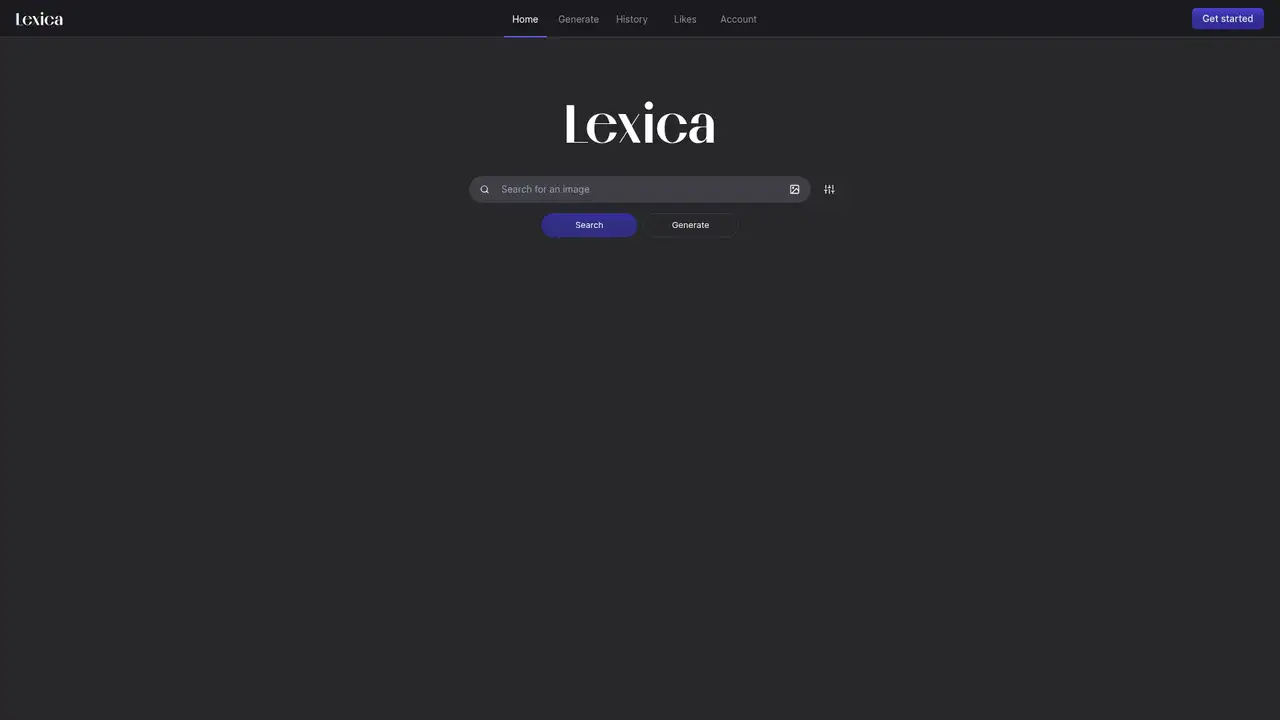
Lexica launched in August 2022 as a search engine for Stable Diffusion images and prompts. Sharif Shameem founded it with Dylan Molina and Subhash Ramesh, and the company says Daniel Gross led a $5 million seed round in September 2022. A founder interview says Lexica reached one million users in roughly ten days and later served more than five billion image searches per month. Its original appeal was practical: users could inspect the prompts behind images instead of guessing at syntax. Lexica now pairs a public image index with browser based generation through its proprietary Aperture model. Search and generation serve different stages of one creative workflow. The service remains active as of October 26, 2026, serving artists, designers, marketers, and people learning prompt construction.
Lexica’s workflow starts with search. Users browse public images, search by text, open results to inspect prompts and model information, or upload a reference image to find visually related work. The Generate workspace accepts a prompt and produces four images per submission. It supports custom aspect ratios and image uploads, while Lexica lists a default Aperture output of 960 by 1,440 pixels. Generation history and likes help users revisit earlier work. The gallery can teach prompt structure quickly because finished images sit beside their prompts. That visibility also exposes other creators’ wording and makes originality harder to judge before production. For concept development, the sequence is direct: find a reference, study its prompt, adjust the wording, and generate a new set.
Lexica’s principal generator is Lexica Aperture, a proprietary text to image model. A founder interview says Aperture V3 shipped in April 2023 after earlier V1 and V2 releases. The service also contains Stable Diffusion 1.5 images, identified separately in image information. Current account material emphasizes Aperture generation, fast and slow queues, custom dimensions, uploads, and early access to new models. Lexica does not present a detailed 2025 or 2026 model changelog. Midjourney, Adobe Firefly, and DALL-E through ChatGPT take different approaches, with differences in controls, integrations, and conversational editing. Lexica’s defining technical choice is the connection between prompt search and image generation. That pairing makes the product more instructive than a generator without an indexed prompt gallery.
Lexica has no free image generation plan, although anyone can browse public search results. Starter costs $8 per month when billed annually and includes 1,000 fast generations, two concurrent fast jobs, public images, uploads, and an individual commercial license. Pro costs $24 per month annually, with 3,000 fast generations, three concurrent fast jobs, unlimited slow generations subject to a daily cap, and commercial rights for teams of two to five. Max costs $48 per month annually, with 7,000 fast generations, private images by default, unlimited slow generations subject to a daily cap, and commercial rights for teams of five or more. Extra fast generations cost $0.05 each while subscribed, and each prompt submission uses four credits. Top ups do not expire.
The public gallery is Lexica’s clearest advantage, while Starter and Pro creations appear in search, making Max more suitable for client work that needs private outputs. Midjourney offers a community led art workflow and private generation options. Adobe Firefly suits Creative Cloud teams seeking integration and commercially positioned training data. DALL-E through ChatGPT is easier for conversational editing, but lacks Lexica’s prompt index learning loop. Lexica lists no public API and offers no self hosted option. Its terms grant the company a broad perpetual license over prompts and generated images, so confidential uploads deserve caution. Pick Lexica if searchable prompt examples and inexpensive browser generation matter more than private defaults, enterprise governance, or an API.
Who is Lexica best for?
- Prompt learners who want searchable examples before generating.
- Designers producing browser-based concept art and references.
- Individual creators needing a low-cost commercial license.
- Teams that can accept plan-specific image privacy rules.
Lexica Pricing (2026)
Pricing model: Paid. All prices in USD.
| Plan | Price | What you get |
|---|---|---|
| Starter | $8/month billed annually | 1,000 fast generations monthly, two concurrent fast jobs, public images, uploads, and an individual commercial license. |
| Pro | $24/month billed annually | 3,000 fast generations monthly, three concurrent fast jobs, unlimited slow generations subject to a daily cap, and commercial rights for teams of 2-5. |
| Max | $48/month billed annually | 7,000 fast generations monthly, private images by default, unlimited slow generations subject to a daily cap, and commercial rights for teams of 5+. |
| Fast-generation top-ups | $0.05/generation | Top-ups do not expire, but an active paid plan is required; each prompt submission uses four credits. |
Pros and Cons
Pros
- The searchable gallery exposes prompts alongside finished images.
- Aperture generation and image search share one workflow.
- Annual Starter pricing is lower than many paid image generators.
- Max makes new generations private by default.
Cons
- Lexica no longer offers free image generation.
- Starter and Pro outputs are public in search.
- Terms grant Lexica broad rights over submitted prompts and images.
Who should look elsewhere?
- Teams requiring a documented public API.
- Users who need private outputs on the entry plan.
- Organizations wanting self-hosted generation or enterprise governance.
Technical Details
Frequently Asked Questions
How much does Lexica cost?
Lexica’s paid plans are Starter at $8 per month billed annually, Pro at $24, and Max at $48. Starter includes 1,000 fast generations, Pro includes 3,000, and Max includes 7,000. Lexica also sells extra fast generations for $0.05 each. Top-ups require an active subscription and do not expire.
Does Lexica have a free plan?
Lexica says there is currently no free image-generation plan. Anyone can browse its public image and prompt search, but generating requires a paid subscription. Starter is the entry plan at $8 per month when billed annually. Public search images can still be used for personal projects under Lexica’s stated noncommercial terms.
Is Lexica better than Midjourney?
Lexica is better for prompt discovery because its gallery lets users search images and inspect prompts before generating with Aperture. Midjourney suits users prioritizing its community, distinctive visual style, and private-generation workflow. Lexica is cheaper at entry, but Starter and Pro creations are public, which can matter more than price for client work.
Does Lexica train on user prompts or images?
Lexica’s terms grant the company a perpetual, worldwide, nonexclusive, sublicensable, royalty-free license to reproduce, modify, display, and sublicense prompts and images created through the service. The terms do not present a narrow no-training promise. Users should avoid confidential material and review current terms before uploading sensitive references.
Can I use Lexica images commercially?
Commercial use requires a paid plan and the correct team-size license. Starter covers an individual creator, Pro covers teams of two to five, and Max covers teams of five or more. Max is private by default. Lexica says images created while paid remain commercially usable after cancellation, with restrictions on reselling non-original images through stock marketplaces.
Best Lexica Alternatives in 2026
These tools do the same job as Lexica, with different pricing, limits and trade-offs.
High-control image generation for visual development and concept work
A multi-model studio for generating and editing creative assets
Flexible image generation for local, API, and hosted workflows

Create images, video, and design assets with hosted generative models
Conversational image creation and editing inside ChatGPT and OpenAI APIs