
Langflow Review, Pricing & Alternatives (2026)
Visual, open-source building for agentic and RAG applications
Last updated: October 26, 2026
What is Langflow?
Langflow is MIT-licensed software for visually building agentic and RAG applications with Python customization, APIs, MCP servers, and self-hosting. Entry price is free for downloadable software, while IBM Elite Support and Watsonx Orchestrate options are Custom. Hosting and model usage may add costs.
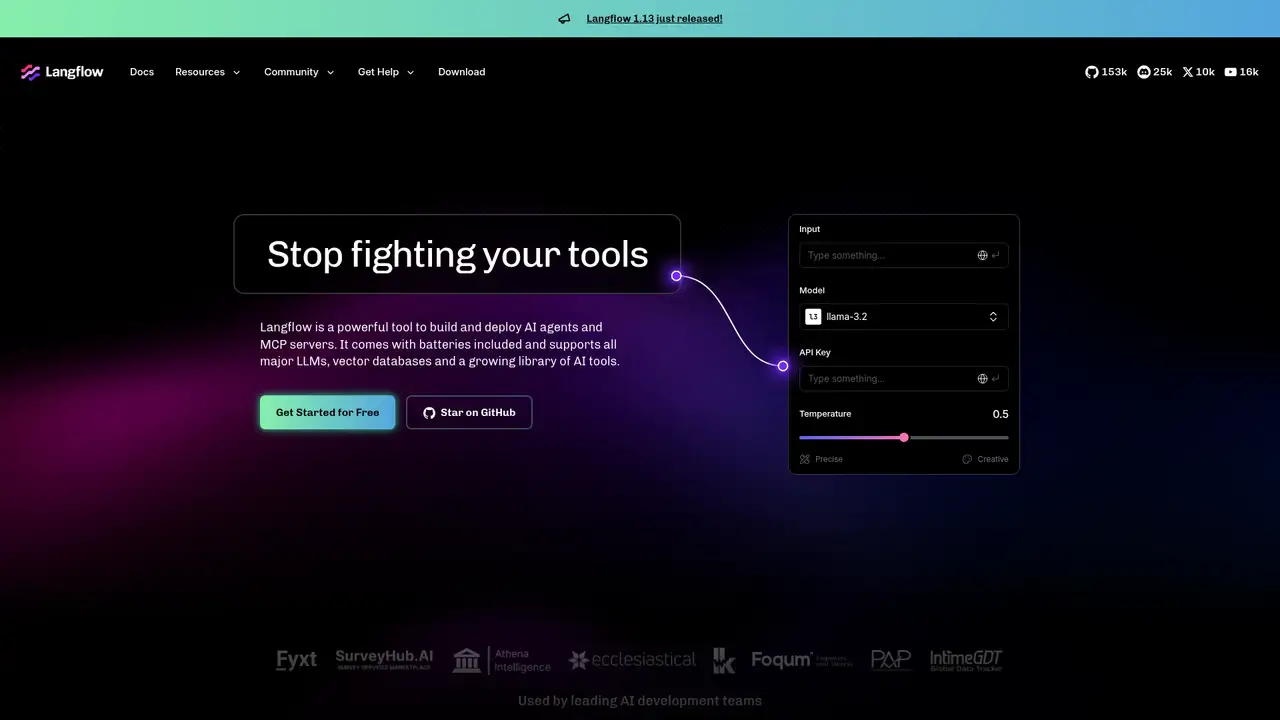
Langflow is open-source software for building agentic and retrieval-augmented generation applications. IBM announced plans to acquire DataStax, Langflow's parent company, subject to closing and regulatory approval. IBM now markets IBM Langflow with OSS, IBM Elite Support, Desktop, and Watsonx Orchestrate integration options, while the project remains available under the MIT License. DataStax removed hosted Langflow from Astra on April 9, 2026, leaving downloadable software as the clearest documented free path. Users can run it locally or on infrastructure they manage. IBM describes Docker and remote-server deployment. Langflow therefore combines a permissive software license with commercial support options. Its corporate status remains an announced transaction rather than a confirmed completed acquisition. Langflow’s permissive MIT license allows commercial use subject to its terms, unlike Flowise’s mixed Apache 2.0 and commercial licensing structure. IBM’s Langflow page lists OSS, Desktop, Elite Support, and Watsonx Orchestrate options, while the project remains available as downloadable software.
Langflow represents applications as visual flows assembled from components for models, prompts, tools, data sources, vector stores, and agent logic. Users can choose from hundreds of prebuilt flows and components, customize behavior with Python, and expose completed flows through an API. Built-in API and MCP servers allow workflows to become tools usable from other frameworks or application stacks. The homepage presents drag-and-drop construction, reusable components, real-time iteration, and deployment choices. The downloadable project can run locally, through Docker, on a remote server, or on other documented infrastructure. This combination suits teams seeking visual development for agents and RAG applications while retaining source access and programmatic integration. Flows can combine routing, tools, memory, structured output, and retrieval components within a visual canvas. Langflow also supports hundreds of prebuilt flows and components, while Python customization can alter component behavior beyond the available visual settings.
Langflow supports major language models, vector databases, tools, RAG applications, agentic flows, and MCP servers. Version 1.13.0 was released on October 22, 2026, adding team and user administration APIs and CLI support, provenance features, pinned MCP action-to-tool mode, OAuth and integration bundles, triggers and events APIs, audit logs, migrations, GDPR data-subject erase requests, and Segment-routed telemetry. Langflow documents installation-scoped pseudonymous telemetry delivered through Segment. Prompts, messages, code, passwords, files, authentication details, and MCP configuration are excluded by default, and users can opt out with DO_NOT_TRACK=True. These details describe the software release, not connected model providers or external infrastructure. Langflow 1.13.0 added administration APIs and CLI support, provenance features, OAuth and integration bundles, triggers, events, audit logs, migrations, and GDPR data-subject erase requests. The release also routes product telemetry through Segment, extending the platform’s administration and governance features.
The MIT-licensed software has a free entry price, and Langflow does not publish a current paid Langflow price schedule or product usage limits. IBM lists Elite Support and Watsonx Orchestrate-related options without public prices, so those commercial routes are Custom rather than free software tiers. Users running Langflow themselves may pay for infrastructure and model-provider calls. Render documentation requires at least 2 GB RAM and a paid Render account, while Railway documents a Hobby account with two CPU cores and 2 GB RAM. Those infrastructure requirements and provider charges are separate from Langflow's license. Langflow’s hosted cloud is advertised as free, but the company does not publish current public usage limits or paid USD tiers. Self-hosting through Render requires at least 2 GB RAM and a paid account, while Railway documents a Hobby deployment with two CPU cores and 2 GB RAM.
Langflow's principal limitation is operational responsibility. Its interface can execute arbitrary developer-provided Python with host filesystem and network access, and it provides no process-level isolation between tenants, so external infrastructure must enforce isolation and authentication. Compared with Flowise, Langflow has an MIT license and current release activity, while Flowise reached EOL on August 31, 2026, with its repository archived and packages deprecated. Compared with Sim, Langflow favors editable Python and self-managed deployment, while Sim offers managed cloud and self-hosting. Langflow’s security documentation warns that flows can run developer-provided Python with filesystem and network access, and that tenants lack process-level isolation. Compared with Flowise, which reached end of life on August 31, 2026, Langflow offers ongoing releases and MIT licensing, while still requiring infrastructure controls. Langflow suits teams seeking visual agent development, source control, and self-hosting who can secure infrastructure and pay model-provider costs.
Who is Langflow best for?
- Visual agent and RAG prototyping
- Teams needing Python customization
- Self-hosted deployments
- Developers building API or MCP tools
Langflow Pricing (2026)
Pricing model: Free. All prices in USD.
| Plan | Price | What you get |
|---|---|---|
| Open Source | Free | MIT-licensed downloadable software for local or self-hosted use. Langflow does not publish product usage caps. |
| Desktop | Free | IBM lists a Desktop edition. Specific feature limits and current distribution details are not published. |
| IBM Elite Support | Custom | IBM lists paid support for Langflow OSS. Public pricing and usage limits are not published. |
| Watsonx Orchestrate integration | Custom | IBM lists integration options. Langflow-specific pricing and usage limits are not published. |
Pros and Cons
Pros
- Langflow uses the permissive MIT License.
- Python customization extends visual components.
- Built-in API and MCP servers support integrations.
- The project has current 2026 release activity.
Cons
- The UI can execute arbitrary Python on the host.
- Langflow provides no process-level tenant isolation.
- Hosting and model-provider costs remain the customer's responsibility.
Who should look elsewhere?
- Teams requiring managed tenant isolation
- Buyers needing transparent enterprise pricing
- Users unwilling to manage hosting and model costs
Technical Details
Frequently Asked Questions
How much does Langflow cost?
Langflow's downloadable MIT-licensed software is free. IBM does not publish prices for Elite Support or Watsonx Orchestrate-related options, so those routes are Custom. Customers running Langflow themselves may pay for infrastructure and model-provider calls. Render requires a paid account and at least 2 GB RAM.
Is Langflow free?
Yes. Langflow's downloadable software is available under the MIT License for local or self-hosted use, and IBM lists a Desktop edition. DataStax removed hosted Langflow from Astra on April 9, 2026, so that former service should not be presented as a current Langflow tier. Infrastructure, storage, and model-provider charges remain separate.
What is the closest competitor to Langflow?
Flowise is the closest named competitor because both provide visual builders for agents and RAG applications with APIs and self-hosting. Langflow uses the MIT License and supports Python customization and MCP servers. Flowise reached EOL on August 31, 2026, followed by repository archival and package deprecation.
Does Langflow train on customer prompts or collect telemetry?
Langflow documents installation-scoped, pseudonymous usage telemetry delivered through Segment. It says prompts, messages, code, passwords, files, authentication details, and MCP configuration are excluded by default. Users can opt out with DO_NOT_TRACK=True. These statements concern Langflow telemetry and do not describe every connected model provider or external infrastructure service.
Can Langflow be used commercially, and what license applies?
Yes. The Langflow repository identifies the MIT License, which permits commercial use subject to its terms. IBM lists commercial support and Watsonx Orchestrate-related options, but public prices are unavailable. Commercial users remain responsible for deployment security, third-party model and data-service terms, infrastructure isolation, and dependencies used in their flows.