
Klaviyo Review, Pricing & Alternatives (2026)
Ecommerce CRM for behavioral marketing, messaging, service, and AI
Last updated: October 26, 2026
What is Klaviyo?
Klaviyo is a B2C CRM and ecommerce marketing platform for brands that connect customer data with email, mobile messaging, analytics, service, and automated journeys. It suits teams that need event-based segmentation and revenue attribution more than basic newsletters. A free plan supports up to 250 active profiles and 500 monthly email sends. Paid email starts at $20 per month for 500 active profiles.
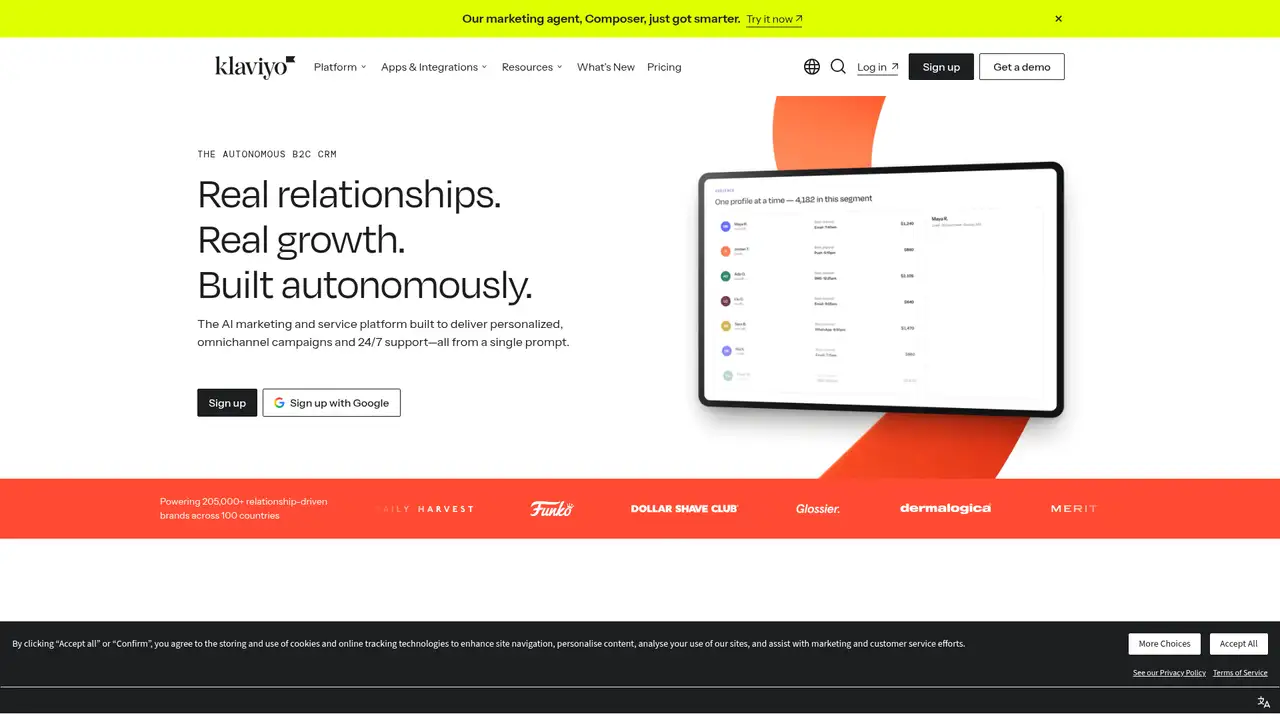
Klaviyo is a B2C CRM and ecommerce marketing platform founded in 2012 by Andrew Bialecki and Ed Hallen. The company says more than 205,000 brands use its products, and it trades publicly on the New York Stock Exchange under KVYO. Its catalog includes email, mobile messaging, Reviews, Customer Hub, Helpdesk, Customer Agent, Composer, Data Platform, and Analytics. That range makes Klaviyo broader than an email sender, although ecommerce marketing remains its clearest center. Its strongest identity is a customer data and automation system for brands that sell directly to consumers online. The company says it began as a customer database, added email marketing in 2013, SMS in 2021, Reviews and a CDP in 2023, and a unified B2C CRM in 2025.
Klaviyo connects an online store and other first-party sources, then unifies customer profiles with behavioral events. Teams build segments, campaigns, and event-triggered flows, send through email or mobile channels, and measure revenue attribution. Klaviyo lists Shopify, Salesforce Commerce Cloud, and WooCommerce integrations, while its 2024 filing described more than 350 integrations as of 2023. Typical journeys include abandoned-cart reminders, post-purchase messages, replenishment prompts, and targeted promotions. Product activity and predictive analytics can influence audience selection and send timing. The system depends on clean event data and thoughtful profile design, making implementation more demanding than a basic newsletter tool. Marketers can connect browsing, purchase, engagement, and service signals to coordinated messages, then examine reported revenue.
Klaviyo describes K:AI as combining agentic marketing and service AI, live customer profiles, generative content, omnichannel orchestration, and continuous optimization. Its AI FAQ names OpenAI, Anthropic, AWS Bedrock, and Gemini as generative AI providers. On August 20, 2025, Klaviyo made its MCP Server generally available, allowing supported tools to query reporting context, generate recommendations, and execute actions through OAuth or a private API key. On September 25, 2025, it released Marketing Agent and Customer Agent. Marketing Agent can create campaigns, flows, forms, and content for approval. Customer Agent answers product, policy, order, and returns questions, recommends products, and hands off to people with context across chat, SMS, email, and soon WhatsApp.
Klaviyo’s free plan costs $0 per month and supports up to 250 active profiles and 500 email sends monthly. It includes a $5 monthly mobile-message allowance, $5 of Composer usage, forms, basic templates, an AI subject-line generator, segmentation, automations, reports, built-in reporting, and email support for the first 60 days. Paid email is profile based, with the public pricing page showing $20 monthly at 500 active profiles. The calculator varies by country, profile count, and product selection. Unsubscribed and suppressed contacts do not count as active profiles, while emails sent to active profiles count toward included capacity. Email, mobile messaging, Reviews, service, Composer, data, and analytics are separately selectable products or add-ons. Reachable-profile growth can raise recurring costs.
Klaviyo’s limits are operational as well as financial. Reachable-profile growth can increase recurring costs, while separately billed products make the total harder to estimate than a single-channel plan. Its AI features require customer review, and necessary prompts or data may be sent to providers to generate requested outputs. Klaviyo says provider contracts prohibit global-model training on customer data, while its policy describes controls that depend on applicable products, settings, contracts, and provider terms. Mailchimp is broader for general small-business marketing, ActiveCampaign is a close automation alternative, and Omnisend also targets ecommerce brands. Klaviyo offers deeper behavioral ecommerce segmentation and revenue attribution than many newsletter-focused tools, but requires better data discipline and a larger budget as reachable profiles grow. Pick Klaviyo when behavioral ecommerce data, profile-based journeys, and revenue reporting matter more than the lowest setup cost.
Who is Klaviyo best for?
- Ecommerce brands using behavioral events for automated journeys.
- Teams that need revenue attribution tied to customer profiles.
- Marketers combining email with mobile messaging and service.
- Companies prepared to maintain detailed customer and event data.
Klaviyo Pricing (2026)
Pricing model: Freemium. All prices in USD.
| Plan | Price | What you get |
|---|---|---|
| Free | $0/month | Up to 250 active profiles and 500 email sends monthly. Includes $5 of mobile-message allowance and $5 of Composer usage monthly. |
| Paid Email | $20/month | The observed price covers 500 active profiles. Pricing scales with active profiles and included email capacity. |
| Higher volume and custom | Custom | Higher-volume, custom, or contract billing is available through sales. Other products are separately selectable. |
Pros and Cons
Pros
- Behavioral segmentation connects customer events to campaigns.
- Revenue attribution supports ecommerce performance reporting.
- Marketing Agent and Customer Agent extend automation beyond email.
- The free plan supports 250 active profiles and 500 monthly emails.
Cons
- Reachable profile growth can increase recurring costs.
- Separate products make total pricing harder to forecast.
- Setup requires well-structured events and customer data.
Who should look elsewhere?
- Small senders wanting only a basic newsletter tool.
- Teams needing one simple price across every product.
- Organizations requiring self-hosted marketing infrastructure.
Technical Details
Frequently Asked Questions
How much does Klaviyo cost?
Klaviyo has a free plan with limits of 250 active profiles and 500 email sends per month. Paid email is profile based, and the public pricing page shows $20 per month at 500 active profiles. Mobile messaging, Reviews, service, Composer, data, and analytics are separately selectable products or add-ons, so the email price does not cover every Klaviyo capability.
Does Klaviyo have a free plan?
Yes. The free plan can continue while the account remains under 250 active profiles and 500 monthly email sends. It includes forms, basic templates, segmentation, automations, reporting, and email support for the first 60 days. It also includes limited mobile-message and Composer allowances. Sending may be restricted after exceeding the stated profile or email limits.
Klaviyo or Mailchimp, which is better for ecommerce?
Klaviyo is the more focused choice when ecommerce events, behavioral segments, product triggers, and revenue attribution drive the program. Mailchimp serves broader small-business marketing across email, SMS, websites, ads, and ecommerce connections. Klaviyo’s profile-based billing and event workflows can require more setup, while Mailchimp counts subscribed, non-subscribed, and unsubscribed records toward contact limits.
Does Klaviyo train AI models on customer data?
Klaviyo says third-party providers are contractually prohibited from training global models on customer data. It says proprietary machine-learning improvement uses aggregated and de-identified data. For generative features, necessary prompts or data may be sent to providers to create requested output. Customers retain control of inputs and outputs subject to contract terms, and people remain responsible for reviewing generated material.
Can Klaviyo outputs be used commercially?
Klaviyo says customers retain ownership and control of generative AI inputs and outputs, subject to its contract terms. Commercial use remains subject to applicable law, customer rights, and the terms governing the service. Klaviyo places responsibility for human review with the customer. The company does not describe a separate output-license fee in the cited AI FAQ.
Best Klaviyo Alternatives in 2026
These tools do the same job as Klaviyo, with different pricing, limits and trade-offs.

Email marketing and automation for growing businesses

CRM-grounded AI assistants, agents, and workflows for go-to-market teams
Email marketing and automation platform with Active Intelligence AI agents and a CRM
Ecommerce email and SMS marketing with AI segments, product picks and a free plan
Enterprise customer engagement platform with BrazeAI agents and AI decisioning