
Kimi Review, Pricing & Alternatives (2026)
Long-context writing, research, coding, and agent workflows
Last updated: October 26, 2026
What is Kimi?
Kimi is Moonshot AI's hosted assistant for document work, research, writing, coding, and agent tasks. It is aimed at researchers, writers, and developers who need long context or automated workflows. A free membership is available, paid membership starts at $19/month, annual billing starts at $180, and API access is metered separately by tokens.
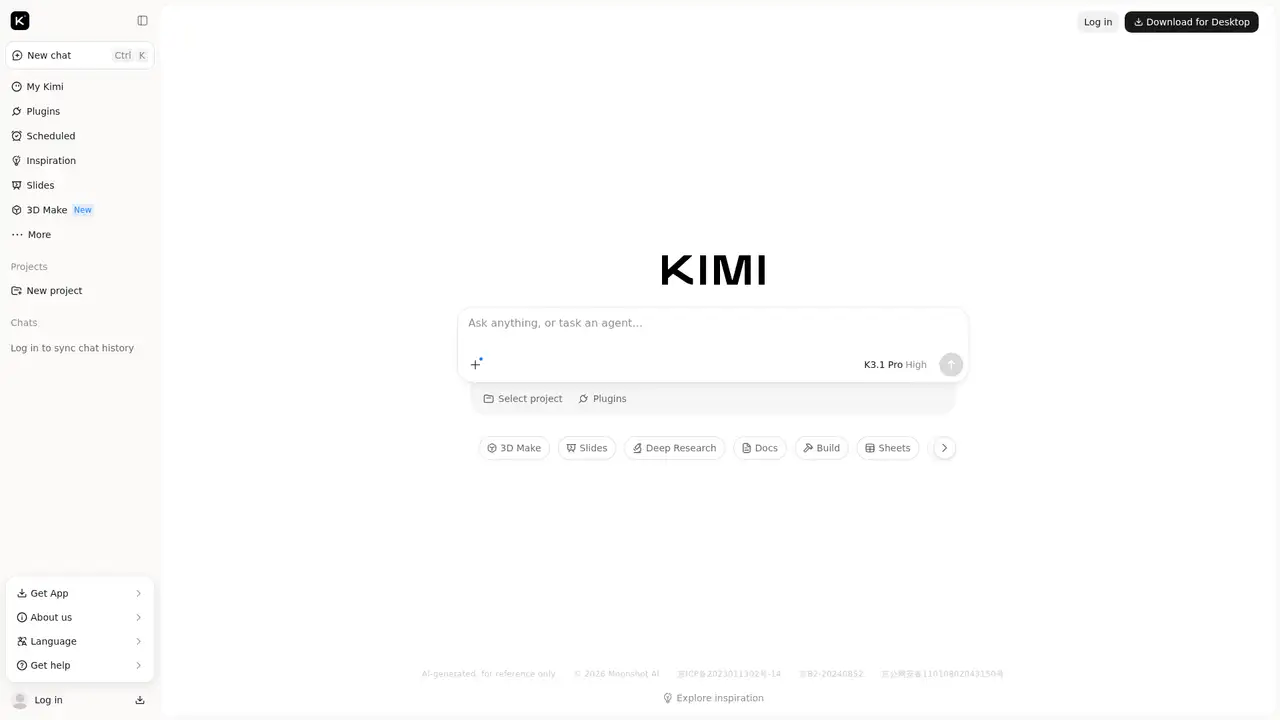
Kimi is a hosted AI assistant from Moonshot AI, the Beijing company founded in March 2023 by Yang Zhilin, Zhou Xinyu, and Wu Yuxin. The chatbot launched in October 2023 and initially stood out for processing very long Chinese documents. Moonshot later expanded Kimi toward coding, research, documents, website deployment, and agent work. The service now includes consumer chat, Kimi Code, Kimi Claw, Agent Swarm, and an API. Hosted membership, API access, and downloadable Kimi model weights are separate offerings. The US-dollar membership page lists a free tier plus Plus, Pro, Max, and Ultra plans. The company also publishes a China membership page with different prices and plan structures, so the displayed currency and regional terms matter when comparing plans.
A typical Kimi session begins with a conversation, uploaded office files, or a research request. Users can ask it to process documents, spreadsheets, and slides, search the web, run Deep Research, deploy a website, schedule tasks, or coordinate agent subtasks. Projects provide persistent work areas, with project counts and storage varying by plan. Kimi Code targets coding work, while Agent Swarm coordinates multiple agents for larger jobs. Kimi Claw can deploy a website with database support through eligible memberships. Scheduled tasks and dashboard widgets can run automatically and push results. Agent actions consume membership credits based on token use. A deployed Kimi Claw website can continue consuming credits while active, which makes ongoing deployments different from one-off document questions.
Moonshot’s model line has changed quickly. Kimi K2 arrived in July 2025, followed by K2 Thinking in November 2025. K2.5 launched on January 27, 2026, with native multimodality and agent swarm support for up to 100 subagents and 1,500 tool calls, according to the company. K2.6 followed on April 20 with company claims of up to 300 subagents and 4,000 collaborative steps. K3 launched on July 16 with native vision, 2.8 trillion total parameters, and a one-million-token context. K3.1 Pro and K3.1 Pro Highspeed arrived on October 23, 2026. The API lists 1,048,576-token context for K3 and K3.1 models, while K2 models have 262,144 tokens. K2.5 was discontinued on August 31, 2026.
The free membership provides two concurrent agent tasks, two scheduled tasks, two widget tasks, two projects, and 500MB of project storage. Plus costs $19/month, or $180 annually paid upfront, and adds Kimi Code, Agent Swarm, 20 projects, and 20GB storage. Pro costs $39/month, or $372 annually, and adds two-times agent credits, Goal Mode, and K3.1 Pro Highspeed. Max costs $99/month, or $948 annually, with four concurrent tasks, 100 projects, 50GB storage, and five-times agent credits. Ultra costs $199/month, or $1,908 annually, with four concurrent tasks, 100 projects, and ten-times agent credits. Credits refresh monthly and do not roll over. API pricing is separate, with K3.1 Pro listed at $2.00 per million input tokens and $10.00 per million output tokens.
Kimi’s constraints include changing model access, credit-based usage, regional terms, and consumer data practices. Kimi Help says de-identified and encrypted user inputs, instructions, and responses may be used to train or improve models. Users can request an account-level opt-out through support, with identity verification and a stated five-to-seven-working-day process. The consumer service says data is stored on secure servers in mainland China. ChatGPT offers a broader general-purpose product, Claude is a close alternative for writing and coding, and Gemini connects more directly with Google services. Downloadable Kimi models have model-specific licenses separate from hosted membership. Kimi is the better pick for long documents, agent workflows, and users who want Kimi Code or Kimi Claw in one workspace.
Who is Kimi best for?
- Researchers handling long documents and multi-step web investigations.
- Writers working with documents, spreadsheets, and presentations.
- Developers using Kimi Code, Agent Swarm, or Kimi Claw.
- Teams comparing hosted assistance with downloadable Kimi models.
Kimi Pricing (2026)
Pricing model: Freemium. All prices in USD.
| Plan | Price | What you get |
|---|---|---|
| Free | $0/month | Two concurrent agent tasks, two scheduled tasks, two widget tasks, two projects, and 500MB of project storage. |
| Plus | $19/month | $180 annual billing, charged upfront. Two concurrent agent tasks, 10 scheduled tasks, 10 widget tasks, 20 projects, 20GB storage, Kimi Code, and Agent Swarm. |
| Pro | $39/month | $372 annual billing, charged upfront. Two concurrent tasks, 15 scheduled tasks, 15 widget tasks, 20 projects, 20GB storage, two-times agent credits, Goal Mode, and K3.1 Pro Highspeed. |
| Max | $99/month | $948 annual billing, charged upfront. Four concurrent tasks, 20 scheduled tasks, 20 widget tasks, 100 projects, 50GB storage, five-times agent credits, and up to one-million-token context. |
| Ultra | $199/month | $1,908 annual billing, charged upfront. Four concurrent tasks, 25 scheduled tasks, 25 widget tasks, 100 projects, 50GB storage, ten-times agent credits, and up to one-million-token context. |
Pros and Cons
Pros
- Kimi supports one-million-token context on K3 and K3.1 models.
- Paid memberships combine research, coding, documents, and agent tasks.
- Kimi Code and Agent Swarm are available from the Plus plan.
- Several Kimi models have downloadable weights and self-hosting support.
Cons
- Membership credits are metered by actual token use and do not roll over.
- Consumer inputs may support model training unless users opt out through support.
- Hosted membership terms do not automatically cover downloadable model licenses.
Who should look elsewhere?
- Users seeking a consumer service with no model-training opt-out process.
- Buyers requiring one worldwide pricing table with fixed usage limits.
- Organizations assuming membership grants self-hosting rights.
Technical Details
Frequently Asked Questions
How much does Kimi cost?
Kimi has a free membership tier. The US-dollar membership page lists Plus at $19/month, Pro at $39/month, Max at $99/month, and Ultra at $199/month. Annual billing costs $180, $372, $948, and $1,908 respectively and is charged upfront. API use is separate and billed by tokens. Regional membership pages can show different prices and currencies.
Does Kimi have a free plan?
Yes. Kimi offers a free membership tier with two concurrent agent tasks, two scheduled tasks, two widget tasks, two projects, and 500MB of project storage. Paid plans add more scheduled and widget tasks, larger project storage, Kimi Code, Agent Swarm, Goal Mode, Kimi Claw, and larger credit allocations. Limits and features can vary by region and plan.
How does Kimi compare with Claude?
Kimi and Claude both support writing, document analysis, coding, and research. Kimi provides K3 and K3.1 models with one-million-token context, plus membership features such as Agent Swarm and Kimi Claw. Claude is a close alternative for users already working with Anthropic’s products and developer services. Their model availability, pricing, usage limits, and data terms differ.
Does Kimi train on user data?
Kimi Help says de-identified and encrypted user inputs, instructions, and responses may be used to train or improve models. Account holders can request an account-level opt-out by emailing support, with identity verification and a stated five-to-seven-working-day process. The consumer service says data is stored on secure servers in mainland China. Enterprise Kimi Business has separate commitments for business data.
Can Kimi be used commercially?
Commercial rights depend on the service and the applicable model license. Hosted membership terms do not automatically grant rights to self-host models or reuse them commercially. K2.5, K2.6, K3, and K3.1 Pro are described as open or open-weight, but each license requires separate review. API and enterprise terms are distinct from membership, and output use should follow the applicable current terms.
Best Kimi Alternatives in 2026
These tools do the same job as Kimi, with different pricing, limits and trade-offs.
General-purpose AI assistance for writing, research, coding, and work
Long-context AI assistant for writing, research, and code
Google's AI assistant with real-time search and Workspace integration
Low cost reasoning and general purpose models with open releases