
Higgsfield Review, Pricing & Alternatives (2026)
Multi-model video creation with cinematic controls and character consistency
Last updated: October 22, 2026
What is Higgsfield?
Higgsfield is a web and API platform for generating video and images with proprietary tools and partner models. It serves creators, marketers, small production teams, and developers who need cinematic controls, character references, lip sync, or several models in one workspace. A free account has limited model access and no credits. Web subscription prices vary by account or region, while API examples start at $0.050 per generated second.
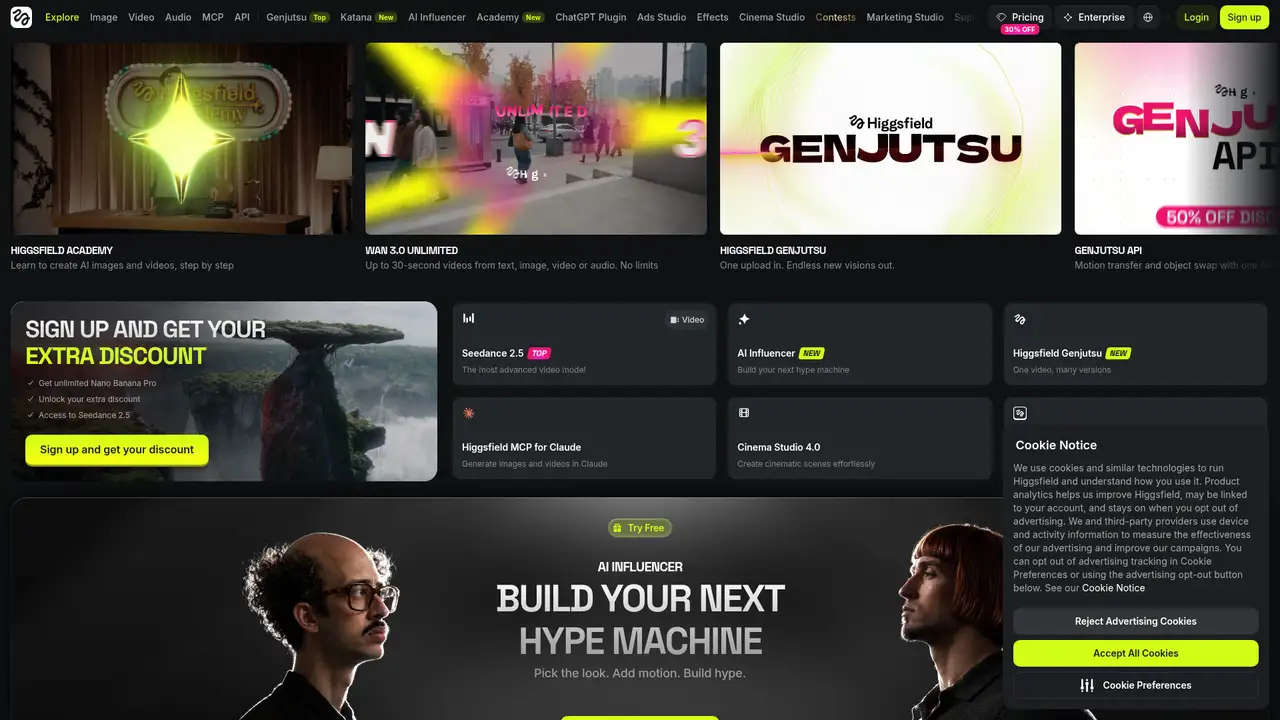
Higgsfield is an active AI video and image platform founded in 2023 by Alex Mashrabov and Yerzat Dulat. TechCrunch covered the company and its first app, Diffuse, in April 2024, while Higgsfield’s about page describes a 2025 launch. In September 2025, the company announced an $8 million seed round and a $50 million Series A led by GFT Ventures. Higgsfield says it reached 11 million users in five months, a company-reported figure. The service is presented as a multi-model creative platform rather than one standalone video model. Its public offering combines browser-based studios, proprietary tools, partner model access, account credits, and a separate developer API. It serves creators, marketers, small production teams, and developers.
A typical Higgsfield workflow begins with text, an image, a character reference, or a selected camera concept. Cinema Studio focuses on cinematic generation, Marketing Studio supports advertising work, LipSync Studio handles talking characters, and Shorts Studio targets short-form social video. Soul ID carries a person or character reference across generations, supporting recurring identity and character work. DOP, Keyframes, Soul Cinema, Soul HEX, and Soul 2.0 add model-specific controls. Current product pages also list Sora 2, Kling 3.0, and Veo 3.1. Users select a model, configure the operation, generate variations, and spend credits according to that model and task. This structure lets users combine specialized workflows with several available generation systems. Monthly credits expire at renewal, so occasional users should compare expected production volume with the allowance before paying.
Higgsfield combines proprietary systems with third-party models and describes more than 30 models in its broader offering. These include Soul 2.0 for images, Soul Cinema, Higgsfield DOP, Keyframes, Cinema Studio, Soul ID, and Soul HEX. Its current site lists Sora 2, Kling 3.0, and Veo 3.1, while the API catalog lists Genjutsu, Seedance 2.0 and 2.5, Wan 3.0, and several Kling versions. The API lists prices from $0.050 per generated second for Genjutsu Light and Wan 3.0 to $0.318 per second for Genjutsu. Those figures describe API usage, not web subscription rates. Product pages dated in 2025 and 2026 emphasize new model and agent-style workflow additions.
Higgsfield’s web service uses subscription credits, while its API uses separate prepaid billing based on generated seconds. The free account has limited model access and no credits, and the company says it does not offer a free trial. Individual subscriptions are monthly or annual, with credits resetting at renewal and not rolling over. Credit packs and automatic-refill credits expire after 90 days. Paid tiers vary by model access, monthly credits, parallel generations, and selected unlimited-model access. Unlimited access is model-specific, generally lasting 365 days, while some newer flagship models are limited to seven days. Current web card prices and allowances vary by account or region, making checkout details important.
Credit expiry and model-specific charges make Higgsfield harder to budget than a conventional editing application. Its terms and privacy policy allow inputs and outputs to be used for training or model improvement while content is stored, subject to stated deletion and enterprise exceptions. Runway is a close alternative for creators who want generation and editing in one product. Sora and Veo are stronger comparisons for users focused on one flagship model, while Kling and Seedance offer direct access to models also listed in Higgsfield’s catalog. Pick Higgsfield when cinematic controls, character continuity, specialized studios, and model choice matter more than fixed, easily comparable generation costs. It is less suitable for teams requiring predictable per-generation pricing.
Who is Higgsfield best for?
- Creators who need cinematic camera controls and recurring character references.
- Marketing teams producing multiple social video variations.
- Users who want several video models in one browser workspace.
- Developers who prefer model-based API billing by generated second.
Higgsfield Pricing (2026)
Pricing model: Usage-based. All prices in USD.
| Plan | Price | What you get |
|---|---|---|
| Free | $0 | Limited model access and no credits. Higgsfield says it does not offer a free trial. |
| Individual paid plans | Price shown at checkout | Monthly or annual plans include model-specific access, monthly credits, and parallel-generation limits. Subscription credits reset at renewal and do not roll over. |
| Team | Price shown at checkout | Business workspace with shared access and pooled credits. Current public card pricing varies by account or region. |
| Scale | Price shown at checkout | Business workspace with shared access and pooled credits. Current public card pricing varies by account or region. |
| Enterprise | Custom | Enterprise terms include business controls and volume rollover credits. |
| API | From $0.050/second | Separate prepaid billing by generated second. Listed examples include Genjutsu Light and Wan 3.0 at $0.050 per second, with two concurrent generations included. |
Pros and Cons
Pros
- It combines proprietary tools and partner models in one workspace.
- Soul ID supports recurring character and identity references across generations.
- Specialized studios address cinematic, marketing, lip sync, and short-form work.
- The API publishes model-specific prices and concurrency thresholds.
Cons
- Individual subscription credits expire at renewal and do not roll over.
- Web subscription prices and allowances vary by account or region.
- Terms allow stored inputs and outputs to support model training.
Who should look elsewhere?
- Teams requiring fixed costs for every generation.
- Organizations that prohibit provider use of content for model training.
- Editors seeking a traditional timeline-first post-production application.
Technical Details
Frequently Asked Questions
How much does Higgsfield cost?
Higgsfield’s web subscription prices are shown dynamically rather than as one universal public rate. The free account has limited model access and no credits. Paid individual plans use monthly or annual billing with monthly credits. The separate API lists examples starting at $0.050 per generated second for Genjutsu Light and Wan 3.0, and API billing does not include web subscription benefits.
Does Higgsfield have a free plan?
Yes. Higgsfield offers a free account with limited model access and no credits. The company says it does not offer a free trial. Paid plans add monthly credits, broader model access, parallel generations, and selected unlimited-model access. Web subscriptions and API balances use separate billing systems, so an API balance does not become web credits.
How does Higgsfield compare with Runway?
Higgsfield emphasizes multiple proprietary and partner models, cinematic controls, character identity, and specialized studios. Runway is a close comparison for creators who want generation and editing in one product. Higgsfield suits users who want to switch among models and camera-focused workflows. Runway may be easier to assess as one integrated system, although neither platform’s credit units provide a direct output or quality comparison.
Does Higgsfield train on user data?
Higgsfield’s terms and privacy policy say inputs and outputs may be used to train or improve models while content is stored. Deleting content or an account stops future training use, subject to backups, legal obligations, public content, and retention rules. Enterprise agreement content is described as confidential and excluded from training. Users remain responsible for rights to uploaded images, likenesses, voices, and other material.
Can Higgsfield generations be used commercially?
Higgsfield says users retain ownership of inputs and outputs, and its terms permit commercial use and transfer or sublicensing of output rights. Those permissions remain subject to third-party rights, likeness and voice permissions, and intellectual-property restrictions. Outputs are not guaranteed to be unique. Enterprise customers receive additional contractual protections, including Enterprise-only intellectual-property indemnity.
Best Higgsfield Alternatives in 2026
These tools do the same job as Higgsfield, with different pricing, limits and trade-offs.