
Grok Review, Pricing & Alternatives (2026)
An X-connected assistant with live search, multimodal tools, and agent features
acquired: SpaceX acquired xAI on February 2, 2026, according to the company announcement. Grok remains an active hosted product under the consolidated xAI and SpaceX structure.
Last updated: October 26, 2026
What is Grok?
Grok is xAI’s hosted writing and general-purpose assistant, distributed through Grok, X, and developer APIs. It suits users who value live web and X search, image and video features, and agent tools. Consumer access starts free, while paid plans begin at $8 per month or $80 per year before tax.
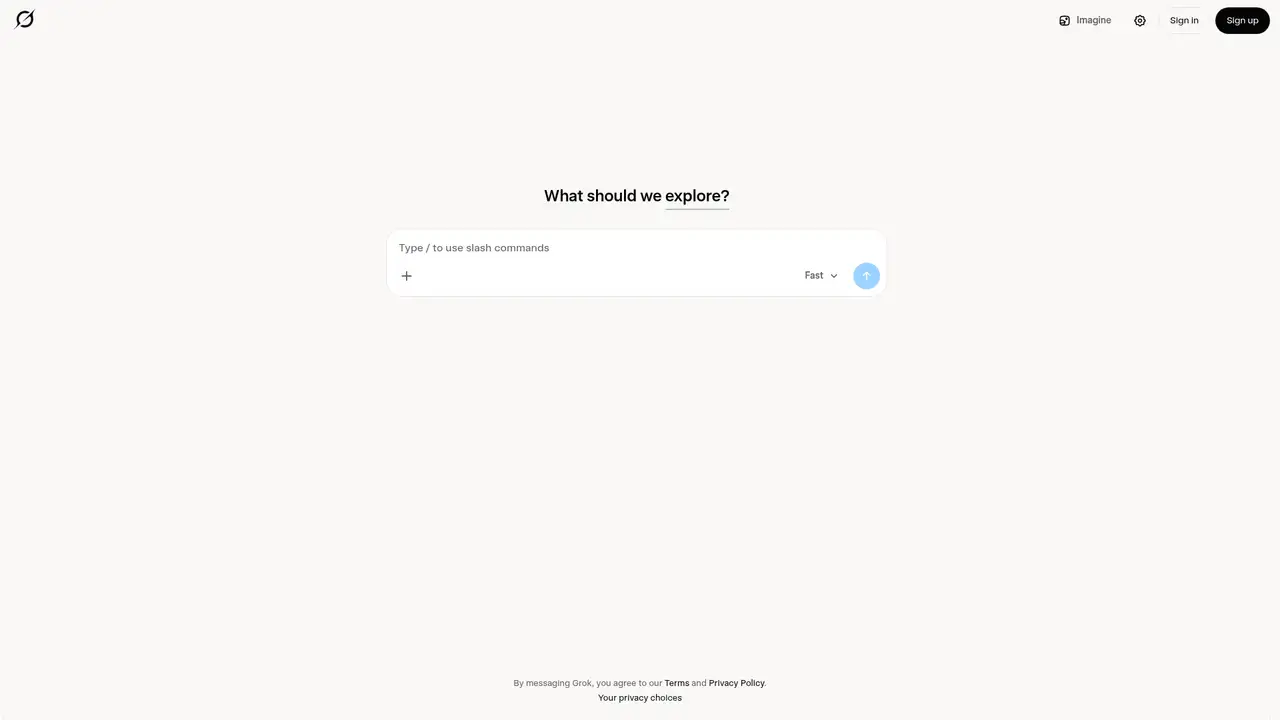
Grok is xAI’s hosted assistant, first introduced in early access on November 3, 2023. xAI launched the Grok API and SDK on November 15, then brought Grok to X Premium+ on December 7. The original product emphasized access to current information through X, setting it apart from assistants built around static knowledge. SpaceX acquired xAI on February 2, 2026, while Grok continued as an active product. Its current reach spans the Grok web and mobile experience, X subscriptions, and a separate developer API. The service is closed and hosted, despite the historical release of Grok-1 weights, which does not describe the current consumer product or its newer models.
Grok’s typical workflow combines chat with live search, writing, voice, image generation, video features, coding, and agent actions. Users can ask for drafts, revisions, explanations, or current information, then use Grok’s search and tool features when a response needs fresh web or X data. Paid subscriptions add higher access, faster responses, model availability, cloud agents, code hosting and reviews, and expanded image and video use. Developers use the separate API with model calls, real-time search, code execution, and remote MCP tools. The shared usage pool introduced in 2026 covers chat, Imagine, Voice, Build, Grok Bot, and Grok model activity in Cursor, so compute-heavy actions consume more of the allowance.
Recent technology centers on Grok 4 and its successors. Grok 4 launched on July 9, 2025, with native tool use, real-time search, multimodal API access, and a 256,000-token context window. Grok 4 Heavy added parallel test-time compute. Grok 4 Fast followed on September 19, 2025, with unified reasoning and non-reasoning modes, web and X search, and a two-million-token context window. Grok 4.1 reached web, X, and mobile users on November 17, while Grok 4.1 Fast and Agent Tools API arrived two days later with tool calling and search. October 2026 legal materials refer to Grok 4.5, 4.6, and 4.7, plus Grok Imagine Image 2.0, but the model catalog changes quickly.
The free plan costs $0 and provides limited AI usage alongside standard X access. Plus costs $8 monthly or $80 annually, Premium costs $30 monthly or $300 annually, Super costs $100 monthly or $1,000 annually, and Ultra costs $200 monthly or $2,000 annually, before tax. Plus includes the base shared allowance, Grok chat, voice, Imagine, Build, and API access. Premium raises usage to four times Plus, Super to 15 times, and Ultra to 50 times, with higher service priority at the top level. Exact message counts are not fixed publicly. Paid users can buy web top-ups starting at $5, and those credits expire after one year.
Grok’s main constraints are changing allowances, closed hosted weights, consumer training settings, and policy and moderation controversy. ChatGPT and Claude offer broader established writing workflows, while Gemini is more tightly connected to Google services. Perplexity is more focused on citation-led search, whereas Grok puts X-native data, image and video generation, and agent tools closer to the main chat experience. Its consumer and API products also remain separate, with API billing based on tokens rather than subscription access. Choose Grok if live X and web information, multimodal creation, and xAI’s agent tooling matter more than fixed limits or local deployment.
Who is Grok best for?
- Writers who need current information from the web and X while drafting or revising.
- Users who want chat, voice, image, video, and coding tools in one hosted service.
- Developers building applications with live search, tool calling, or remote MCP support.
- X users who prefer accessing an assistant through an existing social platform.
Grok Pricing (2026)
Pricing model: Freemium. All prices in USD.
| Plan | Price | What you get |
|---|---|---|
| Free | $0 | Limited AI usage and standard X access. Exact message allowances are not published as fixed numbers. |
| Plus | $8/month or $80/year | Base shared AI allowance, Grok chat, voice, Imagine, Build, and API access. |
| Premium | $30/month or $300/year | Four times Plus usage, latest models, faster responses, image and video tools, code hosting and reviews, cloud agents, and reduced ads. |
| Super | $100/month or $1,000/year | Fifteen times Plus usage and priority access during peak demand. |
| Ultra | $200/month or $2,000/year | Fifty times Plus usage and the highest access level. |
| Premium Teams | $30/seat/month | Team plan with Premium-level access. Plus is unavailable to teams. |
| Super Teams | $100/seat/month | Team plan with Super-level access and 15 times the Plus usage baseline. |
| Ultra Teams | $200/seat/month | Team plan with Ultra-level access and 50 times the Plus usage baseline. |
Pros and Cons
Pros
- Grok combines X search, web search, writing, voice, image, and video features.
- Grok 4 Fast offers a two-million-token context window and unified reasoning modes.
- Paid plans provide clear usage multipliers from four times to 50 times Plus.
- The developer API supports live search, code execution, and remote MCP tools.
Cons
- Consumer limits vary through a shared rolling pool rather than fixed message counts.
- Current Grok service models are hosted and not self-hostable.
- Consumer interactions may train models unless users change settings or use Private Chat.
Who should look elsewhere?
- Teams requiring a locally deployed assistant or downloadable current model weights.
- Users who need stable, published message quotas instead of a rolling shared pool.
- Organizations unwilling to review consumer training and privacy settings before use.
Technical Details
Frequently Asked Questions
How much does Grok cost?
Grok has a free plan, followed by Plus at $8 per month or $80 per year, Premium at $30 per month or $300 per year, Super at $100 per month or $1,000 per year, and Ultra at $200 per month or $2,000 per year. Prices exclude tax. Team versions are available for Premium, Super, and Ultra.
Does Grok have a free plan?
Yes. The Free plan costs $0 and includes standard X access with limited AI usage. xAI does not publish fixed message counts for the free allowance. Paid plans increase access through a shared rolling pool covering chat, Imagine, Voice, Build, Grok Bot, and Grok model usage in Cursor.
How does Grok compare with ChatGPT?
Grok emphasizes live X and web information, image and video features, and xAI agent tools. ChatGPT offers a broader established assistant and productivity environment. Grok can suit users who depend on current X discussion, while ChatGPT may fit users seeking wider third-party integrations and more predictable product workflows.
Does Grok train on user conversations?
Consumer prompts and interactions may be used to train or improve xAI models. Users can disable Improve the model in the app or web settings, while Private Chat conversations are not used for training. Enterprise content is excluded from foundation-model training, subject to enterprise terms and service processing.
Can businesses use Grok commercially?
Businesses can use Grok through consumer subscriptions, team plans, or the separate developer API, subject to the applicable terms. Enterprise customers retain input and own output under enterprise terms. API use is hosted and usage-based, and it does not grant self-hosting rights or access to current model weights.
Best Grok Alternatives in 2026
These tools do the same job as Grok, with different pricing, limits and trade-offs.
General-purpose AI assistance for writing, research, coding, and work
Long-context AI assistant for writing, research, and code
Google's AI assistant with real-time search and Workspace integration
Source-linked AI search with multi-model research and agent features

AI assistance built into Microsoft apps, work data, and everyday tasks.