Gradescope Review, Pricing & Alternatives (2026)
Rubric-based grading for paper, online, code, and bubble-sheet assignments
Last updated: October 22, 2026
What is Gradescope?
Gradescope is a Turnitin-owned assessment service for instructors who grade scanned work, PDFs, online assignments, programming submissions, and bubble sheets. A free Basic plan covers core rubric grading, while Institutional pricing is quote-based. Institutional access adds collaboration, integrations, roster tools, AI-assisted grouping, and administrative controls, with pricing set through institutional terms.
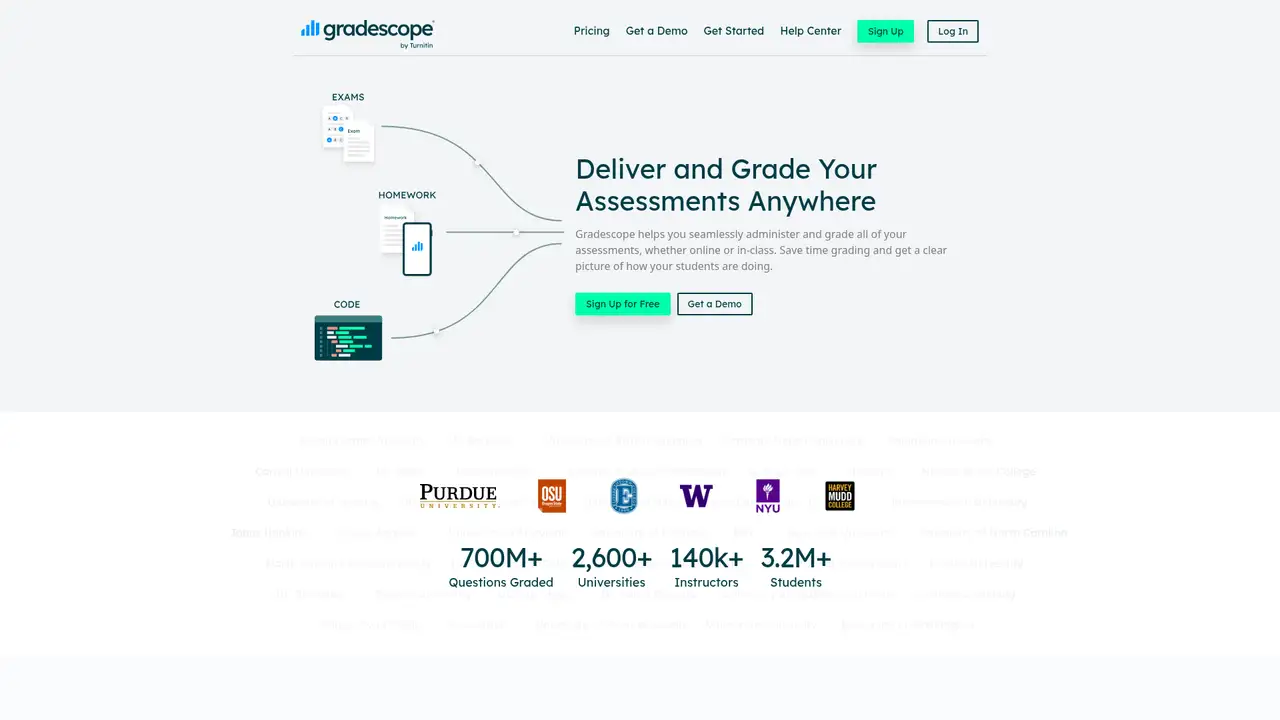
Gradescope began in a UC Berkeley teaching and artificial intelligence setting. Arjun Singh, Pieter Abbeel, and Ibrahim Awwal developed an early prototype called Pandagrader, after which Singh and Sergey Karayev formed a company in response to instructor demand. Company and acquisition accounts date Gradescope to 2014. Turnitin acquired the company in 2018, and Gradescope now operates as an online service of Turnitin, LLC. Before the acquisition, Gradescope announced a $2.75 million Reach Capital-led financing round involving GSV AcceleraTE, Ironfire Ventures, K9 Ventures, Freestyle Capital, and Bloomberg Beta. Its focus remains institutional assessment operations, especially large courses that need consistent rubrics, question-level review, shared grading responsibilities, and organized grade data across varied assignment formats.
Gradescope brings assignment setup, submission collection, rubric design, grading, review, and reporting into a single instructor workflow. Faculty can accept paper scans, PDFs, online responses, programming work, or bubble sheets, then grade one question at a time with a dynamic rubric. Similar short answers can be grouped for faster review, while instructors remain responsible for scores and feedback. Staff can share grading duties, publish results, manage regrade requests, and export statistics. Institutional tools add roster matching, section management, anonymous grading, grade unpublishing, duplicate courses, code similarity, and administrative oversight. Students submit through supported web workflows or the mobile app. LTI 1.3 connections support Canvas, Blackboard, Brightspace, Moodle, Sakai, and other learning-management systems, with SSO available for institutional deployments.
Gradescope’s technology centers on AI-assisted answer grouping, AI roster matching, and automatic bubble-sheet grading. These features assist instructors rather than replacing their judgment. Earlier company accounts described National Science Foundation small-business work involving deep learning for faster grading, while current Turnitin messaging describes the grouping feature as AI-assisted grading. Gradescope has not publicly named its underlying model, disclosed parameter counts or training corpora, or listed per-request quotas. Product maintenance continued through 2026. January releases introduced Grid Rubrics for Institutional and administrator Student Email Visibility; February brought a new Android app; March added a publication confirmation dialog; April revised signup forms; and May added keyboard-only operation for Answer Grouping. The 2026 updates emphasize grading operations, administration, mobile access, confirmation, and accessibility rather than a newly announced model.
The free Basic plan is the practical entry point. It includes dynamic rubrics, question-level grading, instructor or student PDF uploads, assignment statistics, regrade requests, data export, and the student mobile app. A Basic course can include multiple students but only one instructor, so additional instructors, teaching assistants, or readers require Institutional access. Institutional pricing is handled through a sales or order process rather than a public rate card. Public descriptions include an Institutional Trial and state that instructors may receive their first two terms free in marketing language, while the comparison page identifies trial exclusions. Institutional capabilities include AI-assisted grading, roster matching, collaborative and anonymous grading, programming, online and bubble-sheet assignments, advanced rubrics, LMS integration, SSO, dashboards, and onboarding. No public dollar, seat, course, storage, or AI quota is listed.
Gradescope suits departments that need structured grading for scanned work, STEM diagrams, code, or large-enrollment courses, especially when assessment connects to an institutional LMS and identity system. Turnitin Feedback Studio centers on writing feedback and similarity checking, while Crowdmark also targets digital assessment and collaborative grading. Moodle and Canvas provide broader learning-platform tools with quiz and assignment functions, though they do not share Gradescope’s narrow focus on scan-based rubric operations. Gradescope is a hosted service, and its terms place upload rights, privacy duties, and institutional arrangements on users and organizations. It is designed for instructor-led assessment, not self-study, flashcards, or unrestricted automated marking. Choose Gradescope for rubric-centered course grading and staff review; choose Turnitin Feedback Studio, Crowdmark, or native LMS tools when their broader workflows better match the institution.
Who is Gradescope best for?
- Large university courses with scanned work
- STEM instructors using structured rubrics
- Departments needing collaborative grading
- Institutions connecting assessment to an LMS
Gradescope Pricing (2026)
Pricing model: Freemium. All prices in USD.
| Plan | Price | What you get |
|---|---|---|
| Basic | $0 | Core rubric grading, PDF uploads, assignment statistics, regrade requests, data export, and the student mobile app. One instructor per course; additional staff require Institutional. |
| Institutional | Custom | Quote-based pricing. Adds staff collaboration, AI-assisted grading, roster matching, anonymous grading, programming, online and bubble-sheet assignments, advanced rubrics, LMS integration, SSO, administrator tools, and related institutional services. Public seat, course, storage, and AI quotas are not listed. |
Pros and Cons
Pros
- It supports paper, PDF, programming, online, and bubble-sheet assignments in one grading workflow.
- Question-level rubrics can standardize review across instructors, teaching assistants, and sections.
- Institutional tools support LMS connections, roster matching, anonymous grading, and staff collaboration.
- The free Basic plan covers core PDF and rubric grading without a subscription fee.
Cons
- Institutional pricing, quotas, and several important limits are not posted publicly.
- Basic courses allow only one instructor, which restricts staff collaboration on the free plan.
- AI grouping assists review but still requires instructor judgment and does not guarantee grading accuracy.
Who should look elsewhere?
- Students seeking flashcards or self-study
- Teams requiring self-hosted assessment software
- Organizations seeking public fixed institutional pricing
Technical Details
Frequently Asked Questions
How much does Gradescope cost?
Basic costs $0 and includes core rubric grading, PDF uploads, statistics, regrade requests, exports, and the student mobile app. Institutional pricing is custom and is not publicly listed as a fixed monthly or annual amount. Public plan descriptions include an institutional trial and some free terms for instructors, but exact eligibility, duration, seats, quotas, and renewal conditions depend on the applicable institutional arrangement.
Is Gradescope free?
Yes. The Basic plan is free and supports core PDF and rubric grading, assignment statistics, regrade requests, data export, and the student mobile app. A Basic course may contain multiple students but only one instructor. Additional instructors, teaching assistants, or readers require Institutional access, which also covers several assignment types, administrative controls, integrations, and AI-assisted features.
How does Gradescope compare with Turnitin Feedback Studio and Crowdmark?
Gradescope emphasizes question-level rubrics, scanned work, programming, bubble sheets, roster tools, and collaborative course grading. Turnitin Feedback Studio centers on writing feedback and similarity checking, while Crowdmark focuses on digital assessment and collaborative grading. Moodle and Canvas offer broader learning-management features. The best choice depends on assignment formats, staff workflows, existing integrations, and institutional purchasing terms.
How does Gradescope handle privacy?
The terms state that user-created content remains with the user and that Turnitin does not own student educational records, while processing data to provide the service. They describe FERPA compliance, confidentiality, and no third-party advertising based on activity. Users and institutions remain responsible for upload rights and policy compliance. Organizations should review current privacy terms, retention details, subprocessors, and product-improvement language before deployment.
Can instructors use Gradescope commercially?
Gradescope is designed for educational assessment, and paid institutional capabilities are governed by order forms and service terms. Users warrant that they have rights to upload submitted content and must follow privacy, copyright, school-policy, and academic-integrity requirements. The public terms do not grant a broad commercial-content license. Commercial or resale use should be addressed directly in the applicable institutional contract rather than assumed from ordinary teaching access.