
Genmo Review, Pricing & Alternatives (2026)
Open video weights paired with a hosted text-to-video playground
Last updated: October 26, 2026
What is Genmo?
Genmo is a video-generation company offering the hosted Genmo playground, Mochi 1 open weights, and a second generation option called Replay. It targets creators, developers, and researchers who want short text-to-video clips or local experimentation. The free plan costs $0 and includes 250 lifetime credits; paid allowances include commercial use, but current official pricing does not publish every tier price.
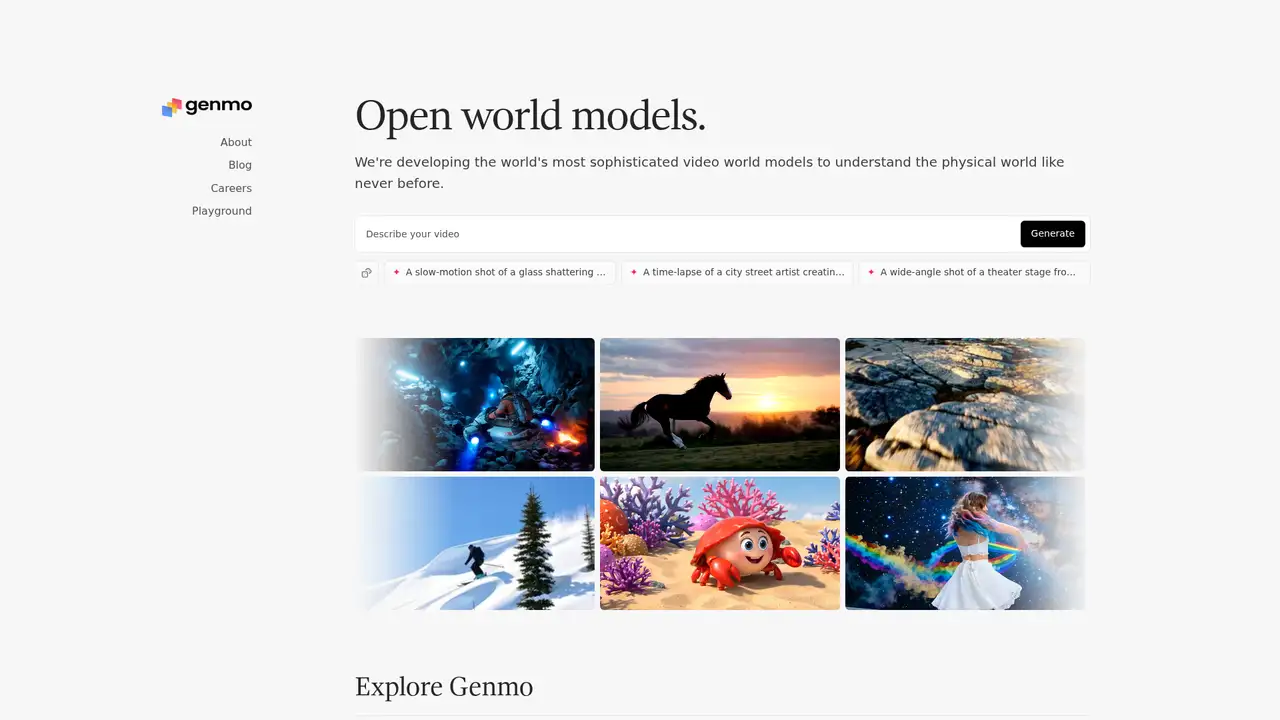
Genmo is a video-generation company focused on world models, embodied AI, and synthetic realities, with a public product mix spanning its browser playground and Mochi 1. The company’s October 2024 Mochi announcement reported a $28.4 million Series A led by NEA, alongside The House Fund, Gold House Ventures, WndrCo, Eastlink Capital Partners, and Essence VC. Its current site groups the offering under Research, Open Source, Playground, and Mochi 1, while also listing Replay as a separate generation option. Mochi 1 is an open-weights text-to-video model released under Apache 2.0, and Genmo says it supports personal and commercial use when run under that model license. The hosted service and open model therefore serve different audiences: browser users seeking a ready-made generation workflow, and developers or researchers who want to inspect, run, or adapt the model.
Genmo’s hosted workflow starts with a prompt, a selected generation option, and a credit balance. The pricing page assigns 100 credits to Mochi video and 50 credits to Replay video. Free accounts receive 250 lifetime credits after adding a payment method, which covers two Mochi generations with 50 credits remaining or five Replay generations. Paid allowances remove the watermark and include commercial usage at the 1,200-credit level. The 5,000-credit level adds the highest queue priority and early model access. This makes the hosted product useful for quick trials without installing model files. Replay is harder to assess because Genmo does not publicly describe its model, resolution, or technical workflow on the cited pricing page.
Mochi 1 remains Genmo’s named public model in 2026. Launched as a research preview in October 2024, it is a 10-billion-parameter diffusion system built with Genmo’s Asymmetric Diffusion Transformer, an open video VAE, and a T5-XXL prompt encoder. Genmo describes a 44,520-video-token context, full three-dimensional attention, three-dimensional rotary positional embeddings, and 96-times causal compression into a 12-channel latent space. The model generates 480p video and is released under Apache 2.0 for personal and commercial use. Its GitHub repository documents ComfyUI support, LoRA fine-tuning, and approximately 60GB of VRAM for repository inference, while optimized ComfyUI configurations can run below 20GB. Genmo’s current pages do not announce a successor, leaving Mochi 1 as the model to assess. The open release suits users who want local experimentation, provided they add appropriate safety controls before deployment.
The free plan costs $0 per month and provides 250 lifetime credits, with a watermark and no commercial-use authorization. Genmo’s pricing page lists paid allowances of 1,200 and 5,000 credits per month. The 1,200-credit level includes no watermark, commercial usage, and high queue priority. The 5,000-credit level includes no watermark, commercial usage, the highest queue priority, and early model access. Genmo’s help page names Free, Lite, Standard, and Pro, while the current official pricing content does not publish every paid price. A September 2026 pricing listing reported Lite at $10 per month and Standard at $30 per month, but those figures should not be treated as current official rates. No annual discount or overage rate is published in the cited official pricing material.
Genmo’s main constraint is the gap between Mochi 1’s open model license and hosted-service rights. Genmo says Mochi 1 is available under Apache 2.0 for personal and commercial use, while its hosted terms grant a worldwide, perpetual, transferable license to use inputs and outputs for operating, improving, and training Genmo services. Free hosted outputs cannot be used commercially; the pricing page identifies paid allowances as the exception. Genmo also does not publish a separate no-training promise for hosted users. Runway offers a more established creator platform, LTX Studio adds storyboards, camera controls, editing, localization, and commercial rights from Standard upward, while Pika remains closer to consumer-first generation. Genmo suits developers, researchers, and creators who value open weights, local experimentation, and Apache licensing over a documented production suite, while teams handling confidential commercial work should choose LTX Studio.
Who is Genmo best for?
- Developers experimenting with open video model weights.
- Researchers studying diffusion-based video generation.
- Creators needing paid-plan commercial usage and watermark removal.
- ComfyUI users with suitable GPU hardware.
Genmo Pricing (2026)
Pricing model: Freemium. All prices in USD.
| Plan | Price | What you get |
|---|---|---|
| Free | $0/month | 250 lifetime credits after adding a payment method; watermark included. Mochi video costs 100 credits and Replay video costs 50 credits. |
| Lite | $10/month | A September 2026 pricing listing reported 1,200 monthly credits, no watermark, commercial usage, and high queue priority. The current official page does not publish this price. |
| Standard | $30/month | A September 2026 pricing listing reported 5,000 monthly credits, no watermark, commercial usage, highest queue priority, and early model access. The current official page does not publish this price. |
| Pro | Not published | Genmo’s help page names Pro, but does not publish its allowance, price, or feature limits. |
Pros and Cons
Pros
- Mochi 1 is released under the Apache 2.0 license.
- The repository documents ComfyUI support and LoRA fine-tuning.
- Paid allowances include commercial use and watermark removal.
- The hosted playground avoids local model installation.
Cons
- Replay’s model, resolution, and technical details are not publicly documented.
- Hosted terms grant Genmo broad rights to use inputs and outputs for training.
- Current paid tier names and prices are not consistently exposed.
Who should look elsewhere?
- Teams needing documented enterprise privacy controls.
- Creators seeking a mature editing and storyboard workspace.
- Users requiring clearly documented current model and API details.
Technical Details
Frequently Asked Questions
How much does Genmo cost?
Genmo has a free plan with 250 lifetime credits. A September 2026 pricing listing reported Lite at $10 per month for 1,200 credits and Standard at $30 per month for 5,000 credits, but the current official pricing page does not display those paid prices. Genmo’s help page also names Pro without publishing a price or allowance.
Does Genmo have a free plan?
Yes. Genmo’s free plan costs $0 per month and provides 250 lifetime credits after a payment method is added. Mochi video uses 100 credits per generation and Replay video uses 50 credits. Free generations include a watermark, and Genmo’s terms do not authorize commercial use for free outputs.
How does Genmo compare with LTX Studio?
Genmo centers on Mochi 1, an open-weights 480p video model, plus a hosted playground and Replay option. LTX Studio is a broader creative-production workspace with storyboards, camera controls, editing, audio-to-video, captions, and localization. Genmo fits open-model experimentation better, while LTX Studio fits structured production workflows better.
Does Genmo train on user content?
Genmo’s terms grant the company a worldwide, royalty-free, perpetual, transferable license to use inputs and outputs for operating, improving, and training its services and technologies. The cited Genmo material does not provide a separate no-training promise for hosted users. This differs from LTX Enterprise’s stated policy that enterprise inputs and outputs are not used to train models.
Can Genmo videos be used commercially?
Commercial use is not authorized for free outputs under Genmo’s terms. The official pricing page says the 1,200-credit and 5,000-credit paid levels include commercial usage. Mochi 1’s downloadable model is separately released under Apache 2.0, but local users remain responsible for following that license and the repository’s safety guidance.
Best Genmo Alternatives in 2026
These tools do the same job as Genmo, with different pricing, limits and trade-offs.
Generative media tools for video, images, audio, and production workflows
Create and transform video, images, audio, and more with generative AI.

AI video generation with text, image, motion and audio controls

Short-form AI video with credit plans and frame controls

A structured workspace for planning, generating and editing AI video.