
fal Review, Pricing & Alternatives (2026)
Pay-as-you-go infrastructure for generative video models
Last updated: October 22, 2026
What is fal?
fal is an API and cloud infrastructure platform for developers building generative video, image, audio, and 3D products. It suits teams that need many hosted models, automated inference, or private deployments rather than a single consumer video editor. There is no public monthly subscription. Usage is prepaid, with model prices starting below one cent for some outputs.
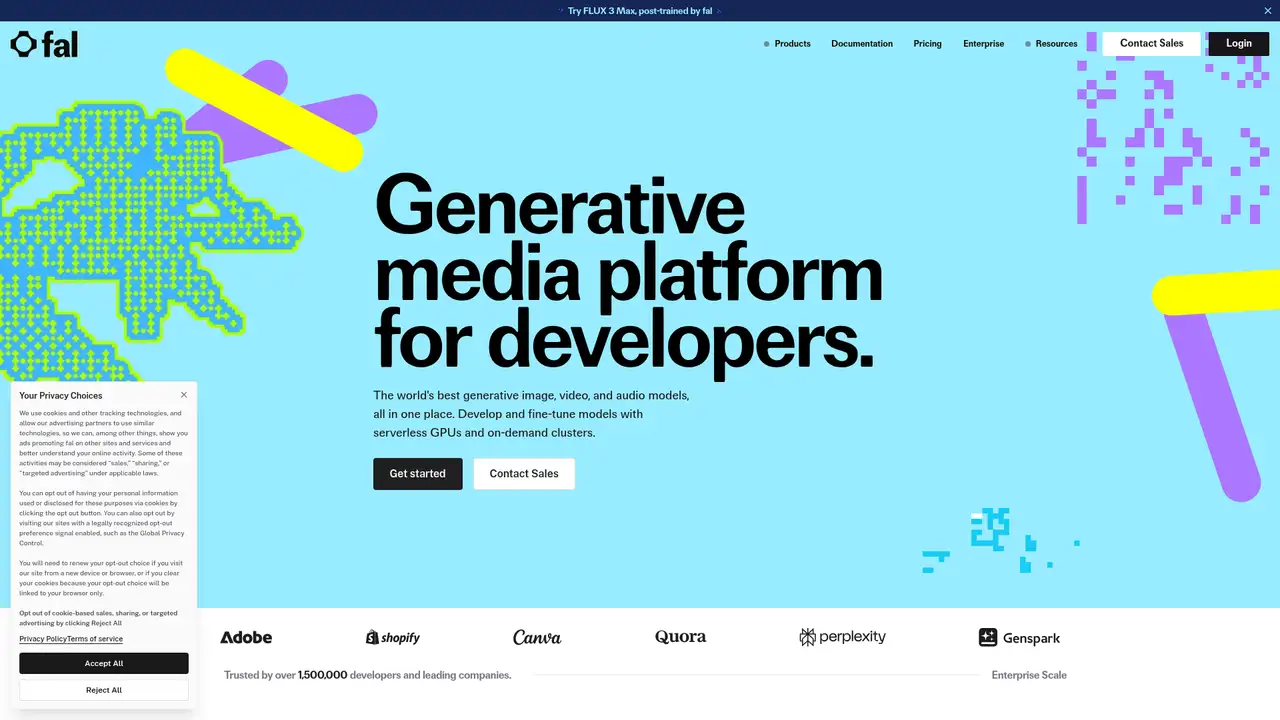
fal is an AI inference platform founded in 2021 by Burkay Gur and Gorkem Yurtseven. It began with infrastructure for generative media and expanded into a model marketplace, developer APIs, serverless GPU compute, and private deployments. fal announced $49 million in Series B funding in February 2025, bringing reported total funding to $72 million. It then announced a $125 million Series C in July 2025 at a reported $1.5 billion valuation. In December 2025, fal announced a $140 million Series D and a reported $4.5 billion valuation. The company says it serves more than 1 million developers and 50 enterprise customers, while its Series B announcement reported more than 100 million inference requests per day. These figures describe company claims rather than independent measurements.
A typical fal workflow begins with selecting a model from the catalog, reviewing its input and output schema, and sending a request through an API or hosted interface. Developers can submit prompts, images, videos, audio, or other model-specific inputs, then receive generated media through the response workflow. The platform supports asynchronous queues, webhooks, model-specific endpoints, and authenticated pricing queries. Platform APIs can host custom models, while serverless GPU runners bill for the time a runner remains active. fal also provides integration tools for placing model outputs inside products. Its terms restrict exposing fal APIs directly to end users without an approved customer solution structure. Enterprise customers can request private deployments and separately negotiated arrangements.
The platform hosts a changing catalog of more than 1,000 models, with entries including Kling v3, MiniMax H3 Max, Seedance, LTX, FLUX 2, Nano Banana 2, PixVerse V6, and other generative media systems. Its documented registry includes PixVerse 5.6 for video, PixVerse 6 Extend, Seedream 3.0 for images, Veo 3.1 Fast, Nano Banana Lite 2, and FLUX Schnell. Model limits differ by endpoint, while the documented registry reports video output up to 1080p. In 2025, fal described an inference engine optimized for real-time video and announced endpoints including Whisper, FLUX, and Stable Diffusion. Model availability, settings, prices, licenses, and output behavior can change. Endpoint documentation therefore matters more than a single platform-wide feature list.
fal uses prepaid credits and pay-as-you-go billing rather than public monthly plans. Representative listed video rates include $0.005 per second for PixVerse V6, $0.025 per second for MiniMax H3 Max Turbo, $0.05 per second for MiniMax H3 Max and Grok Imagine, $0.07 per second for Kling Video, and $0.14 per second for Kling v3 Pro or Standard. Serverless GPU pricing is billed per second while a runner is active, with listed rates from $1.99 per hour for an RTX PRO 6000 low price to $5.99 per hour for a B300 low price. Successful outputs are charged, while server errors and queue time are free. Exact rates require authenticated pricing queries and can change.
fal suits engineering teams better than people seeking a finished browser editor with a predictable monthly bill. Replicate provides a comparable hosted-model approach, while Together AI also serves developers using hosted inference. Runway is closer to a packaged creative application with its own generation experience instead of fal's broad endpoint infrastructure. fal's principal tradeoff is fragmentation: models can have different inputs, prices, licenses, output behavior, and availability. Outputs may be inaccurate or nonunique, and commercial rights depend on each model. Choose fal when model choice, automation, and API access matter more than a uniform editing workflow. Review model licenses and provider terms before releasing paid work.
Who is fal best for?
- Developers building products around generative video APIs.
- Teams comparing many hosted video models through one platform.
- Companies requiring asynchronous inference and automated workflows.
- Organizations seeking private or enterprise model deployments.
fal Pricing (2026)
Pricing model: Usage-based. All prices in USD.
| Plan | Price | What you get |
|---|---|---|
| Pay-as-you-go model APIs | $0.07/second for Kling Video | Prepaid credits are charged per successful output. Rates vary by model, and exact prices can change. |
| Serverless GPU | $1.99/hour and up | GPU runners are billed per second while active. Listed low prices range from $1.99 per hour for RTX PRO 6000 to $5.99 for B300. |
| Enterprise and private deployment | Custom | Private deployments and enterprise arrangements can include different capacity, support, and contract terms. |
Pros and Cons
Pros
- fal exposes a large and changing catalog of generative media models.
- Usage billing can cost little for short or low-volume generations.
- The platform supports APIs, queues, webhooks, and serverless GPU runners.
- Private deployment and enterprise options are available.
Cons
- Model pricing, inputs, licenses, and output limits vary by endpoint.
- Prepaid credits and GPU billing create two different cost structures.
- fal does not guarantee output originality, accuracy, or universal commercial rights.
Who should look elsewhere?
- Creators seeking a complete timeline-based video editor.
- Buyers requiring one predictable monthly subscription.
- Teams unwilling to review model-specific licensing terms.
Technical Details
Frequently Asked Questions
How much does fal cost?
fal has no public monthly subscription tier. Customers prepay credits and pay according to each model's output price or serverless GPU runtime. Listed examples include PixVerse V6 at $0.005 per second, Kling Video at $0.07 per second, and some serverless GPUs from $1.99 per hour at the listed low price. Rates and model availability can change.
Does fal have a free plan?
fal does not publish a conventional free plan. It uses prepaid, usage-based credits, and successful model outputs are billed according to the selected endpoint. Server errors and queue time are free, but generation access requires an account and applicable billing arrangement. fal does not publish a universal free monthly allowance.
How does fal compare with Replicate?
fal and Replicate both provide developer access to hosted AI models with usage-based infrastructure. fal emphasizes generative media endpoints, model-specific pricing, serverless GPUs, and private deployments. The comparison depends on the model, rate, latency, schema, and license required. fal does not provide a single platform-wide price or performance advantage across every model.
Does fal train models on customer data?
fal's API Services terms say fal will not use Client Content to create, train, or develop its products and services, with exceptions for third-party APIs and models marked Pending Enterprise Ready or an equivalent designation. Third-party model providers may receive submitted content. Enterprise contracts and model-specific terms can change the applicable protections.
Can I use fal outputs commercially?
Commercial use depends on the selected model's license. fal says many models permit commercial use, while some are Research Only and cannot be used commercially. Outputs may not be unique, and fal does not guarantee originality or freedom from infringement. Review the endpoint license and third-party provider terms before releasing paid work.