
Factory Droid Review, Pricing & Alternatives (2026)
Delegate software work from the terminal, desktop app, SDK, or CI.
Last updated: October 22, 2026
What is Factory Droid?
Factory Droid is an agentic software development tool for developers and engineering teams. It plans, edits, tests, and reviews repository changes through a desktop app, CLI, SDK, cloud agents, and local background agents. Individual access starts at $20 per month, while team and enterprise plans add shared billing, governance, and deployment options.
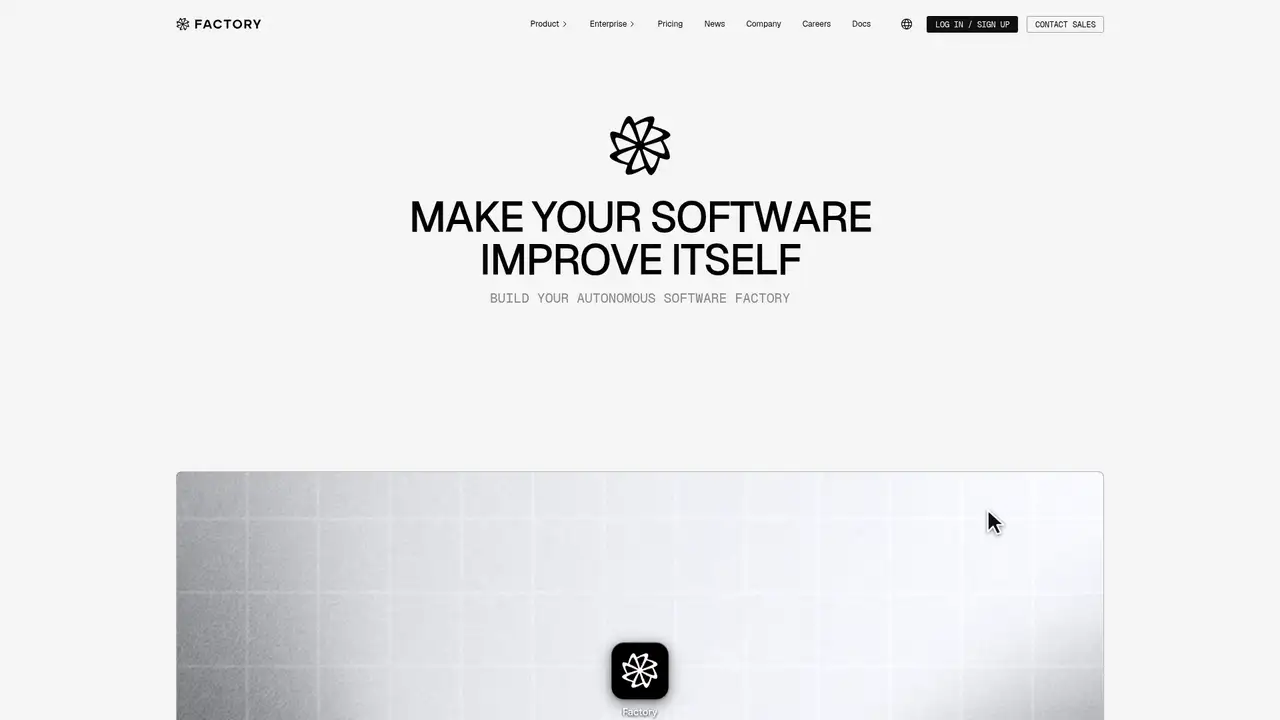
Factory Droid is Factory’s software development agent, released broadly in September 2025 after Factory reported a $50 million Series B at a $300 million valuation. Factory says it was founded in 2023. Droid is designed for delegated repository work rather than inline autocomplete. A developer gives it a task, reviews its plan and tool calls, then approves changes. Factory’s pricing page presents Droid through a desktop app, CLI, SDK, cloud background agents, and local background agents. Enterprise options include dedicated compute, on-premise deployment, data residency, customer-managed encryption keys, and service-level support. That combination makes Droid relevant to individual developers and organizations that need controls around automated repository operations, while its public pricing gives smaller teams a clear starting point.
A normal workflow starts in the interactive terminal interface, where Droid reads repository files and instructions, proposes a plan, runs shell commands, edits files, executes tests, and presents a diff for review. The CLI supports headless droid exec runs, Missions, custom subagents, Skills, plugins, hooks, and MCP connections. Factory also offers a desktop app, SDK access, background agents, Droid Computers, and connections to engineering workflows. Autonomy levels, approval controls, sandboxing, secret scanning through Droid Shield, and worktrees constrain potentially destructive actions. Developers can keep work in a local background process, send it to a cloud computer, or connect the agent to an automated workflow. This range matters when tasks move from interactive terminal work into CI or scheduled engineering operations.
Droid is model-agnostic rather than tied to one permanent provider. Factory documentation lists native commercial and open-weight models, Factory Router, bring-your-own-key connections, and local model endpoints. The September 2025 release highlighted Opus 4.1, GPT-5, and Sonnet 4 benchmark configurations. Factory’s 2026 changelog lists continuing App and CLI releases, including CLI v0.220.0 and Desktop v0.177.0. The CLI and SDK therefore act as control layers for repository work while model choice can vary by account configuration. Users should treat model availability, provider behavior, and limits as plan-dependent details. Droid’s technology story centers on agent execution, computer access, policy controls, and model routing rather than a single proprietary model.
Factory’s public plans are Pro at $20 per month, Plus at $100, Max at $200, Teams at $60 per month per team plus $40 per seat, Business at custom pricing, and Enterprise at custom pricing. Pro includes the desktop app, CLI, SDK, cloud and local background agents, usage statistics, and an agent-readiness dashboard. Plus provides about five times Pro usage, expanded rolling limits, and managed Droid Computers. Max provides about ten times Pro usage and early feature access. Teams supports up to 10 seats and includes 10 shared Droid Computer hours monthly. Individual plans use separate five-hour, seven-day, and 30-day rolling limits. Extra Usage is prepaid, starts at $10, and does not expire. Bring-your-own-key access remains subject to plan allowances and provider charges.
Droid’s main limitation is operational and financial complexity. Rolling five-hour, seven-day, and 30-day limits make high-volume consumption less predictable than a flat editor subscription, while extra model or computer usage can add cost. Business and Enterprise pricing requires a sales conversation, so larger deployments cannot be compared from a public rate card. Claude Code is a narrower terminal agent, Cursor combines agent work with a code editor, and GitHub Copilot centers on coding assistance across development tools. Aider is a more minimal open-source terminal option. Droid is the better fit for teams wanting terminal, desktop, SDK, cloud computer, automation, and organization controls in one product. Developers seeking a minimal local workflow should pick Aider.
Who is Factory Droid best for?
- Engineering teams automating repository work beyond autocomplete.
- Developers who prefer terminal-first agent sessions with reviewable changes.
- Organizations requiring SSO, audit logs, or on-premise deployment options.
- Teams connecting coding agents to automated engineering workflows.
Factory Droid Pricing (2026)
Pricing model: Freemium. All prices in USD.
| Plan | Price | What you get |
|---|---|---|
| Pro | $20/month | Includes the desktop app, CLI, SDK, cloud and local background agents, usage statistics, and an agent-readiness dashboard. |
| Plus | $100/month | Includes about five times Pro usage, expanded rolling limits, and managed Droid Computers. |
| Max | $200/month | Includes about ten times Pro usage, expanded rolling limits, and early access to new features. |
| Teams | $60/month per team + $40/month per seat | Supports up to 10 seats with centralized billing and 10 shared Droid Computer hours per month. |
| Business | Custom | Supports up to 150 seats, custom limits, SSO, SAML, SCIM, ZDR, audit logs, admin controls, onboarding, and support. |
| Enterprise | Custom | Adds unlimited members, partitioned dedicated compute, on-premise options, data residency, encryption keys, and priority SLAs. |
Pros and Cons
Pros
- The CLI, desktop app, SDK, and background agents cover several execution modes.
- Teams receive centralized billing and shared Droid Computer hours.
- Business and Enterprise plans add SSO, audit logs, and retention controls.
- Enterprise includes on-premise deployment options and data residency.
Cons
- Rolling usage limits make high-volume spending harder to forecast.
- Business and Enterprise pricing is not publicly listed.
- Cloud computers and model usage can introduce additional cost.
Who should look elsewhere?
- Users requiring a completely offline agent without a hosted account.
- Developers wanting predictable unlimited usage at one low price.
- People unwilling to review automated shell and file changes.
Technical Details
Frequently Asked Questions
How much does Factory Droid cost?
Pro costs $20 per month, Plus costs $100, and Max costs $200. Teams costs $60 per month per team plus $40 per seat. Business and Enterprise use custom pricing. Individual plans have separate rolling five-hour, seven-day, and 30-day limits. Extra Usage is prepaid, starts at $10, and does not expire.
Does Factory Droid have a free plan?
Factory’s public pricing page lists paid Pro, Plus, and Max plans rather than a permanent free subscription. Factory also describes Droid Core as a free open-weight model pool with separate rate limits after standard usage is exhausted. Users can connect their own model keys, subject to plan allowances and provider charges.
How does Factory Droid compare with Claude Code?
Both tools operate from a terminal and can modify repositories. Droid covers a wider product surface with a desktop app, SDK, cloud and local background agents, Droid Computers, organization plans, and on-premise options. Claude Code is more focused on terminal-based work. Choose Droid for broader team operations, or Claude Code for a narrower terminal workflow.
Does Factory train on customer code?
Factory’s enterprise privacy documentation describes configurable data paths, direct provider API routing in some configurations, zero-data-retention options, and air-gapped deployment. Repository content can remain local when the selected setup supports it, but chosen context may be sent to a configured model or service. Treatment depends on plan, deployment, provider, and telemetry settings.
Can teams use Factory Droid commercially?
Yes. Factory sells individual, team, business, and enterprise subscriptions for software development. Commercial use remains subject to Factory’s terms, subscription limits, model-provider conditions, and any licenses attached to models used through customer connections. Factory’s public product pages do not present Droid as an open-source licensed product.
Best Factory Droid Alternatives in 2026
These tools do the same job as Factory Droid, with different pricing, limits and trade-offs.
An agentic coding assistant for terminal, IDE, desktop, and web
AI coding workspace with repository context and software agents
AI coding assistance across editors, terminals, and GitHub
Open-source AI pair programming in a Git-aware terminal