
DoNotPay Review, Pricing & Alternatives (2026)
Consumer self-help tools for bills, subscriptions, privacy, and bureaucracy
pivoted: Following the February 2025 FTC order restricting unsupported AI-lawyer claims, DoNotPay markets consumer self-help and administrative tools rather than professional legal services.
Last updated: October 22, 2026
What is DoNotPay?
DoNotPay is a consumer self-help platform for subscription cancellations, complaints, refunds, privacy requests, bill disputes, and bureaucratic tasks. It is aimed at people handling routine consumer problems without a lawyer. The company does not publish a stable current public dollar price, and its terms allow recurring subscription and à-la-carte charges.
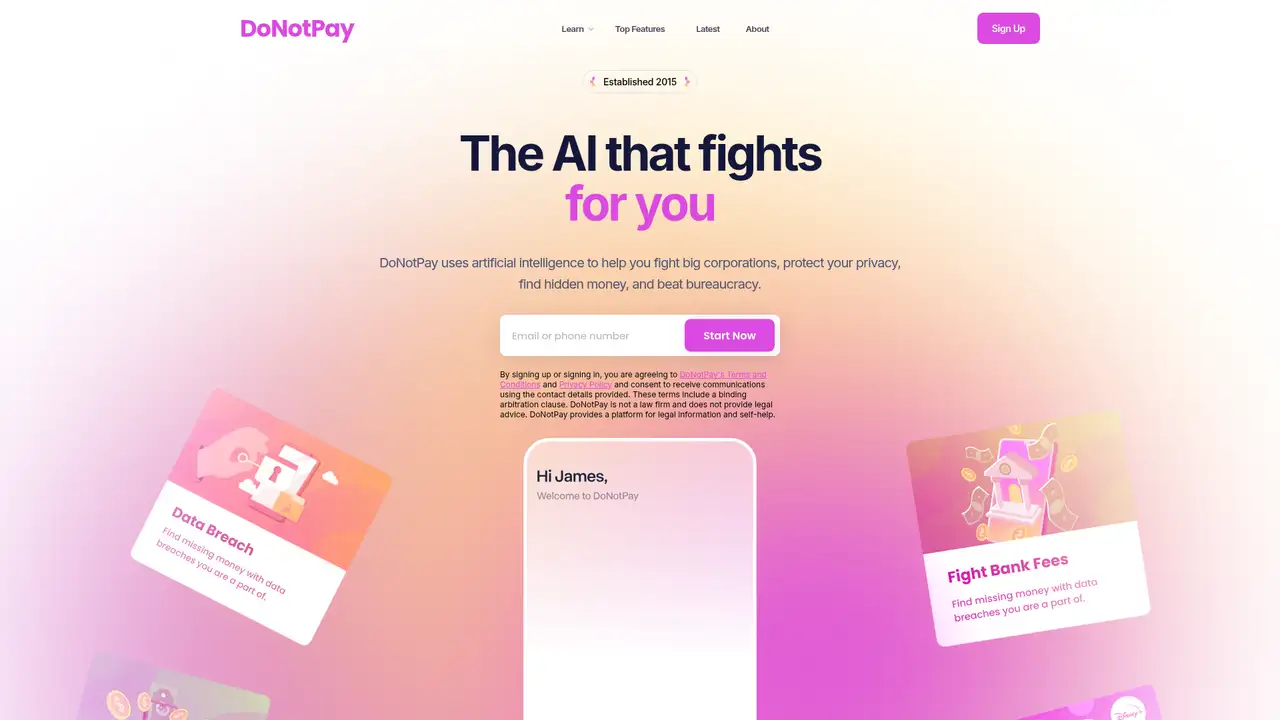
DoNotPay is a consumer self-help service operated by DoNotPay, Inc. It began in 2015 after Josh Browder launched a tool for fighting parking tickets in London, then expanded to the United States and a mobile app in 2017. The company says its current service includes more than 100 AI-powered tools for fighting corporations, protecting privacy, finding unclaimed money, and handling bureaucracy. Its timeline also says DoNotPay raised a $12 million Series A in 2020, led by Coatue, with Andreessen Horowitz and Founders Fund participating. The website describes the product as an AI consumer champion. Its terms state that DoNotPay provides legal information and self-help, does not provide legal advice, and is not a law firm. The iOS listing identifies DoNotPay Inc. as the developer and places the app in Utilities.
DoNotPay organizes its product around tasks rather than a conventional legal consultation. Users describe a problem, select a relevant workflow, and enter information needed to prepare a letter, form, request, or communication. Listed functions include subscription cancellation, complaint letters, privacy requests, bill negotiations, refunds, unclaimed-money searches, bank-fee appeals, parking and traffic-ticket appeals, government forms, burner phone numbers, and a free trial card. The iOS listing says DoNotPay can contact corporations on a user’s behalf, generate complaint letters, and send them. Some workflows can require a linked email account. The terms say DoNotPay may review receipts, correspondence, and contact information in linked accounts for certain airline and hotel services. Merchant rules remain decisive, and the company says its self-help tools are not guaranteed to help every situation.
The company describes DoNotPay as an artificial-intelligence service, but it does not identify a current underlying model or publish technical performance measures in the product pages. Its documented approach combines AI with templates, forms, automated communications, and account workflows. The company says it launched a chatbot in 2022 that could communicate with customer-service representatives to cancel subscriptions and negotiate bills. The current homepage advertises more than 100 AI-powered tools, while the About page lists later additions for privacy, refunds, consumer complaints, and bureaucratic tasks. DoNotPay’s legal positioning changed after Federal Trade Commission action. On February 11, 2025, the FTC announced a final order prohibiting unsupported claims that the service operates like a human lawyer and requiring $193,000 in monetary relief and notices to eligible past subscribers.
DoNotPay does not publish a stable current public price on the homepage or billing page. Its terms describe two paid formats: recurring Subscription Services and as-used A La Carte Services. Subscription fees, taxes, renewal periods, and applicable terms are shown in account settings or agreed in writing, and cancellation must occur at least 48 hours before automatic renewal. The billing FAQ says a subscription activates after signup and can be managed through the app’s settings. The homepage advertises a free trial card, which is a feature rather than a general free plan. Historical FTC complaint figures were $36 every two months for General Membership and $49.99 monthly for a Small Business Protection Plan at relevant times. The App Store listing shows in-app purchases, but its visible listing is not a current universal price quote.
DoNotPay is best suited to routine consumer administration, where a generated letter, form, cancellation request, or privacy request may save time. It is a poor fit for matters requiring legal advice, representation, jurisdiction-specific judgment, or reliable outcomes. Rocket Money overlaps on subscriptions and bills. LegalZoom overlaps on some document-related needs, but its product model is different. Consumer Reports and government consumer portals can be preferable when a free, authoritative process is available. DoNotPay’s own terms disclaim legal advice and say the service does not review information for legal accuracy or apply law to a user’s facts. The FTC order makes the boundary explicit. Pick DoNotPay for low-stakes self-help after checking the fee, renewal terms, permissions, and output; use a licensed lawyer when the consequences are serious.
Who is DoNotPay best for?
- Consumers handling routine subscription, refund, privacy, or complaint tasks.
- People seeking automated letters or forms for low-stakes disputes.
- Users willing to review renewal terms and required permissions.
- Consumers managing varied administrative chores in one account.
DoNotPay Pricing (2026)
Pricing model: Usage-based. All prices in USD.
| Plan | Price | What you get |
|---|---|---|
| Subscription Service | Custom | Recurring fees, renewal periods, and applicable terms appear in account settings or at signup. The company does not publish a stable current public price. |
| A La Carte Services | Custom | Fees apply on an as-used basis and may vary by service. External government or corporate fees may also apply with permission. |
Pros and Cons
Pros
- The service groups more than 100 consumer and bureaucratic tools in one account.
- It can generate complaint letters and automate some company communications.
- The task-based format can reduce the work of finding individual procedures.
- The company states that its self-help tools are not guaranteed to work.
Cons
- The company does not publish a stable current public dollar price.
- The FTC prohibited unsupported claims that the service operates like a human lawyer.
- Some workflows can require linked accounts or sensitive payment information.
Who should look elsewhere?
- Anyone needing licensed legal advice or representation.
- Users unwilling to share necessary payment or account information.
- High-stakes disputes where incorrect work could cause harm.
Technical Details
Frequently Asked Questions
How much does DoNotPay cost?
DoNotPay does not publish a stable current public price. Its terms allow recurring subscriptions and à-la-carte charges, with applicable fees shown in account settings or at signup. Historical FTC complaint figures were $36 every two months for General Membership and $49.99 monthly for a Small Business Protection Plan, but those figures applied at relevant historical times and are not current quotes.
Is DoNotPay free?
DoNotPay is not presented as a fully free service. Its homepage advertises a free trial card, while its terms allow paid recurring and à-la-carte services. The amount and renewal period should appear before signup. Users should also check for external government, corporate, or payment-related fees connected with a task.
DoNotPay or LegalZoom: which should I use?
DoNotPay focuses on consumer self-help tasks such as cancellations, complaints, refunds, privacy requests, and bureaucratic forms. LegalZoom is a different service category that includes legal-document offerings. DoNotPay may suit routine administrative work, while a formal document or consequential legal issue may require a different provider or a licensed lawyer.
Does DoNotPay train on my data?
DoNotPay’s published privacy policy describes collecting information through the service, connected email or shopping accounts, usage data, and payment details. It says information may be used to operate, improve, personalize, and analyze the service, and may be shared with service providers. The published policy does not give a complete, tool-specific answer about model training.
Can I use DoNotPay for commercial or legal work?
The terms authorize use solely for personal, non-commercial purposes unless DoNotPay gives prior written consent. DoNotPay is not a law firm and does not provide licensed legal representation. The FTC’s 2025 order prohibits unsupported claims that the service operates like a human lawyer or performs professional services. Users should seek qualified counsel when legal consequences matter.