Diffit Review, Pricing & Alternatives (2026)
Differentiated, classroom-ready resources in minutes
Last updated: October 26, 2026
What is Diffit?
Diffit is a web app for turning topics, links, images, articles, or pasted text into differentiated readings and classroom activities. A free plan includes core creation and PDF workflows; Individual costs $14.99 monthly or $149.99 yearly, while schools receive custom quotes. It suits teachers supporting mixed reading levels, multilingual learners, intervention, and MTSS instruction, but generated content needs review.
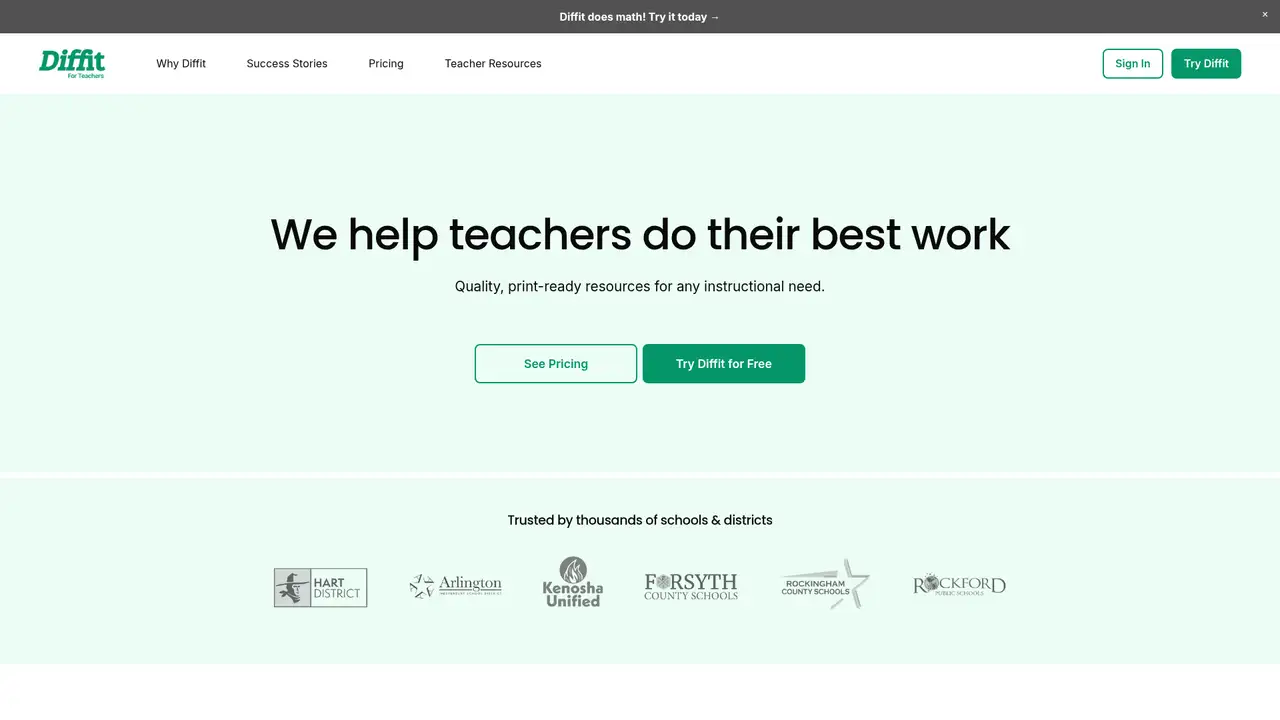
Diffit is an education software company founded in 2023 that creates materials for differentiated instruction. Its stated purpose is helping teachers adapt topics, articles, links, images, and reading material for students working at different levels. The product targets schools and districts, including English-language learner, special education, intervention, and MTSS instruction. Diffit is a for-profit company, and its school offering is intended for broad staff access rather than student accounts. The service runs as a web app and produces resources for printing or sharing. Its focus is narrower than an all-purpose teacher assistant: adapting instructional material is the central task, while related activities are generated around that source. This makes it most relevant when one lesson must serve learners with varied reading needs.
Diffit begins with a teacher-provided topic, question, article link, image, or pasted text. The teacher selects an approximate reading level and language, then generates materials that may include a leveled reading, summary, vocabulary, multiple-choice questions, short-answer questions, and open-ended prompts. Each resource can be edited, scaffolded, extended, copied, printed, downloaded as a PDF, or shared with colleagues. The workflow creates several classroom components from one request, reducing the need to prepare every reading level and activity separately. Teachers can therefore start with existing instructional content instead of writing a full lesson from scratch. The free plan covers the central creation workflow, while paid access adds exports, alignment, history, reuse, refreshing, and graphic organizers for recurring planning.
Diffit does not publish model names, so its underlying technology cannot be evaluated through a named model family. Its update record through October 26, 2026 lists curriculum integration, math materials, front-of-room slides, a Chrome extension, image-based starting points, folders, collections, templates, source-text controls, layout options, and additional activity formats. It also lists a connector for using Diffit in Claude, though Diffit does not describe its own model stack. These additions extend the service beyond leveled passages while preserving its source-based workflow. Diffit says it does not collect student data and describes encryption, annual independent security testing, and restricted employee access. Teachers remain responsible for checking generated material before classroom use.
Basic is free and includes creation, editing, adaptation, PDF download, printing, sharing, and access to content made within the previous 90 days. Individual access costs $14.99 per month or $149.99 per year for US customers, with possible country variation. It adds Google, Canva, and Microsoft exports, standards and skills alignment, curriculum and MTSS alignment, complete history, refreshing, reuse, and graphic organizers. School and district subscriptions are annual, enrollment-tiered, and quote-based. They provide premium access for staff, an administration dashboard, professional development, and dedicated support. Buyers should note three practical limits: institutional pricing is not published, model names and usage quotas are not disclosed, and generated instructional content requires teacher review before use.
Diffit is more focused on differentiated source material than MagicSchool, which covers a wider range of teacher tasks. Brisk Teaching is more closely connected to browser and document workflows, while Canva for Education is stronger for visual design and presentation production. Diffit’s main advantage is the short path from source material to leveled readings, questions, vocabulary, and printable activities. Its tradeoffs are narrower scope and limited public detail about technical operation and school pricing. Teachers who need fast differentiation around existing material should pick Diffit. Teams seeking an all-purpose teacher assistant, a design suite, or a public integration layer should consider MagicSchool, Brisk Teaching, or Canva for Education instead.
Who is Diffit best for?
- Teachers adapting material for mixed reading levels.
- Multilingual learner, intervention, and MTSS instruction.
- Schools creating print-ready supplemental resources.
- Educators using Google, Canva, or Microsoft exports.
Diffit Pricing (2026)
Pricing model: Freemium. All prices in USD.
| Plan | Price | What you get |
|---|---|---|
| Basic | $0 | Create, edit, adapt, download PDF files, print, share, and access content made within the last 90 days. |
| Individual Subscription | $14.99/month or $149.99/year | Adds Google, Canva, and Microsoft exports, alignment, full resource history, refreshing, reuse, and graphic organizers. |
| Diffit for Schools | Custom annual quote | Enrollment-tiered access for school or district staff, with premium features, dashboard, professional development, and dedicated support. |
Pros and Cons
Pros
- One source can produce several differentiated classroom materials.
- The free plan includes creation, editing, printing, sharing, and PDF download.
- Paid plans support common Google, Canva, Microsoft, and Classroom workflows.
- Diffit says it does not collect student data.
Cons
- School pricing is quote-based.
- The company does not publish model names or usage quotas.
- Generated resources require teacher review before classroom use.
Who should look elsewhere?
- Teams seeking a public API.
- Users wanting a student-facing chatbot.
- Buyers requiring published school price bands.
Technical Details
Frequently Asked Questions
How much does Diffit cost?
Basic is free. The Individual Subscription costs $14.99 per month or $149.99 per year for US customers, and prices may vary by country. Diffit for Schools uses annual enrollment-tiered pricing, with quotes for schools or districts. Individual purchases require a credit card through a teacher account.
Is Diffit free?
Yes. Basic includes creation, editing, adaptation, PDF download, printing, sharing, and access to content made within the last 90 days. Paid access adds exports, alignment, complete history, resource refreshing and reuse, and graphic organizers. School trials provide temporary premium access before the account returns to free features.
What is the closest rival to Diffit?
MagicSchool is the closest broad rival because both serve teachers with AI-assisted planning tools. Diffit is more specialized in adapting source material into leveled readings and related activities. Brisk Teaching is another close option for browser and document workflows, while Canva for Education is stronger for visual resource design.
How does Diffit handle privacy and training data?
Diffit says it collects teacher names, email addresses, and IP addresses to provide the service, and does not collect student data. It says personal data is not sold or used for third-party advertising. Its privacy policy describes service-provider sharing, retention rules, deletion rights, and security measures, but does not explain model-training use.
Can businesses license Diffit content commercially?
Diffit publicly describes individual teacher, school, and district subscriptions. Its published pages do not identify a separate commercial content license, redistribution license, or public API program. Organizations planning to publish, redistribute, or use generated resources outside the stated education subscriptions should ask Diffit about the applicable terms.
Best Diffit Alternatives in 2026
These tools do the same job as Diffit, with different pricing, limits and trade-offs.