
Briefpoint Review, Pricing & Alternatives (2026)
Automated written discovery with editable, Bates-cited responses
Last updated: October 26, 2026
What is Briefpoint?
Briefpoint is a browser-based legal AI platform for plaintiff and defense firms that automates written discovery, client file collection, and document generation. Its Rainmaker plan costs $150 per attorney per month when billed annually and includes flat-rate document generation. Find Answers uses pooled monthly credits, with overage charges for firms that exceed their allowance.
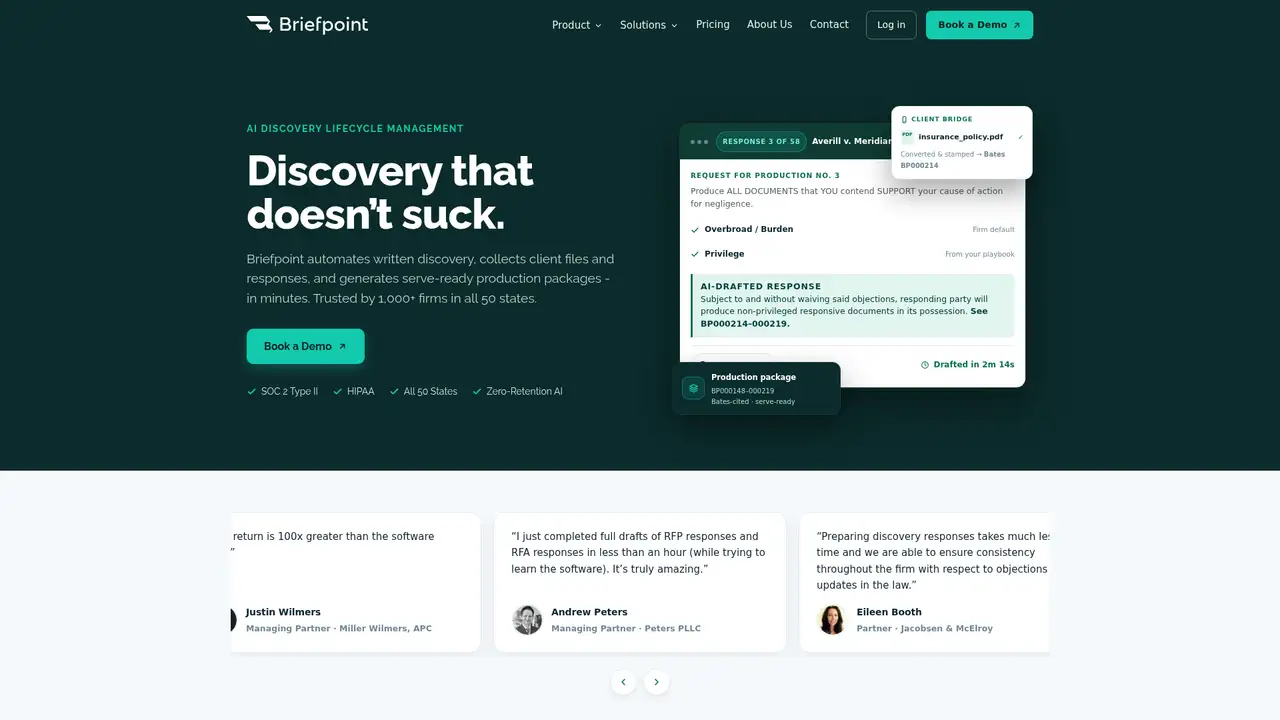
Briefpoint is a browser-based application from The Simple Associate, Inc., founded by Nathan Walter and Chris Maffin and launched in June 2022. It serves attorneys, paralegals, and litigation teams handling recurring written discovery. The platform drafts interrogatory answers, requests for production, and requests for admission, while collecting client files and assembling Bates-cited production packages. Briefpoint describes itself as a focused discovery system rather than a general legal research assistant. Current product materials emphasize editable Word output, firm processes, objection libraries, client collection, and support across all 50 states and 98 federal district courts. It does not publish a named foundation model or detailed funding history. Its strongest fit is a plaintiff or defense firm that repeatedly prepares similar discovery responses across active matters.
A typical workflow begins when a team uploads discovery requests and case files, or sends a client a secure collection workflow for answers and documents. Briefpoint drafts objections and substantive responses, checks documents against interrogatories through Find Answers, and supports privilege tagging and privilege-list construction. Users review and revise the output in Word before service. Interrogatory Answers can draft from uploaded case files with exact page and line citations, while production workflows identify responsive files and generate Bates-cited responses and packages. AutoDoc, supplemental responses, client collection, and Doc Drop extend the process to later discovery tasks. Generated documents remain editable, so attorneys retain responsibility for factual accuracy, privilege decisions, client verification, and final service.
Briefpoint does not publish a model name or version. It describes purpose-built legal AI for written discovery, including objection-aware drafting, substantive answers, jurisdiction-specific formatting, and outgoing discovery generated from pleadings. Its Discovery Playbook stores firm objections and responses, while Find Answers checks one document against one interrogatory per credit. The company has also described Doc Drop for individual file uploads in production and admission workflows, but feature timing should be confirmed directly because product pages change. Find Answers gives each attorney seat 20,000 monthly credits to a pooled firm balance, with no rollover and one-cent overage pricing. Simplify, Auto-Object, and Translate do not consume those credits. Attorneys should review generated work before relying on it or serving it.
Rainmaker is the current base plan at $150 per attorney per month when billed annually, or $1,800 per year. It includes flat-rate document generation, listed features, support, training, and no per-case or per-document generation fees. Find Answers adds a usage boundary: each attorney seat contributes 20,000 monthly credits to a shared firm pool, and unused credits do not roll over. Overage costs $0.01 per credit. Briefpoint Pro is a firm add-on priced at $99 per month. It adds 20,000 Find Answers credits and unlimited Discovery Playbook slots, while every plan includes 100 Playbook slots. Paralegal seats do not add credits. Briefpoint promotes live demos, but does not list a free commercial plan. Teams should confirm taxes, onboarding terms, and cancellation conditions before subscribing.
Briefpoint is narrower than Gavel, Clio Draft, and HotDocs: its workflows are designed around written discovery rather than general legal document automation. Gavel supports configurable templates and client-facing questionnaires, while Clio Draft connects document preparation to case management. HotDocs is another template-automation option. Briefpoint instead packages objections, substantive responses, client collection, and Bates-cited production into a discovery-specific workflow. That focus limits its usefulness outside litigation discovery. Its public pages do not advertise self-hosting or a general-purpose API, and attorney review remains necessary. Find Answers overages also mean the subscription is not an unlimited document-analysis budget. Choose Briefpoint when recurring written-discovery responses and production packages consume more time than broader template drafting.
Who is Briefpoint best for?
- Firms handling recurring interrogatories, production requests, and admission requests.
- Teams collecting client files and answers inside a discovery workflow.
- Firms standardizing objections through a shared Discovery Playbook.
- Attorneys requiring editable Word documents before service.
Briefpoint Pricing (2026)
Pricing model: Paid. All prices in USD.
| Plan | Price | What you get |
|---|---|---|
| Rainmaker | $150/attorney/month, billed annually | Includes flat-rate document generation, all listed features, support, training, and 100 Discovery Playbook slots per plan. |
| Briefpoint Pro | $99/month per firm | Firm add-on that adds 20,000 Find Answers credits and unlimited Discovery Playbook slots. |
| Find Answers overage | $0.01/credit | One credit checks one document against one interrogatory. Monthly credits do not roll over. |
Pros and Cons
Pros
- Automates objections and substantive written-discovery responses.
- Collects client files and answers within the discovery workflow.
- Rainmaker includes flat-rate document generation.
- Find Answers reports usage through pooled firm credits.
- Supports Bates-cited production packages and editable Word review.
Cons
- The published Rainmaker price requires annual billing.
- Find Answers can create one-cent-per-credit overage charges.
- The product does not publish a named model or public API.
- Feature availability and contractual security details should be confirmed during procurement.
Who should look elsewhere?
- Research teams needing broad case-law or citator coverage.
- Organizations requiring a public API or self-hosted deployment.
- Firms unwilling to review AI-generated discovery before service.
Technical Details
Frequently Asked Questions
How much does Briefpoint cost?
Rainmaker costs $150 per attorney per month when billed annually, or $1,800 per year. It includes flat-rate document generation, listed features, support, and training. Find Answers contributes 20,000 monthly credits per attorney seat to a pooled firm balance. Additional usage costs $0.01 per credit.
Does Briefpoint offer a free plan or trial?
Briefpoint does not list a free commercial plan. Its site promotes live demos, but current pricing materials do not describe a standard free trial with defined limits or duration. Firms can discuss demonstrations, pilots, and procurement terms with the company before subscribing.
Briefpoint versus Clearbrief: which should a litigation firm choose?
Briefpoint is built for written discovery, including objections, substantive answers, client file collection, and Bates-cited production packages. Clearbrief works inside Word to connect litigation writing with supporting evidence, citations, timelines, and tables of authorities. Choose Briefpoint for discovery volume; choose Clearbrief for evidence-linked brief drafting.
Does Briefpoint use client data to train AI?
Briefpoint says information entered into the service is not used to train Briefpoint or third-party AI models. It also describes account-level data separation and encryption in transit and at rest. Firms should review the privacy policy, contractual terms, retention settings, and any available opt-out controls against their confidentiality requirements.
Can Briefpoint outputs be used commercially?
Briefpoint sells Rainmaker subscriptions to law firms for commercial litigation work. Its generated documents are editable and intended for attorney review before service. Commercial use does not remove duties involving accuracy, privilege, confidentiality, jurisdictional rules, or client approval. Firms remain responsible for final responses and production decisions.