
Bria Review, Pricing & Alternatives (2026)
Licensed-data image generation and editing for production teams
Last updated: October 26, 2026
What is Bria?
Bria is an image-generation and editing platform for creative teams, developers, and enterprises that need API access, local deployment, or licensing controls. Its hosted platform includes 100 free generations, then pay-as-you-go access from $0.018 per generation. Fibo 2 self-hosted licensing starts free for eligible organizations and reaches $499/month for Starter.
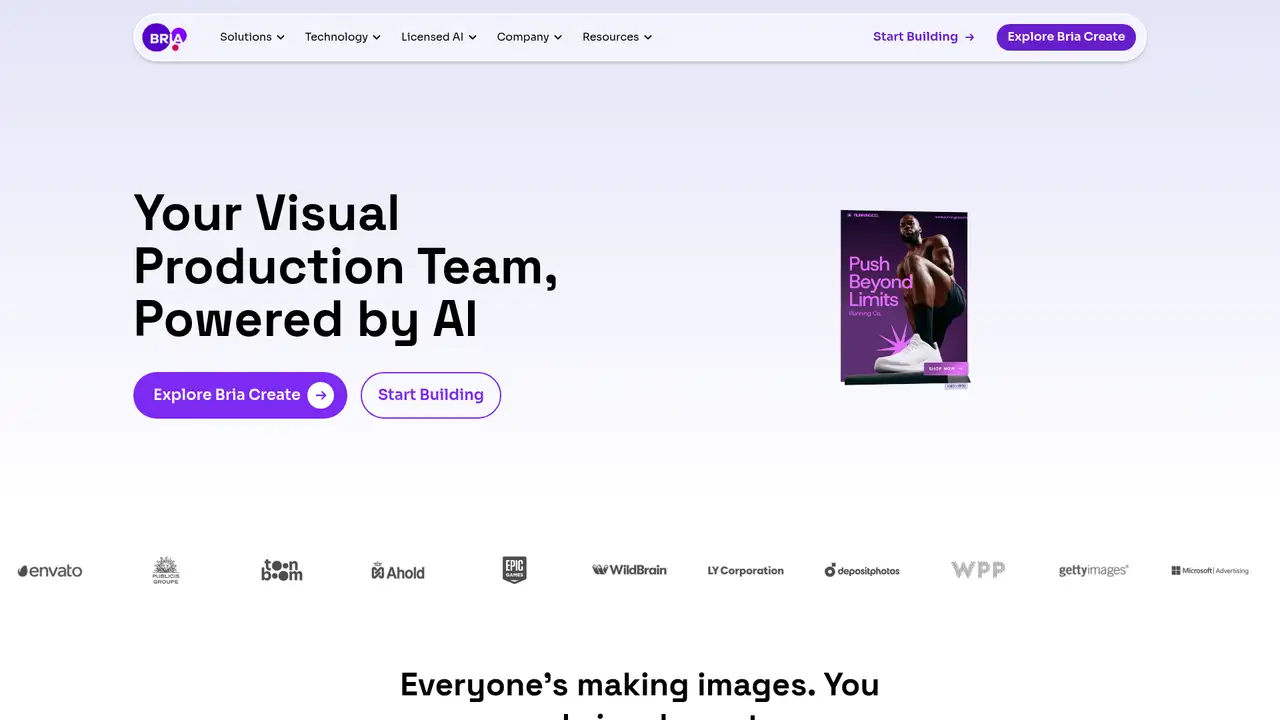
Bria is an image generation and editing company founded in 2020 by Yair Adato and Gal Jacobi, with operations in New York and Tel Aviv. It builds models, APIs, integrations, and deployment options for creative teams, developers, and enterprises. TechCrunch reported a $40 million Series B in March 2025, bringing total funding to about $65 million, with 40 employees and 40 customers at that time. Bria says its foundation models use licensed training data from about 20 partners. The platform targets organizations that need commercial controls, attribution, customization, API access, or private deployment. That positioning differs from consumer image tools centered on quick experimentation and social sharing. Bria is active, and its main current model family is Fibo 2.
Bria combines text-to-image generation with image editing, background removal, image expansion, upscaling, object removal, and advertising-layer separation. A typical workflow begins with a prompt or source image, then uses natural-language instructions, masks, reference images, or structured Visual GenAI Language inputs to guide the output. Fibo 2 accepts up to four reference images and can preserve areas outside a requested edit. Teams can work through hosted APIs, Figma and DCC integrations, ComfyUI nodes, or sandbox interfaces. Bria also supports fine-tuning and private cloud, on-premises, or offline deployment for enterprise customers. Developers can start with cloud services, while production teams can connect generation and editing functions to an existing product or design workflow.
Fibo 2 is Bria’s current flagship, an 8-billion-parameter model designed for image generation and editing. Bria describes it as a flow-matching system using the FLUX.2 VAE, Qwen3-VL-4B-Instruct prompt encoding, and structured VGL captions for lighting, composition, camera, and style. Fibo 2 Dev is the full checkpoint for quality, research, and fine-tuning. Edit Turbo is distilled for fewer-step editing. The model supports masked edits, multi-reference editing, improved in-image text, and structured JSON output. Bria says Fibo 2 was trained on about one billion licensed images. Its October 2026 model page reports first place for open-weights image editing and second place for text-to-image in Artificial Analysis rankings dated October 20, 2026.
Bria’s hosted service starts with 100 free generations or API calls, no credit card, cloud-only deployment, a 10 requests per minute limit, and queue-based latency. Hosted pay-as-you-go removes the generation cap, raises throughput to 60 requests per minute, and starts at $0.018 per generation, although individual API services have separate rates. Self-hosted Fibo 2 uses separate plans. Eligible organizations receive 2,000 monthly calls on Free, then pay $0.04 per extra call. Starter costs $499 per month for 25,000 calls, while Scale costs $1,499 per month for 125,000 calls. Starter and Scale include output IP warranties. Enterprise adds custom models, resale, offline or on-premises deployment, SLA terms, and uncapped indemnity.
Licensing is Bria’s main complication. Fibo 2 weights use CC BY-NC 4.0 for non-commercial work, while commercial deployment requires a separate agreement, and hosted protections vary by plan. Midjourney is easier for fast visual exploration, but it does not offer Bria’s stated self-hosted Fibo licensing structure. Adobe Firefly fits teams already working inside Creative Cloud, while Bria places more emphasis on APIs, deployment, and licensing controls. Stability AI offers open models and APIs, but its model lineup and licensing terms differ by release. Bria also keeps enterprise pricing custom, and self-hosting requires infrastructure work. Pick Bria if licensed-data positioning, controlled editing, API integration, or private deployment matters more than a simple consumer interface.
Who is Bria best for?
- Teams building image generation or editing into a product.
- Enterprises requiring licensed-data positioning and IP protections.
- Developers needing hosted APIs or private Fibo 2 deployment.
- Creative workflows using masks, references, and structured visual controls.
Bria Pricing (2026)
Pricing model: Freemium. All prices in USD.
| Plan | Price | What you get |
|---|---|---|
| Hosted Free | Free | 100 generations or API calls, 10 requests per minute, cloud-only deployment, queue-based latency, and Discord community support. |
| Hosted Pay-as-you-go | From $0.018/generation | No generation cap, 60 requests per minute, priority queue latency, standard technical support, and capped standard indemnification. |
| Hosted Enterprise | Custom | Commercial rights for open-source models, visual birth certificates, SSO/SAML, audit logs, custom DPA, private deployment, and custom capacity. |
| Fibo 2 Self-hosted Free | Free | 2,000 calls per month, then $0.04 per call; no fine-tuning; available to organizations under $2 million annual revenue. |
| Fibo 2 Self-hosted Starter | $499/month | 25,000 calls per month, $0.04 per extra call, IP warranty, email support, and eligibility for organizations under $10 million annual revenue. |
| Fibo 2 Self-hosted Scale | $1,499/month | 125,000 calls per month, $0.04 per extra call, self fine-tuning, IP warranty, and eligibility for organizations under $10 million annual revenue. |
| Fibo 2 Self-hosted Enterprise | Custom | Unlimited flat-price usage, custom models, resale, on-premises or offline deployment, SLA, and uncapped indemnity. |
Pros and Cons
Pros
- Fibo 2 combines text-to-image generation and image editing in one model.
- The platform supports hosted APIs, ComfyUI, integrations, and private deployment.
- Bria says its foundation models are trained exclusively on licensed data.
- Native masks and up to four visual references suit controlled production edits.
Cons
- Commercial use of open weights requires a separate Bria agreement.
- The hosted and self-hosted pricing structures are separate and complex.
- Enterprise deployment pricing is custom rather than publicly itemized.
Who should look elsewhere?
- Casual users wanting the simplest consumer image generator.
- Teams needing commercial rights from open weights without a separate agreement.
- Organizations seeking a fully self-hosted product without infrastructure work.
Technical Details
Frequently Asked Questions
How much does Bria cost?
Bria’s hosted platform has a free tier with 100 generations or API calls. Hosted pay-as-you-go starts at $0.018 per generation, with service-specific API rates. Fibo 2 self-hosted licensing has a free plan with 2,000 monthly calls for eligible organizations, followed by Starter at $499 per month and Scale at $1,499 per month. Enterprise pricing is custom.
Does Bria have a free plan?
Yes. Hosted Bria provides 100 free generations or API calls, cloud-only deployment, 10 requests per minute, and queue-based latency. Fibo 2 self-hosted licensing separately provides 2,000 calls per month on its Free plan for organizations under $2 million in annual revenue. Calls above that allowance are billed at $0.04 each.
Bria versus Adobe Firefly: which is better?
Bria is the stronger fit when API access, Fibo 2 self-hosting, private deployment, structured controls, or explicit licensing terms are central requirements. Adobe Firefly is the closer choice for teams already working inside Creative Cloud. Bria’s public plans emphasize model deployment and usage, while Firefly’s product experience centers on Adobe applications and creative workflows.
Does Bria train on user images or use them for model training?
Bria says its foundation models are trained exclusively on licensed data and that its dataset contains about one billion images. TechCrunch reported that Bria’s customers own their data and outputs. Those statements describe Bria’s training data and customer ownership position, but the cited pricing and model pages do not provide a complete, general retention policy for every hosted input.
Can Bria images be used commercially?
Bria’s hosted pricing page says its models use fully licensed commercial-grade data and offers commercial protections that vary by plan. Fibo 2 open weights are released under CC BY-NC 4.0 for non-commercial use. Commercial use of those weights requires a commercial agreement with Bria, while Enterprise licensing adds commercial rights, deployment options, and stronger indemnity terms.
Best Bria Alternatives in 2026
These tools do the same job as Bria, with different pricing, limits and trade-offs.
A multi-model studio for generating and editing creative assets
High-control image generation for visual development and concept work
Text-accurate image generation for creators and design teams

Create images, video, and design assets with hosted generative models