
Brandwatch Review, Pricing & Alternatives (2026)
Enterprise consumer intelligence, social management and influencer marketing
Last updated: October 26, 2026
What is Brandwatch?
Brandwatch is a Cision-owned marketing intelligence platform for organizations that monitor public conversation, manage social channels and measure influencer campaigns. It combines consumer intelligence, social media management and influencer marketing in a sales-led product suite. Brandwatch publishes no free tier or public dollar entry price, so buyers must request a custom quote based on selected products, data access and contract scope.
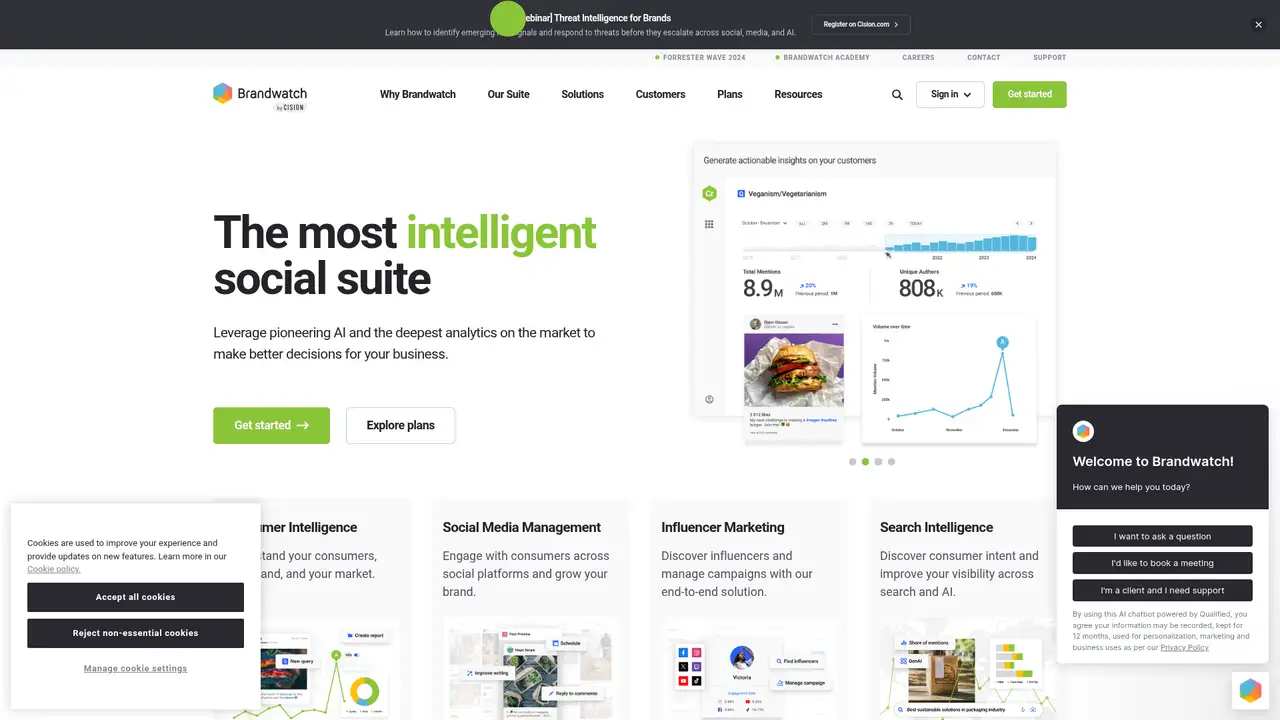
Brandwatch is a marketing intelligence company founded by Giles Palmer in 2007 and owned by Cision. Cision announced its $450 million acquisition in February 2021 and completed the deal on June 1, 2021. Brandwatch and Crimson Hexagon announced a 2018 merger that they described as creating an approximately $100 million ARR business. Earlier acquisitions included PeerIndex in 2013 and BuzzSumo in 2017. The current suite spans Consumer Intelligence, Social Media Management and Influencer Marketing. That range makes Brandwatch an enterprise marketing platform rather than a narrow social listening tool. It covers public conversation, publishing, customer engagement, creator discovery, campaign measurement and reporting, with products aimed primarily at larger marketing, communications and research teams.
Brandwatch connects three marketing workflows, although each solution family has its own plan structure. Consumer Intelligence searches a large archive of consumer opinion and turns findings into customizable dashboards, alerts, automated reports and AI-assisted analysis. Social Media Management unifies channels for organic and paid content calendars, social CRM, listening, benchmarking and dashboards. Influencer Marketing supports creator discovery, relationship management and campaign reporting through a database of more than 30 million creators. A typical team can monitor a topic, classify findings, summarize themes, share a dashboard, schedule social content and measure creator activity. The products are presented separately, so buyers should map required functions to the order form rather than assume every feature appears in one subscription. That separation can complicate planning for smaller teams.
Brandwatch combines in-house AI with optional services from OpenAI, Google Gemini and Speechify. Published use cases include summarization, classification, narrative identification, trend and volume analysis, public-dataset tagging, query generation and content creation. In August 2025, Brandwatch announced a Trajaan partnership covering traditional search, ecommerce, social platforms and emerging generative AI applications. In November 2025, it announced Ask Iris, AI Query Writer, AI Dashboards, influencer summaries, translations and industry benchmarks. Coverage expanded to Threads, YouTube, TikTok, LinkedIn, Trajaan data and more than 70,000 trending podcasts with transcript analysis. APAC data, Bring Your Own Data, richer video and image analysis and a mobile app were described as 2026 plans, not delivered capabilities.
Brandwatch uses paid, custom quote pricing. Its official plans page lists Standard through Enterprise for Consumer Intelligence, Social Media Management and Influencer Marketing, but gives no dollar figures and offers no free tier. Business Essentials terms place fees on the Order Form, describe them as generally non-refundable and permit monthly or annual billing. Actual cost can vary with solution family, seats, data access, historical coverage, integrations and contract scope. Buyers should request an order form specifying products, billing period, data limits, retention terms and usage restrictions before comparing Brandwatch with seat-based social tools. Individuals and students have separate consumer terms requiring website fees to be paid in advance by credit card. The sales-led model suits procurement teams, but limits quick budget comparisons.
Brandwatch requires a more involved purchase than self-serve social tools because pricing, data access and product scope are negotiated. Sprout Social publishes annual-billing prices from $79 per seat monthly for Essentials to $399 for Advanced, with Enterprise custom, making seat budgeting easier. Talkwalker and Meltwater are closer enterprise listening comparisons, while Hootsuite emphasizes publishing and engagement. Sprinklr covers a broader customer-experience operation. Brandwatch also merits privacy review because its database contains personal data and products can process customer-provided information. Optional third-party AI vendors may retain data for up to 30 days for support and security, while Brandwatch describes opt-out and deletion controls and says customer data is not used for model training. Choose Brandwatch when broad intelligence, social operations and influencer reporting justify a custom enterprise contract.
Who is Brandwatch best for?
- Enterprise teams combining consumer intelligence with social workflows.
- Brands needing customizable dashboards, alerts and automated reporting.
- Marketing groups managing influencer discovery and campaign reporting.
- Organizations prepared to evaluate a custom sales-led contract.
Brandwatch Pricing (2026)
Pricing model: Paid. All prices in USD.
| Plan | Price | What you get |
|---|---|---|
| Standard | Custom | Brandwatch sells Consumer Intelligence, Social Media Management and Influencer Marketing separately. Features, data allowances and user limits depend on the order form. |
| Enterprise | Custom | Enterprise packaging is sales-led. Request product-specific allowances, AI access, API terms and annual commitments in the quote. |
Pros and Cons
Pros
- Three solution families cover intelligence, social management and influencer marketing.
- Influencer Marketing includes a database of more than 30 million creators.
- AI features support queries, summaries, classification and trend analysis.
- Administrators can opt out of optional third-party AI vendors.
Cons
- Brandwatch publishes no public dollar prices for current plans.
- Several products can process customer-provided personal data.
- Some announced 2026 capabilities remain planned rather than delivered.
Who should look elsewhere?
- Small teams seeking a public self-serve entry price.
- Buyers requiring a free social media management tier.
- Organizations needing self-hosted or open-source software.
Technical Details
Frequently Asked Questions
How much does Brandwatch cost?
Brandwatch does not publish dollar prices for its current plans. Consumer Intelligence, Social Media Management and Influencer Marketing are offered across Standard through Enterprise tiers with custom, sales-led pricing. Business Essentials terms say fees appear on the Order Form and may be billed monthly or annually. Ask for a quote identifying products, seats, data access, history and contractual limits.
Does Brandwatch have a free plan?
Brandwatch does not publish a free tier on its official plans page. Its current business structure is paid and custom quoted, with Standard through Enterprise plans across three solution families. Individuals and students have separate website fee terms, while business customers receive fees through an Order Form. Any trial or demonstration should be confirmed for the specific product family being evaluated.
How does Brandwatch compare with Sprout Social?
Brandwatch combines consumer intelligence, social media management and influencer marketing, with opinion search, creator discovery and enterprise dashboards. Sprout Social publishes annual-billing prices for several social-suite tiers, making seat-based budgeting more transparent. Brandwatch fits teams that want listening and influencer functions in one buying process, while Sprout Social is a clearer choice for social publishing, engagement and public pricing.
Does Brandwatch train AI models on customer data?
Brandwatch says it does not allow third-party AI vendors to use Customer Data to train machine-learning systems. Its privacy statement also says collected Personal Data is not used to train Brandwatch models or third-party models powering features. Optional vendors may retain data for up to 30 days for support and security. Administrators can opt out, and contracts should be reviewed for deployment-specific terms.
Can businesses use Brandwatch commercially?
Brandwatch is designed for business workflows covering consumer research, publishing, engagement, dashboards and influencer campaigns. Its privacy FAQs identify products that can process customer-provided data, including Publish, Engage, Vizia, Influence, Consumer Research and the Content Upload API. Commercial users should review data roles, permissions, retention, deletion and data-processing terms before uploading personal or confidential information.
Best Brandwatch Alternatives in 2026
These tools do the same job as Brandwatch, with different pricing, limits and trade-offs.