
Bardeen Review, Pricing & Alternatives (2026)
Browser-based AI automation for research, enrichment, and GTM workflows
Last updated: October 26, 2026
What is Bardeen?
Bardeen is a browser-centered automation platform for web scraping, search, enrichment, AI text tools, and spreadsheet or CRM work. It offers 100 free credits, while current paid prices are Custom because the official page does not display readable dollar amounts. Commercial use requires a paid or business arrangement.
Bardeen was founded in 2020 by Artem Harutyunyan and Pascal Weinberger, then launched publicly in February 2022. TechCrunch reported more than 25,000 users at launch, a $15.3 million Series A, and $18.8 million in total funding. In August 2024, TechCrunch reported another $3 million from Dropbox Ventures and HubSpot Ventures, bringing reported funding to $22 million, alongside more than 300,000 users and 1,000 paying customers. The company’s positioning later shifted from broad browser workflow automation toward GTM and work intelligence. Its current site emphasizes scraping, search, enrichment, and lead data collection. No acquisition or shutdown is identified. Bardeen’s 2025 Work Intelligence release reframed the product around observing task-level behavior and generating agents for recurring work. The company identifies Salesforce, LinkedIn, Salesloft, and HubSpot as observed work environments, connecting its newer positioning to sales and revenue operations use cases.
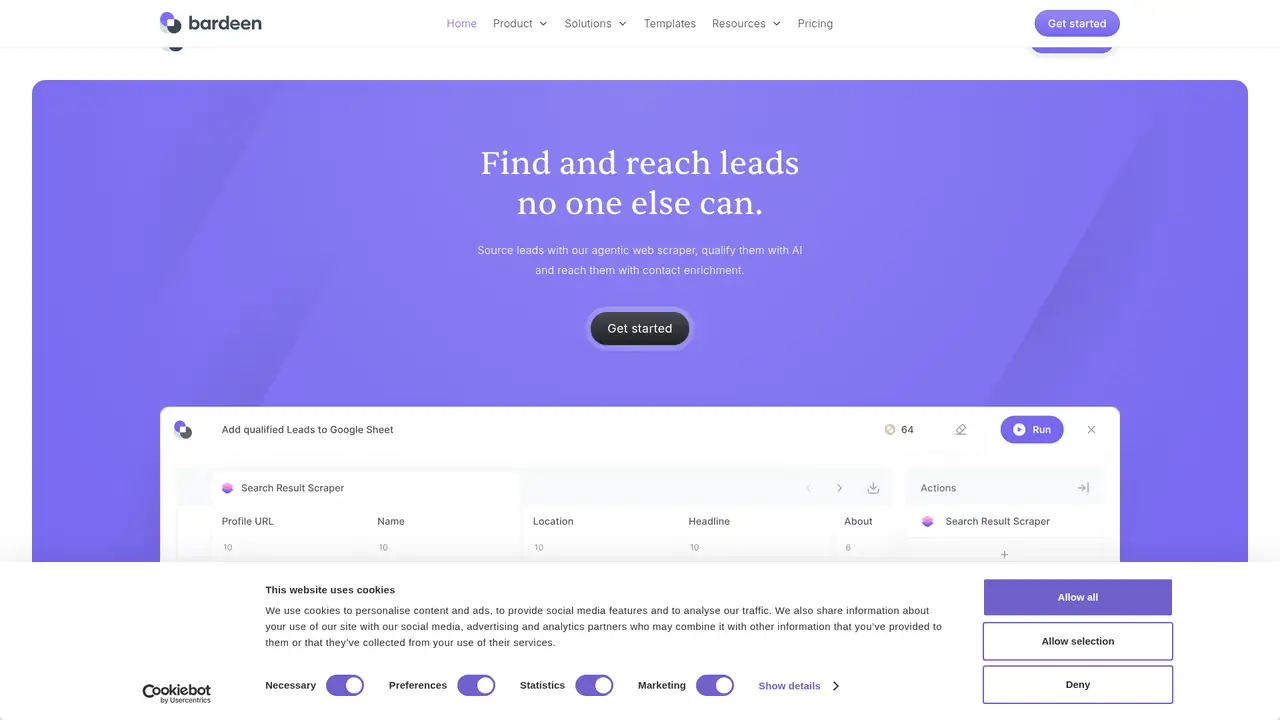
Bardeen works through a Chrome and browser extension. Users can begin with a natural language prompt, move through planning, and create a repeatable Playbook or automation. Workflows can run manually, in the background, locally in the browser, or in the cloud for larger jobs. Current capabilities include web scraping, web search, contact and company enrichment, AI text tools, CRM actions, spreadsheet exports, and document or email tasks. Earlier company coverage described integrations with about 100 tools, including Microsoft 365, CRMs, and sales platforms. The browser model lets actions use webpage context rather than relying only on connector records. January 2025 materials identify Sales, Customer Success, RevOps, Sales Engineering, and Sales Leadership as target users.
The platform combines an AI assistant for building and refining workflows with a proprietary domain-specific language for repeatable logic. Bardeen’s 2025 Work Intelligence release described observing task-level behavior across Salesforce, LinkedIn, Salesloft, and HubSpot, then generating agents from those observations. Browser and cloud execution remain available, with local browser processing presented as useful for privacy. Earlier company coverage said processing and storage were near the browser, although that historical claim does not define handling for every cloud feature. The privacy policy distinguishes third-party API data from broader User Content. Third-party API data receives a scoped no-generalized-model-training statement, while User Content is covered by a broader contractual license. Bardeen describes a proprietary domain-specific language for repeatable workflow logic alongside its AI assistant. Its 2025 product materials also present browser execution as a privacy-oriented option, while cloud execution supports larger workloads and generated agents for recurring operational tasks.
Bardeen’s official pricing page states that every user receives 100 free credits and that unused credits expire at the end of each billing period. Scraper and web-search work cost one credit per row, enrichment costs three credits per row, and AI tools cost one credit per row. Utilities are free, while import and export can be free or credit-metered depending on the flow. Deep scraping is unavailable on Free. The current page does not display readable paid dollar amounts or complete tier names, so paid pricing and allowances are Custom until verified. The Free plan is limited to personal, not-for-profit use under the Terms. Commercial use may lead to termination or a retroactive business charge.
Bardeen suits browser-centered research, lead sourcing, scraping, and enrichment more closely than Sierra’s managed customer-facing agents. It also differs from Zapier and Lindy through webpage context and browser execution rather than a connector-first model. Constraints include credit metering, free-plan commercial restrictions, uncertain paid packaging, and no documented public platform API or self-hosted edition. Bardeen’s security page lists SOC 2 Type II, GDPR, and CASA Tier 2 and 3 certifications. Privacy terms still merit review because User Content receives a broad service-improvement license. Bardeen advertises SOC 2 Type II, GDPR, and CASA Tier 2 and 3 certifications. Its privacy terms separately distinguish third-party API data from User Content, so the stated restriction on generalized model training applies to a narrower data category than the broader contractual license. Choose Bardeen for browser-based data collection and repeatable GTM work when local webpage context matters.
Who is Bardeen best for?
- Sales and RevOps research
- Browser-based scraping and enrichment
- Repeatable GTM Playbooks
- Local browser execution
Bardeen Pricing (2026)
Pricing model: Freemium. All prices in USD.
| Plan | Price | What you get |
|---|---|---|
| Free | $0 | 100 credits; personal, not-for-profit use; unused credits expire; deep scraping unavailable. |
| Paid plans | Custom | The official pricing page does not display readable current dollar amounts, complete tier names, or complete allowances. Credit-based usage applies. |
| Enterprise | Custom | Custom bulk credits, customer scraper development and maintenance, and premium support are advertised. |
Pros and Cons
Pros
- Browser context supports actions across webpages and web applications.
- Credit rates make major data actions visible.
- Local and cloud execution support different workflow sizes.
- Scraping and enrichment serve lead research use cases.
Cons
- Free usage is restricted to personal, not-for-profit work.
- Current paid prices are not readable from the official page.
- No official self-hosted edition or public platform API is documented.
Who should look elsewhere?
- Commercial use on the free plan
- Self-hosted deployment requirements
- A documented public platform API
Technical Details
Frequently Asked Questions
How much does Bardeen cost?
Bardeen provides a free tier with 100 credits. The official pricing page does not show readable paid dollar amounts or complete current tier names, so paid plans are Custom until verified. Credit usage is metered by action and row, including one credit for scraping, search, and AI tools, and three credits for enrichment.
Does Bardeen have a free plan?
Yes. Bardeen gives users 100 free credits, with unused credits expiring at the end of each billing period. The Free plan is limited to personal, not-for-profit use under the Terms. Scraping, search, enrichment, and AI actions consume credits at different rates, while utilities and some imports or exports do not.
What is Bardeen’s closest competitor?
Lindy is a close comparison for AI-assisted workflow automation, while Zapier is a broader connector-first alternative. Bardeen differs through its browser extension, webpage context, scraping, enrichment, and Playbooks. Sierra is closer for enterprise customer-facing agents, although its managed omnichannel model and outcome-based contracts address a different primary use case.
Does Bardeen train on customer data?
Bardeen’s privacy policy says third-party API data, such as Google Drive or Gmail data, is used to provide or improve automation features, is not used to train generalized AI models, and is not retained. Its Terms separately grant a broad license for User Content to operate and improve services, including training and development.
Can businesses use Bardeen commercially, and is it open source?
The Free plan is reserved for personal, not-for-profit use. Businesses require a paid or business arrangement, and the Terms allow Bardeen to terminate unauthorized commercial Free-plan use or charge the highest current business price. Bardeen is not open source, and no official self-hosted deployment or public platform API is documented.
Best Bardeen Alternatives in 2026
These tools do the same job as Bardeen, with different pricing, limits and trade-offs.