
AlphaSense Review, Pricing & Alternatives (2026)
AI market intelligence for research, strategy, and finance teams
Last updated: October 26, 2026
What is AlphaSense?
AlphaSense is an enterprise market-intelligence platform for financial institutions, corporations, consultants, and strategy teams. It searches premium research, filings, news, expert transcripts, and internal documents, then produces cited analysis through AI workflows. Pricing starts with an annual custom subscription, with per-seat and enterprise options available through sales.
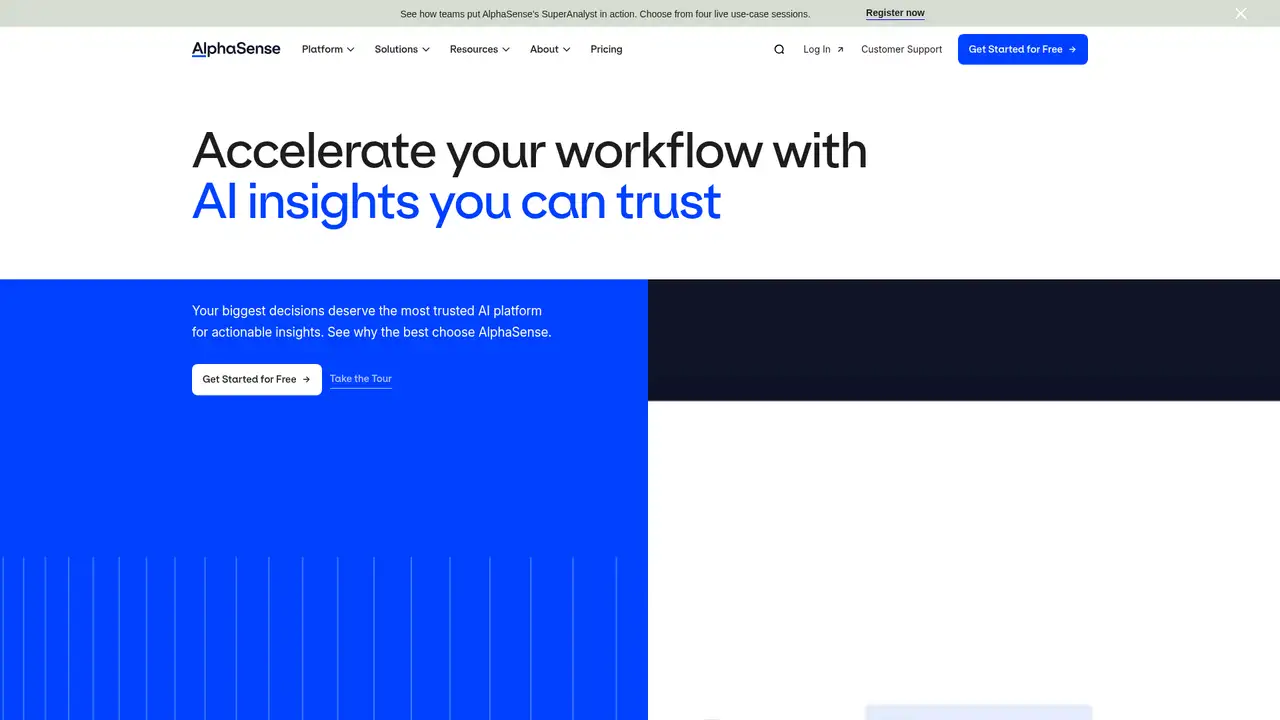
Founded in 2011 by Jack Kokko and Raj Neervannan, AlphaSense provides an AI market-intelligence platform for business and finance teams. The company says it serves more than 8,000 enterprise customers and indexes over 500 million documents, including filings, earnings calls, broker research, news, expert interviews, and internal content. Its search and analysis tools are intended for tasks such as comparing companies, reviewing industry developments, and finding evidence across public and proprietary materials. AlphaSense acquired Tegus in 2024 for about $930 million, adding expert transcripts and related research capabilities. In June 2026, it announced $350 million in funding at a $7.5 billion valuation and said annual recurring revenue exceeded $600 million in the first quarter. A separate announcement reported more than 7,000 global enterprises.
The usual workflow begins with a keyword, company, topic, or natural-language question. Researchers search AlphaSense’s external library, narrow results by document type or date, and inspect source passages before using the findings. Generative Search produces answers linked to citations, while Generative Grid compares repeated questions across companies or documents, such as revenue trends or management commentary. Teams can add proprietary files through Enterprise Intelligence, connectors, uploads, or an ingestion API. Federated search respects existing permission controls, so internal documents can be reviewed alongside public material. Alerts support ongoing monitoring, and expert-call transcripts, Canalyst financial models, and workflow tools cover recurring research needs. iOS and Android apps support mobile review, while GraphQL and Agent APIs connect search, ingestion, and AI workflows to other systems.
AlphaSense describes its technology as domain-specific AI connected to a large, curated content library, without naming a foundation model or publishing a fixed context-window specification. Its tools include Generative Search for cited answers, Generative Grid for comparing repeated questions across companies or documents, Deep Research, Workflow Agents, and SuperAnalyst, an always-on agent announced in June 2026. The company says responses are grounded in source documents and reports 98% citation accuracy on its security page. Developers can use a GraphQL API, an Agent API for GenSearch, MCP tools, and pre-built skills. Enterprise deployment options include SaaS, customer-managed encryption keys, customer buckets, SAML 2.0, SCIM, and private connectivity for internal content.
AlphaSense does not publish a standard monthly price. Its pricing page lists annual subscriptions, enterprise packages, and per-seat options, with quotes tailored to each organization. Market Intelligence covers external business data, AI workflows, integration services, support, and enterprise data protection. Enterprise Intelligence adds internal-content search, API or third-party uploads, hosting choices, and customized training and IT support. There is no published permanent free tier or public self-serve trial price. Expert calls and Canalyst financial models are sold as separate product areas, while API access requires an account and API key. AlphaSense does not disclose usage-based rates for ordinary platform searches. As a result, prospective buyers must discuss team size, content needs, integrations, deployment, and support with sales before comparing costs.
The main limitation is procurement: annual custom pricing, per-seat options, and enterprise positioning make AlphaSense difficult for individuals or small teams to test without a sales process. It also centers on research synthesis, so it is not a complete replacement for every financial-data terminal. Bloomberg Terminal is stronger for live market data, news, analytics, and trading workflows. FactSet is better suited to structured financial data and analyst workstations, while PitchBook provides deeper records on private companies, deals, funds, and investors. AlphaSense fits teams that need to search filings, premium research, news, expert transcripts, and permissioned internal documents in one environment, then produce AI-assisted answers linked to source passages. Pick AlphaSense if your team needs enterprise market research across public and proprietary content.
Who is AlphaSense best for?
- Financial institutions researching companies, sectors, and markets across many source types.
- Corporate strategy teams combining external intelligence with permissioned internal documents.
- Consultancies that need cited research outputs and repeatable AI workflows.
- Large enterprises requiring BYOK, BYOB, SSO, SCIM, and private content controls.
AlphaSense Pricing (2026)
Pricing model: Paid. All prices in USD.
| Plan | Price | What you get |
|---|---|---|
| Market Intelligence | Custom | Annual subscription, with enterprise-wide or per-seat pricing; includes external business content, AI workflows, integrations, support, and enterprise data protection. |
| Enterprise Intelligence | Custom | Annual subscription, with enterprise-wide or per-seat pricing; adds internal-content search, API or third-party uploads, hosting choices, and expanded support. |
| Expert calls | Custom | Custom annual or service pricing; includes expert matching, pre-qualification, brokered calls, transcripts, translations, and compliance-portal access. |
| Canalyst financial models | Custom | Custom pricing; includes industry KPIs, non-GAAP metrics, auditable model data, and Excel tools for updates, audits, and templates. |
Pros and Cons
Pros
- Searches more than 500 million business documents across public, premium, expert, and internal sources.
- Generative Search returns research answers with linked source citations.
- Enterprise Intelligence supports BYOK, BYOB, federated search, SSO, and SCIM.
- GraphQL and Agent APIs support search, ingestion, and AI workflow integrations.
Cons
- AlphaSense publishes no standard public price or self-serve free tier.
- Annual custom procurement can make evaluation difficult for small teams.
- The platform is less suited to live market-data and trading-terminal workflows.
Who should look elsewhere?
- Individuals seeking a transparent monthly subscription or permanent free plan.
- Teams needing a live trading terminal as their primary research workstation.
- Small businesses without budget for annual enterprise procurement.
Technical Details
Frequently Asked Questions
How much does AlphaSense cost?
AlphaSense does not publish a fixed public price. Its pricing page says subscriptions are annual and can be structured as enterprise-wide or per-seat packages. The company provides custom quotes based on organization needs and selected products. Market Intelligence and Enterprise Intelligence are both sold through sales, and expert calls and Canalyst financial models are separate product areas with custom pricing.
Does AlphaSense have a free plan?
AlphaSense does not list a permanent free plan or public self-serve trial price on its pricing page. The published options are annual subscriptions for Market Intelligence and Enterprise Intelligence, with pricing tailored to team size and requirements. Prospective customers need to contact AlphaSense for a quote and to discuss access, content coverage, integrations, and deployment options.
How does AlphaSense compare with Bloomberg Terminal?
AlphaSense is centered on qualitative market research, document search, expert transcripts, internal content, and cited AI analysis. Bloomberg Terminal is a stronger fit for live financial-market data, news, analytics, and trading-oriented workflows. AlphaSense can suit strategy, corporate development, consulting, and research teams that need broad document synthesis, while Bloomberg is often the closer choice for market professionals requiring real-time market information.
Does AlphaSense train AI models on customer data?
AlphaSense says large language models are never trained on customer content and that it works with providers enforcing zero data retention policies. It also says client documents, prompts, and queries are not used to train underlying models. Enterprise customers can choose BYOK or BYOB options, and BYOB can keep uploaded documents in a customer-controlled AWS environment, subject to eligibility and configuration.
Can AlphaSense be used for commercial research?
AlphaSense is designed for commercial use by financial institutions, corporations, consultancies, and other enterprises. Its published customer groups include investment banking, private equity, hedge funds, asset management, venture capital, life sciences, technology, energy, industrials, consumer goods, and professional services. Organizations should confirm content entitlements, expert-call compliance requirements, and licensing terms with AlphaSense before distributing outputs externally.
Sources
Best AlphaSense Alternatives in 2026
These tools do the same job as AlphaSense, with different pricing, limits and trade-offs.